
Count booked inspections, signed roofs and completed paid jobs. If clicks aren't bringing work you want, find out where people drop off before you spend more.
Want us to run it? Here's our roofing marketing agency.
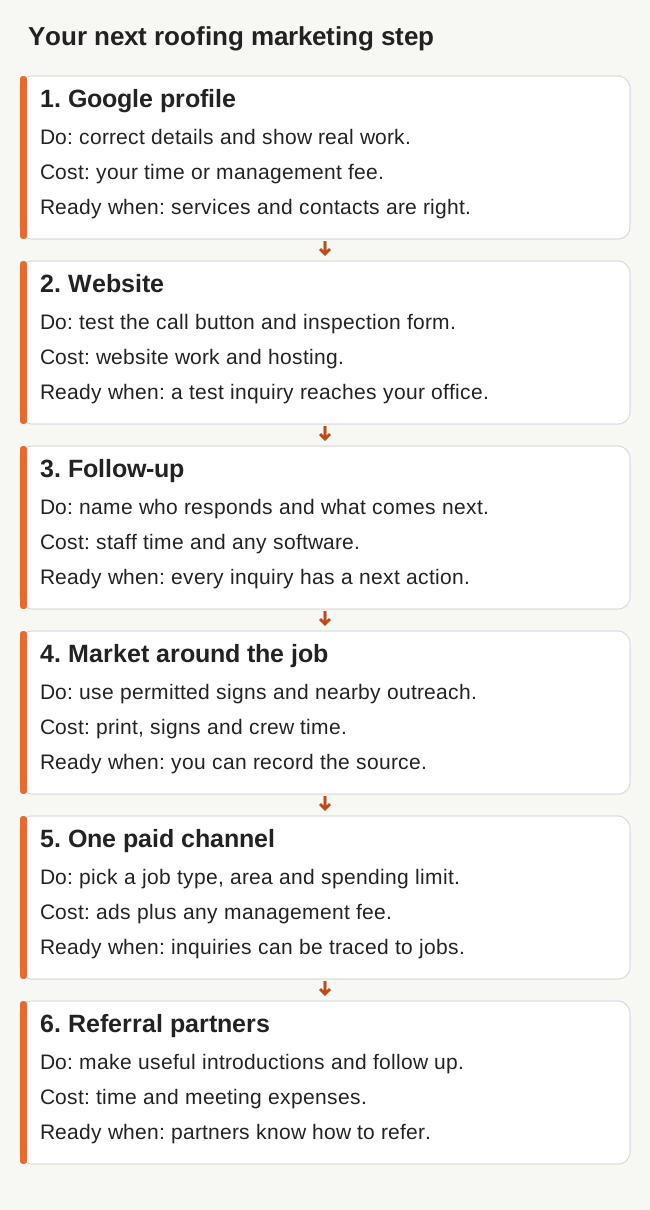
Use this sequence to find the first missing piece. You can keep a successful referral source running while you fix the website.
| Step | Start here | Cost to allow for | Move on when |
|---|---|---|---|
| 1. Google profile | Correct the business details; add genuine work photos | No profile listing fee; your time or management fee | Homeowners can see the right services, area and contact details |
| 2. Website | Explain your work and test the call and form routes | Website work and hosting | Your office gets the test call or form |
| 3. Follow-up | Assign the first reply and estimate follow-up | Staff time and any software | Someone's handling each inquiry and knows what to do next |
| 4. Job-site marketing | Ask permission for a sign and nearby outreach | Print, signs and crew time | You record which street or job produced the inquiry |
| 5. One paid channel | Choose a job type, area and spending limit | Ad budget plus any management fee | You can trace suitable inquiries through inspections and sales |
| 6. Partners | Make useful introductions and keep in touch | Your time and meeting costs | Partners know what you take and how to reach you |
The 4 ways roofers get work
You go to them
Door knocking, letters and direct outreach. You choose the street and make the introduction. It takes people and time.
They come to you
Google Maps, search, Local Services Ads and your website. Match the work they're looking for and make it easy to call.
They're introduced
Past customers, realtors, property managers and other trades recommend you. The introduction gives you a reason to talk.
They find you
Job videos, useful posts and local conversations introduce your company before a homeowner needs a roofer.
Look at your recent signed jobs and find your strongest source. Keep it working. Cut spending on unsuitable inquiries, then test one new source with its own budget and records. Splitting a small budget across every channel makes it harder to learn what works.
Before you spend: pick your customer and your area
Write down the work you want and the places your crew can serve profitably. I'd start with nearby towns or a 10 to 15 mile area, then check drive times. There's no point filling your day with calls for jobs your crew can't reach profitably.
Then choose three promises your crew can keep. For example: call back the same day, explain the repair with photos, and do a second magnet sweep before leaving. Use the same promises on your website, ads and trucks.
| Work you want | Where I'd start | What the inquiry needs |
|---|---|---|
| Leaks and repairs | Google profile, then eligible Local Services Ads or Search ads | A quick answer and an available visit |
| Planned replacements | Real job proof, then a focused Facebook or Instagram offer | An inspection, clear estimate and follow-up |
| Local storm work | Past customers and nearby job sites, then a short local campaign | Capacity checks and an honest assessment |
| Commercial work | Property managers, related trades and a commercial service page | Access, scope and the bid deadline |
Step 1: Google Business Profile and reviews
Choose Roofing contractor as your main category if that's your main work. Add your services, hours, phone number and the towns you serve. Use your real business name and keep ownership of the profile in your business.
Only list an address where you really work from. Hide your home address if customers don't visit, and don't create another profile just because you serve another town. Add job photos you have permission to share, and give the profile a quick check each week.
Ask customers for an honest review when the job's finished, using the same invitation for everyone. Don't pay, offer gifts or ask only the happy customers. Reply to reviews without sharing private customer details.
Read SEO for roofers for the profile and website checklist. If you'd rather have it done for you, see our roofing SEO services.
Step 2: A website that books inspections
Put five things in place:
- Say what roofing work you do and where, near the top.
- Provide tap-to-call and a short inspection form: name, phone, address and what needs attention.
- Show your own crew and completed jobs with permission.
- Put genuine reviews where visitors can check your work.
- Give each main service a useful page with the next step clearly stated.
Test the form on your phone. If the site needs rebuilding, our roofing website design service includes the build with no separate setup fee. Make sure the thank-you message says who'll reply and that your office actually gets the inquiry. If you've got an instant estimate tool, tell homeowners what you'll inspect before giving them a firm price.
Step 3: Answer and follow up fast
Aim to reply within minutes during advertised hours. Put someone in charge of missed calls and after-hours inquiries. If you send an automatic reply, tell the homeowner when they'll hear from a person.
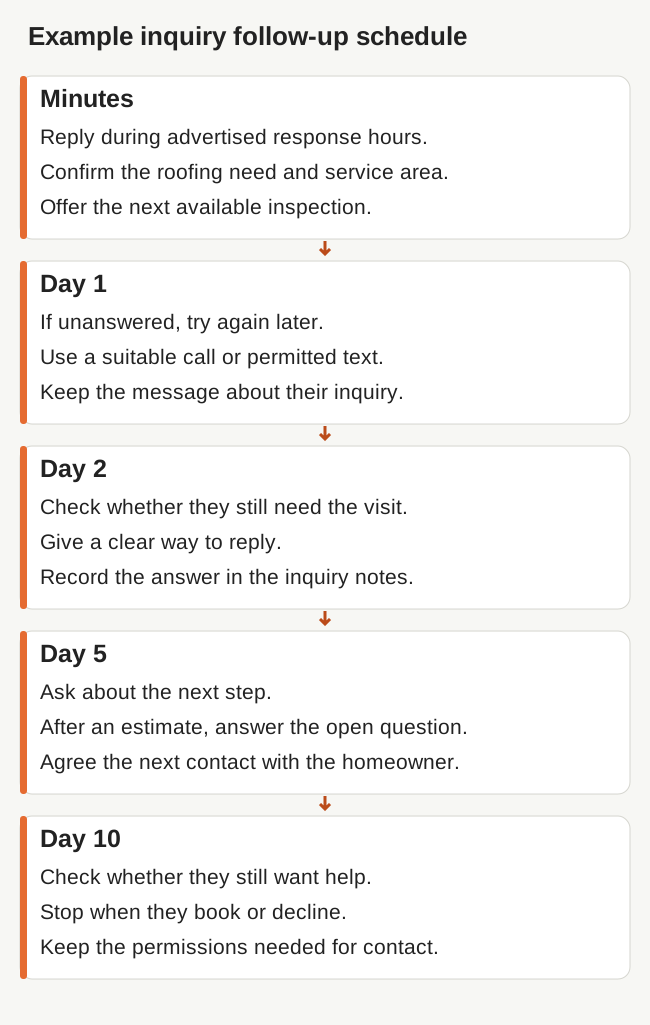
Example: reply in minutes; try again later on day one and on day two if unanswered; on day five, ask about the next step; on day ten, check whether they still want help. Get consent for calls and texts, and stop the follow-up when they book, decline or opt out.
Before you leave the inspection, book the next conversation. If they're comparing estimates, suggest a call in 3 to 7 days and ask what's holding up the decision.
Step 4: Market around every job
Make each installation a chance for neighbors to recognize you. Ask the homeowner if you can put up a yard sign, keep your truck details readable and start with 10 to 20 door hangers on nearby houses.
Before work, introduce the crew and tell neighbors about the noise and deliveries. During the job, be available for questions. When you're done, offer a roof check to neighbors who've shown interest and send the street a postcard with a job photo you have permission to use. Follow local permit rules and respect no-soliciting signs and customer privacy.
A simple introduction: “We're working on a roof nearby this week. If you'd like us to look at yours, here's how to reach the office.”
Record the job site behind each inquiry.
Turn each job into useful local content
Start with a question you answered on the roof: “Why did this leak need flashing work rather than a replacement?” With permission, photograph the problem and the repair, then record a short explanation from a safe location.
Put the photos and explanation on the right service page, then share them in a local social post. Show what you found, what you did and where you worked. Answer questions in neighborhood groups where their rules allow it. You don't need to post every day. Give homeowners something useful to judge your work by.
If you use AI to turn your notes into copy, check every roofing detail and keep the photos real.
Step 5: Add one paid channel
For repairs, I'd price a focused Google campaign first. For planned replacements, I'd test Facebook or Instagram with real job photos and a clear inspection offer.
| Decision | Google Search / Local Services Ads | Facebook and Instagram |
|---|---|---|
| Homeowner's starting point | Actively searching for help | Notices the offer while browsing |
| First job to test | A repair or replacement service people search for locally | A planned replacement offer |
| How you pay | Search usually charges per click; Local Services Ads charges per lead | Ad delivery; judge the cost of resulting inspections and jobs |
| Example test allowance | $50 to $100/day for one Search campaign; price eligible Local Services Ads separately | $30 to $50/day for a focused 30-day test |
| Must be ready | Phone answering, matching service page and open inspection slots | Clear offer, qualifying questions and prompt follow-up |
Start with the daily budget above, then use local ad estimates to narrow your area or job type. If you've only got $10/day, keep your profile, neighborhood work and referrals going and test one narrow Facebook or Instagram offer.
Three ad ideas you can learn from
See more roofing advertising examples.
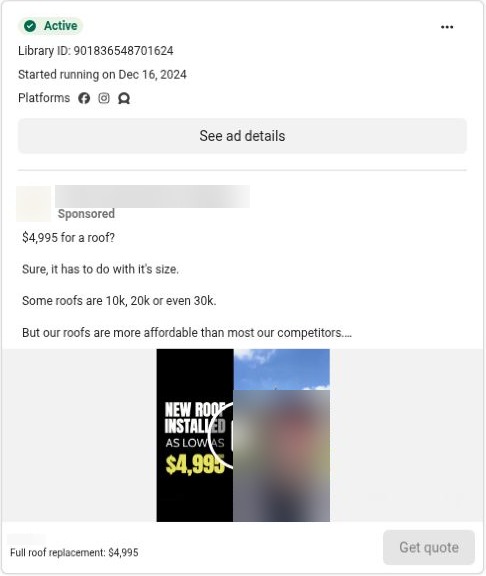
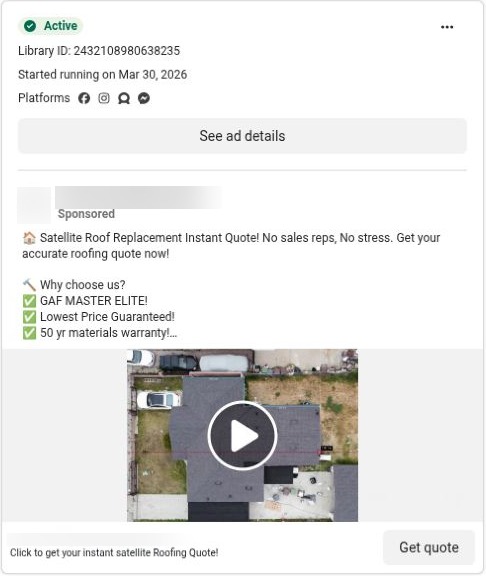
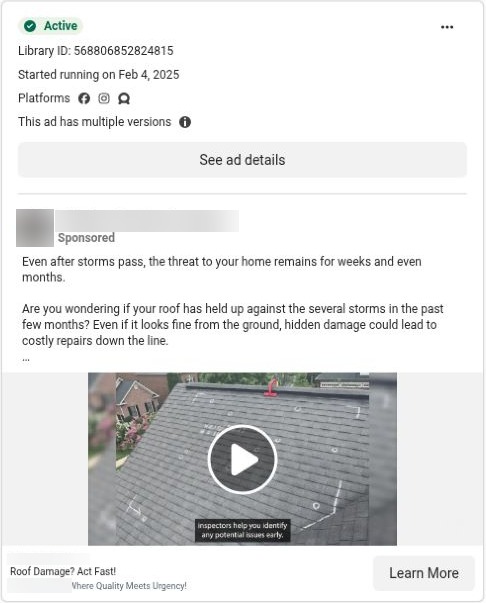
For the setup and test plan, read Facebook ads for roofers. If you'd like either channel run for you, see Google Ads management for roofers or Facebook and Instagram ads for roofers.
Buying leads: when it makes sense
Buy roofing leads as a top-up when you've got spare inspection slots and someone ready to call within minutes. Ask whether the seller sends each inquiry to other roofers, what you'll pay for and how you dispute a bad lead.
Track signed and completed jobs from those inquiries. A cheap shared lead can be expensive if nobody answers or the job falls outside your area. Stop buying a source that repeatedly brings the wrong work. The alternative is roofing lead generation from ads in your own accounts, so the leads aren't shared.
Step 6: Referral partners
Start with people already serving your customers. Offer realtors a roof condition report before a listing goes live. Give property managers an easy way to book inspections and maintenance. Let gutter, solar and HVAC contractors know which roofing work you'll take. Insurance agents may also need a roofer to document the roof's condition.
Bring a short sample report to a local business meeting. Explain where you work, how soon you can visit and who'll answer. After a referral, ask the customer if you can let the partner know how it went. Keep a record of the partner and the work won.
Storm season and slow season
| After a local storm | When the schedule is quiet |
|---|---|
| Check crew safety and inspection capacity first | Review estimates that still have an open decision |
| Contact past customers who want to hear from you | Ask whether the homeowner wants an updated estimate |
| Document actual damage and offer available visits | Offer useful maintenance inspections and relevant work you already provide |
| Keep local campaigns within the slots you can handle | Meet referral partners and prepare real job photos and answers |
Don't promise insurance approval, a free roof or payment of the homeowner's deductible; follow your state's contractor and insurance rules. See the storm-season marketing plan.
Before adding a slow-season discount, check the margin and whether timing is actually the objection. An unanswered question may be the reason an estimate has stalled.
How much to spend
For your first paid test, I'd allow $50 to $100/day for Google Search or $30 to $50/day for Facebook and Instagram, plus any management fee. Use the extra roofs you can deliver to set the total budget, rather than picking a percentage of revenue.
Example: You want 3 additional roofs a month. If one in four booked inspections signs, you need 12 booked inspections. If your chosen marketing-cost ceiling is $300 per booked inspection, that supports a total monthly budget of $3,600 across ads, management and other marketing costs.
Now compare that ceiling with your gross profit. A $14,000 roof at 30% gross margin leaves $4,200 before marketing and overhead. At the example 25% inspection-to-sale rate, expected gross profit per booked inspection is $1,050. Spending $300 leaves $750 in expected gross profit per inspection before overhead. Track completed, paid roofs too, so you can see how much of that expected profit you've collected.
If your sales rate falls, your affordable inspection cost falls too. Start with a limited test, review inquiries every week and allow roughly three months to assess sales from a working campaign. Fix unanswered calls, irrelevant targeting or broken forms immediately. For local SEO, plan on 3 to 6 months to build meaningful growth in inquiries; a new site or a busy metro can take longer than an established local business.
What to measure
Keep a row for each source and connect it to individual inquiries. A spreadsheet is enough to start.
| Source | Total marketing cost | Unique inquiries | Booked inspections | Estimates | Signed jobs | Completed paid jobs |
|---|---|---|---|---|---|---|
| Google profile / organic search | ___ | ___ | ___ | ___ | ___ | ___ |
| Google Search ads | ___ | ___ | ___ | ___ | ___ | ___ |
| Local Services Ads | ___ | ___ | ___ | ___ | ___ | ___ |
| Facebook / Instagram ads | ___ | ___ | ___ | ___ | ___ | ___ |
| Bought leads | ___ | ___ | ___ | ___ | ___ | ___ |
| Job sites and referrals | ___ | ___ | ___ | ___ | ___ | ___ |
Cost per booked inspection = total marketing cost ÷ booked inspections.
Cost per signed roof = total marketing cost ÷ signed roofs.
For the example above, $3,600 ÷ 12 inspections = $300 per inspection, and $3,600 ÷ 3 signed roofs = $1,200 per signed roof. With no sales, report “no signed jobs yet” rather than a zero acquisition cost.
Keep the inquiry date, inspection date, sale date and completion date in the underlying record. Follow each month's inquiries through to the finished jobs. A roof you've completed this month might have started with an ad three months ago. Count a homeowner who calls and fills out a form once, and use the same method each month to split shared management costs.
Google profile “calls” count call-button clicks. To see who actually spoke to you and booked, match your call and form records to your job records.
Do it yourself or get help
Do it yourself if you can give marketing 5 to 10 hours a week and someone can answer inquiries throughout the day. You'll need time to update the site, manage ads, collect photos and keep the records useful.
Hire help when marketing keeps slipping because you're running inspections and crews. Keep estimates and sales with someone on your team, and send the agency your job photos and sales outcomes.
Want it run for you? Our roofing marketing agency handles steps 1 to 5 from $297/month. We're your agency replacement for more booked roofing jobs, with experienced people running the marketing and an AI assistant following up until leads book. Your crew supplies the job photos and handles the job-site outreach. Ad spend is separate, paid directly to the platform without markup. We're month to month, with a 30-day money-back guarantee.
FAQ
What is the best marketing for a roofing company?
Start with your Google profile, a useful website and fast inquiry handling. Add neighborhood work and one paid channel suited to your jobs. Keep the source that already produces profitable work, then use your inspection and sales records to choose the next investment.
How much should a roofing company spend on marketing?
Start with $1,000 to $2,000/month on one paid channel, plus your management and website costs. Choose the channel to fit that budget; use the higher Search range above if local clicks need it. In the worked example, a target of 3 extra roofs supports $3,600/month in total marketing costs. Your margin and inspection-to-sale rate set what you can afford.
How do roofers get leads without buying them?
Use your Google profile, useful service pages, honest reviews, job-site signs and referrals. These need time, materials or management, even when you pay no advertising platform. Start around the customers and streets where you already do good work.
How do roofing companies stay busy in the slow season?
Start with open estimates and past customers who may need maintenance. Ask what held up the decision, offer an updated estimate where useful and meet partners before their next referral. Promote only work your crew can deliver profitably.
Are Facebook ads worth it for roofers?
Yes, I'd test them for planned replacements. Start with a clear offer, real job photos and someone ready to reply and book inspections. Use cost per signed and completed roof to judge the test. A low lead price alone is not a reason to keep spending.