
Our roofing marketing agency page explains how that fits the website, ads and follow-up around your business.
I'd choose one workflow and test it before buying a stack of subscriptions. A useful assistant needs your actual services, area, hours and handoff rules. A fluent answer doesn't tell you whether the office received the inquiry or the calendar booking is real.
Use / try / skip
Use this table to choose the first task. “Use” still means a named person owns the setup, testing and exceptions.
| Task | My starting pick | What a person needs to check |
|---|---|---|
| First replies and follow-up texts | Use where permitted | Correct business facts, contact permission, booking route and stop conditions |
| After-hours or overflow call answering | Use after testing | Accurate call handling and a working handoff for complex or urgent requests |
| Rain-day rescheduling messages | Use with office approval | The actual crew decision and replacement time |
| Ad, post and review-reply drafts | Use with edits | Real claims, your voice and the right next step |
| Inspection notes into a homeowner report | Try | Every finding and photo reference checked by the inspecting roofer |
| Training from your own procedures | Try | Current instructions, controlled access and a way to escalate uncertainty |
| Roof color visualizers | Try for retail choices | Label the picture as an illustration and compare real samples |
| AI or photo-based estimating | Try with checks | Measurements, scope, costs and the actual roof condition |
| Cold AI sales calls or robocalls | Skip as a first project | Contact rules and reputation make this a poor shortcut |
| Fake reviews or generated images passed off as real jobs | Never | Use genuine experiences and actual job photos |
Call answering, visualizers and estimating are categories to evaluate. Check the exact product and setup; don't assume every tool that says “AI” can perform all of them.
Missed-lead math
Use your own delayed-inquiry count and two separate rates: the share that books an inspection, then the share of booked inspections that becomes signed work. That keeps a quick reply from being counted as a sold roof.
Example: ten delayed inquiries a month, a 25% inquiry-to-booking rate and a 25% booked-inspection-to-sale rate. A $14,000 replacement at a 30% job gross margin produces $4,200 before marketing and other business costs. At that sale rate, each booked inspection represents $1,050 of expected job gross profit if the resulting work is completed and paid.
Ten inquiries x 25% booking rate x $1,050 is $2,625, or about $2,600 of modeled job gross profit connected to that group. Some delayed inquiries may already book through your current process. Measure the extra completed work before counting any of this as an AI benefit.
Use the delayed-inquiry opportunity model to change the count, both rates, job value, gross margin and monthly tool/handling cost. A zero booking or sale rate produces zero job gross profit. The amount left after those entered costs still comes before other marketing and overhead.
If your main loss happens after the estimate, start with the roofing estimate follow-up routine. An instant first reply won't fix a proposal nobody follows through on.
What AI follow-up looks like
Give the assistant a narrow job: acknowledge the inquiry, ask the useful screening questions, offer a real next step and pass the conversation to a person when needed. You can start with the work type and timing rather than an interrogation about the whole roof.
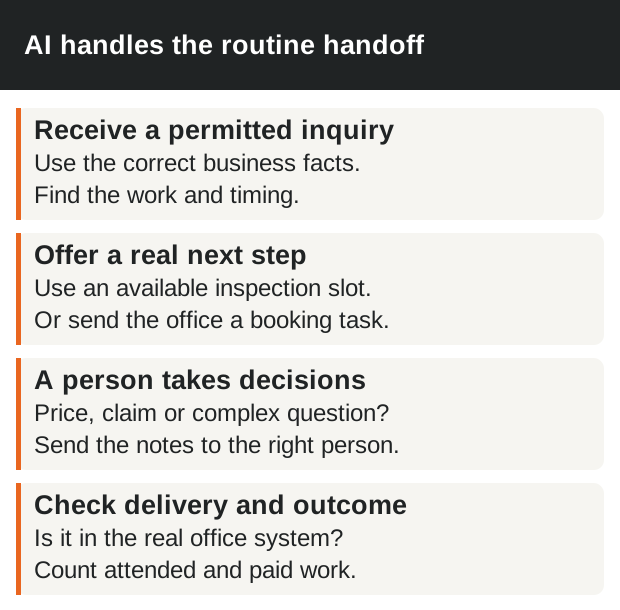
Example text thread after a permitted website or Facebook inquiry:
Assistant: Hi [name], this is [company]'s booking assistant. Thanks for asking about your roof. Is this a leak or a planned replacement, and when would you like us to take a look?
Homeowner: Planned replacement. Sometime next week.
Assistant: We've got [actual available slot A] or [actual available slot B]. Would either suit you? The visit lets our roofer check the roof and explain your options.
Homeowner: What will it cost? Will insurance cover it?
Assistant: I'll pass those questions and your notes to [named person]. They'll explain the roofing price after reviewing the job, and your insurer decides coverage. Would you like the office to call you?
A reminder should repeat the actual booked time and the office contact. If the system can't read the live calendar, it should send a booking request to the office rather than announce an appointment. Have the office check that the task arrived and someone owns it.
5 copy-ready prompts
Give AI the facts, the intended reader and the format you want. Tell it to mark missing information rather than complete the story for you. Here are five original prompts you can adapt without a customer database.
1. Facebook ad draft for a storm-free area
Write three short Facebook ad drafts for a roofing company serving [area]. Target planned [roof work], using only these facts: [approved services, offer, genuine proof, contact route]. There is no current storm campaign. Give a clear inspection next step. Don't invent hail, deadlines, discounts, reviews, results or payment terms. Mark missing facts as questions for me.
Before using it, check the service area, actual offer and every proof statement. If the draft mentions weather you didn't supply, remove it. An attractive ad needs an accurate landing page and someone to handle the inquiry.
2. A review reply
Draft a short, human reply to this genuine review: [review with personal details removed]. Use only what the reviewer actually said. Thank them without adding project facts or their address. If the review raises an unresolved issue, invite them to contact [approved office route] and flag it for a person. Don't invent a resolution.
Read the original review beside the draft. The person handling the customer should decide how to answer a complaint. A polished response saying an issue is fixed is harmful if nobody has fixed it.
3. Inspection notes into a homeowner summary
Use only these scrubbed inspection notes: [notes]. Separate observed findings, recommended next actions and unanswered questions. Keep photo references. If a roof detail, quantity or cause isn't stated, mark it unknown. Don't infer damage, coverage, lifespan or a fixed price. The inspecting roofer will check every line before sending.
Compare each sentence with the notes and photos. If the inspection didn't establish the cause of a leak, the summary should keep that uncertainty visible. Clearer writing is useful; a new unsupported diagnosis isn't.
4. A roofing sales-rep job description
Draft a job description for [actual role] in [area], using only these duties, hours, travel, experience requirements and compensation terms: [facts]. Explain who handles inspections and follow-up. Don't invent earnings, employment terms, license requirements or company results. List missing details for the employer to supply.
Have the hiring manager check duties and compensation before posting. Keep a real gap as a question for the employer. Don't let the draft turn a possible commission outcome into a promised salary.
5. A caption from three job photos
Write a short post from these approved job notes and photos: [scrubbed details]. Explain the actual starting question, work and useful detail. Use the neighborhood only if approved. Don't invent damage, a customer quote or results. Give one relevant next step. Ask me about anything you can't establish from the supplied material.
Check the caption with the crew member who supplied the photos. Remove customer identifiers from the inputs first, and use only a tool approved for those materials. The social post ideas give you a calendar and caption examples.
Download the five original prompts. Keep a copy of the version your team uses so you can improve an instruction when the same error repeats.
Guardrails
Set the operating rules before the first customer conversation. The assistant needs to know what it can do, when to stop and who takes over.
- Contact permission: get the required consent for calls and texts, keep the permission record and honor opt-outs; outbound AI/artificial-voice telemarketing to consumers generally needs prior express written consent under applicable calling rules.
- Customer data: use an approved account and share only what's needed; check access, retention, model-training use and deletion terms before supplying customer files.
- Roofing decisions: the inspecting roofer owns findings and estimates; a person approves contracts, prices, claim conversations and changes to the work.
- Real proof: keep job photos and reviews genuine; label color visualizations as illustrations and compare them with actual material samples.
- Escalation: a request for a person, an urgent issue or a question beyond the approved facts goes to a named team member.
Train staff on those rules with examples. A private procedure can help an assistant answer consistently, but it needs an owner and a current version. Retire old prices or instructions rather than leaving two conflicting documents for the assistant to choose between.
When AI won't change much
If the office already replies promptly and handles every next step, another intake assistant may duplicate what you've got. Start by checking whether your current software can handle a reminder or shared task before paying for a second system.
With very low inquiry volume, checked writing drafts may save more useful time than a complex booking setup. If your offer attracts the wrong work, fix the offer. If homeowners can't find clear proof or a working phone number, fix the page. More automated messages won't answer those questions for them.
Look at the whole business before blaming response speed. The complete roofing marketing guide helps you choose the next missing piece, and roofing lead generation services explains the managed route.
Landing pages with AI builders
Use an AI builder to get a first layout and copy draft, then check it like any other website. The page needs your actual service, area, proof, phone number and next step. Test the form on a phone and make sure the office gets the message.
Replace invented project pictures, reviews and credentials with genuine material. Have a person check prices and claims before publishing. A good-looking preview doesn't establish that the contact route works.
For a price calculator, check the measurement source and scope as well as the arithmetic. The instant roof quote tools guide explains that decision. Our roofing website design service covers the managed website option.
Test the handoff before a live trial
Use made-up inquiries before routing real customers into a new system. Start with a normal inspection request, then an unavailable time, an out-of-area address, a pricing question, an insurance question, a cancellation, an opt-out and a request for a person.
Use the AI trial checklist to write the expected behavior and actual outcome for each case. Check the office inbox or task system and the real calendar. Read the conversation the human receives. A screen saying “sent” isn't enough if the office can't find it.
I'd pause the trial if it invents availability, keeps messaging after an opt-out or loses the human handoff. Fix that case and test it again before increasing the volume. Keep an office route available while you're testing.
Choose one workflow and measure it
Take a baseline from last month: inquiry count, time to first useful response, booked inspections, attended visits and completed paid jobs. Pick the gap that matters, then record the same stages during a limited trial. Count canceled and duplicate bookings too.
Ask the provider to show your actual workflow with synthetic data. Can the assistant use the calendar you have? Can the office take over? Can you export the conversation and change the business facts? What's the full cost, including usage, setup and extra staff handling?
If you don't get enough volume to judge bookings, review accuracy and time saved first. Don't turn a small sample into an uplift percentage. Keep the tool that handles a real gap and gives the team a better next step.
Want it run for you? Our roofing marketing service combines website support, suitable ads and AI text follow-up until leads book. The assistant can book inspections into your calendar or hand the lead to the office; you choose. 9xLocal is your agency replacement, with packages from $297/month and no separate setup or build fee. Ad spend is separate and paid directly to Google or Meta without markup. Tell us your area and where inquiries get stuck, and we'll show you the first 30 days we'd run. See if we're a fit.
FAQ
How can roofers use AI?
Start with a measured gap in replies, booking or follow-up, then use checked drafts for repetitive writing. Count last month's delayed inquiries before choosing an intake tool. Keep a person responsible for roof findings, prices and the customer relationship.
Is AI answering safe for roofing calls?
Use it for routine intake only after the handoff tests pass. Give it approved services, hours and booking rules, with a named person for urgent or complex questions. If it invents a time or can't pass the conversation to the office, pause it and fix the route.
Can AI estimate a roof?
Yes, it can help organize measurements, costs and a draft estimate. Have the roofer check the actual roof, included work and selling price before the proposal goes out. A photo or aerial model doesn't establish hidden condition or the insurer's coverage decision.
Will AI replace roofing sales reps?
I'd use it to reduce routine writing and booking work so reps can spend more time with customers. People still inspect, explain options and take responsibility for the proposal. Judge the tool by the work it handles accurately, rather than assuming it replaces the whole role.
Is it legal to use AI to call leads?
Yes, some uses can be lawful, but an inbound answering assistant and an outbound AI sales call need different checks. Use the contact-permission rule above and have the exact calling setup reviewed before launch. Buying a lead or having an AI voice doesn't give you permission to make a sales call.