
If you'd like help connecting that proof with your website and ads, see our roofing marketing agency.
You don't need to film every job. Ask the crew for a few good photos and a short note about what they found. With those ready, set aside about 20 minutes a week to choose, write and schedule your posts. Photography, video editing and answering messages need their own time.
What posting does and doesn't do
Use your social page as a place where a homeowner can see the people, work and process behind your company. Someone who heard your name from a neighbor should be able to find a real job, a useful explanation and your contact details.
I wouldn't rely on routine posts as your only route for urgent repair calls. Keep the phone, website and relevant search presence working. Social posts can also create inquiries, but a busy page and a full inspection calendar are different outcomes.
Consistency is easier when the content comes from work you're already doing. A clear photo of a flashing repair with a good explanation is worth posting even if it doesn't become a widely shared video.
12 post ideas with captions
These are original caption templates to adapt to real work. Replace the bracketed details and remove anything you can't support. Don't publish a specimen as though it happened to your crew.
1. Before and after from the same angle
Shoot: the starting roof and finished roof from the same safe street-level position. Format: two photos or a simple swipe-through post.
Before and after in [neighborhood]. We replaced [actual roof system] and handled [specific included work]. The second photo shows the finished roof from the same spot. If you're planning similar work, our office can arrange an inspection.
Keep the lighting reasonably comparable. You don't need to darken the first photo or invent damage to make the work look worthwhile.
2. What we found on this roof
Shoot: one inspected detail and the work that addressed it. Format: a short video or a photo pair with a plain explanation.
The homeowner called about [reported issue]. Our inspection found [actual finding] at [roof detail]. Here's what we repaired and why we chose that approach. If you're seeing a similar sign, arrange a roof visit so we can check the cause.
Explain the observed condition. A stain inside a house doesn't tell every viewer what's happening on their own roof.
3. A finished roof in the neighborhood
Shoot: the completed roof with permission. Format: one strong photo and a short project note.
Finished this week in [neighborhood]: [material and color] on a [roof type] roof. The homeowner chose it for [their actual reason, with permission]. Thanks for having our crew work here.
Name the neighborhood or town, not the street address. Skip the homeowner's reason if they haven't supplied one.
4. Meet a crew member
Shoot: a willing team member in a safe work area. Format: a portrait or brief introduction video.
Meet [name], who handles [actual role] on our roofing jobs. Their favorite part of the handover is [real answer]. If you see them on a job, they're the person to ask about [responsibility].
Let them answer in their own words. Their everyday explanation will sound more convincing than a corporate biography.
5. One useful homeowner tip
Shoot: a real detail that helps explain a simple maintenance question. Format: a photo with one action, or a short talking video.
Seeing debris collect at [visible area]? Keep an eye on it from the ground and arrange suitable maintenance if needed. On this job, we found [actual observation]. If you're unsure what needs attention, send the office a photo or book a visit.
Keep filming and homeowner advice within safe access rules; don't invite anyone onto a roof for a social post. Seasonal tips should fit the local weather and the work you actually provide.
6. Explain a material choice
Shoot: real samples or a completed detail. Format: two options side by side, with a short spoken explanation.
Choosing between [material A] and [material B]? Start with your roof, the look you want and the work each system needs. Here are the differences we'd explain during an estimate: [specific verified differences]. We'll price the actual scope so you're comparing the same work.
Keep warranty, fire-rating and performance statements tied to the specific product. Don't turn a color comparison into an unsupported promise about every metal or shingle roof.
7. A genuine review and a thank-you
Shoot: a permitted screenshot or exact excerpt of a real review. Format: a clean card that preserves the wording and source.
Thanks for taking the time to describe your experience with our crew. We're pleased the [specific point actually mentioned] was helpful. Here's the original review on [source].
Ask neutrally for honest reviews; don't pay for them or create one for the customer. Share only the details you have permission to use, and avoid exposing a full name or profile photo unnecessarily.
8. Questions to ask before hiring a roofer
Shoot: the owner or estimator explaining a checklist. Format: a short video or a few readable cards.
Before choosing a roofer, ask who's doing the work, what's included in the estimate and what happens if the crew finds hidden damage. You'll be comparing the process as well as the price. Bring those questions to your next estimate conversation.
Use your own process to explain the answer. If you offer a written scope or a named contact, show a blank specimen rather than a customer's private paperwork.
9. Answer a question from a sales call
Shoot: the person who answers it well in real life. Format: one short answer per video.
Can a roof be repaired instead of replaced? We start by inspecting the condition and the area that needs attention. In this example, [actual finding] meant we recommended [actual option]. Here's what we'd need to check before recommending it for another home.
Keep a list of your top seven repeated sales questions. You can turn each answer into a short video, a photo caption or a useful website explanation. Revisit a good question months later with a different real example.
10. A day-in-the-life story
Shoot: preparation, a safe work moment and cleanup. Format: a small story sequence.
Today's job starts with protecting [actual area] and setting up [actual preparation]. Later we'll show the roofing detail we're working on and the cleanup before handover. [Crew contact] is the point person for this visit.
You don't need dramatic angles. Showing how the team prepares and leaves the property can answer a question a finished-roof photo misses.
11. A current offer with clear terms
Shoot: your owner explaining the real service. Format: a short video or readable offer card.
We're offering [actual service/offer] for [eligible work and area] until [real date]. It includes [work] and excludes [important exclusions]. Contact [office route] to find out whether it's suitable for your roof.
Use an offer you actually run. If there's no deadline, leave it out. Get financing-ad wording and required disclosures from your lender before advertising a monthly payment.
12. A partner shout-out
Shoot: an authorized joint visit or the partner explaining a useful point. Format: a brief interview or shared project post.
Roof questions before a home goes on the market? We joined [partner] to explain what a roof condition report covers and how a seller can plan the next step. Thanks for helping us make the process easier to understand.
Get the partner's permission before tagging them. Keep the customer and property details out of the post unless they've agreed. The referral partner guide covers the relationship behind this kind of content.
4-week calendar
Use Monday, Wednesday and Friday as a simple starting rhythm. Move the days around your crew and office schedule. If you've only got two useful posts ready, publish those and keep the third slot for a later job.
| Week | Monday | Wednesday | Friday |
|---|---|---|---|
| 1 | Before-and-after | Homeowner tip | Crew introduction |
| 2 | What we found and fixed | Material explanation | Genuine review |
| 3 | Finished roof and neighborhood | Questions to ask a roofer | Answer one sales question |
| 4 | Day-in-the-life story | Current offer with terms | Partner introduction |
Download the four-week calendar. Add the photo, writer, permission status and planned date in your own sheet. Swap an offer slot for another customer question if you aren't running a promotion.
What we found on this roof: a 30-second video script
Keep one finding and one repair in the video. This original timing plan gives the speaker enough structure without making them memorize a speech.
| Time | Picture | Original script to adapt |
|---|---|---|
| 0 to 3 seconds | A clear inspected detail | This roof looked sound from the street. Here's what we found at the flashing. |
| 3 to 20 seconds | Show the real finding | Water was getting in at [actual location]. You can see [actual observation] here. |
| 20 to 27 seconds | Show the work performed | We [actual repair] so [plain explanation of its purpose]. |
| 27 to 30 seconds | Speaker or finished detail | If you've got a similar concern in [area], call the office to arrange a roof inspection. |
Use the blank video script and adapt it to work you can show. Record vertically for a reel or story; use a horizontal version when the wider view helps a website explanation. Check wind noise and keep captions readable on a phone. Real safety equipment and safe working methods belong in the shot when applicable.
Where to post
I'd start with Facebook and reuse suitable visual posts on Instagram. Your existing customers and referral partners may already be interacting there. Test that assumption against the people who actually contact you, rather than choosing a platform because another roofer has lots of followers.
Add suitable job photos or business updates to your Google Business Profile and relevant website pages too. That's a way to give customers current information; it isn't a promise that a posting schedule will improve rankings. The SEO guide for roofers covers the wider foundation.
Staff can share a company post on their personal page if they want to. Don't require them to turn their private accounts into a company channel. In local groups, answer the question, follow the group's business-post rules and ask before promoting a service. A helpful repair explanation is better than dropping your number into every thread.
Getting photos from the crew
Ask for three useful photos per job: before, during and after, plus a voice note or a sentence explaining the work. Give the crew one shared folder or app route and let the office handle the captions.
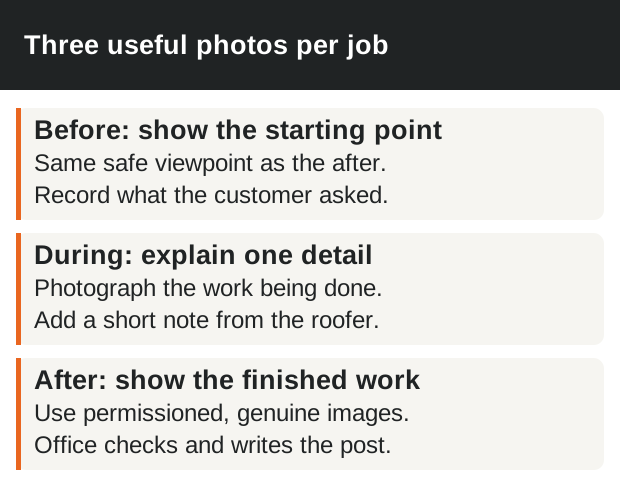
The handoff should include the town or neighborhood, roof system, work completed, the useful detail and permission status. Keep house numbers, plates, documents and customer faces out unless their use is authorized. Check the background before uploading.
Name one person to select the photos and ask follow-up questions. If the note says “fixed flashing,” ask which detail changed and why that mattered. That's how you get a useful caption without making the crew write marketing copy after a long day.
Turn your best post into an ad
Use relevant local comments and shares as clues to a good topic, then check whether the post fits the work you want. A funny clip that attracts roofers across the country may be less useful than a clear repair explanation a nearby homeowner asks about.
For a small, straightforward test, boosting an eligible post can be an easy starting route. A campaign built around inquiries gives you more control over the objective and follow-up. Either way, choose the local area, keep the offer accurate and give people a working destination.
Read Facebook ads for roofers before turning reactions into a paid budget, or have our Facebook and Instagram ads for roofers team build the campaign from your best posts. Compare real roofing ad examples for the headline, proof and next step. The complete roofing marketing guide puts that test in the wider sequence.
A 20-minute weekly posting routine
With approved photos already available, I'd spend about five minutes picking the three topics, ten writing the short captions and five checking the details and scheduling. Add time for a video edit or any missing permission. If that target doesn't fit your team, reduce the post count before you reduce the checking.
Keep a question bank alongside the photos. Ask the estimator what homeowners repeated this week, then choose the question that a photo can explain. One job might support a flashing explanation now and a cleanup story later. Give each post its own useful point.
Track conversations, not just likes
Review the month with the person answering inquiries. Record which posts brought a relevant message, which became booked inspections and which led to paid work. Ask callers what brought them to you and whether they checked the social page before calling.
Keep both pieces of information. A referral may be the first introduction while a crew video helps the homeowner feel ready to call. Don't count that as two new customers or give the post sole credit for the job.
Want help putting real job proof to work? Our roofing marketing service includes website support, suitable ads and AI inquiry follow-up. Crew photos shared through the 9xLocal app can go onto relevant website pages after strategist review. 9xLocal is your agency replacement, with packages from $297/month and no separate setup or build fee. Ad spend is separate and paid directly to Google or Meta without markup. Tell us your area and the work you want, and we'll show you the first 30 days we'd run. See if we're a fit.
FAQ
What should a roofing company post on social media?
Start with real before-and-after work, one useful roof explanation and a crew or customer-experience post. Use the twelve ideas above to rotate the topic. A clear caption about a job you actually did is a better starting point than a feed of generic graphics.
How often should roofers post?
I'd start with two to three useful posts a week. Use the four-week calendar and a named office owner. If you're short of usable photos or time, publish two good posts and keep collecting real customer questions.
Does social media get roofing leads?
Yes, it can bring inquiries and help referred homeowners judge your company before they call. Track the messages through booked inspections and paid work to see what it contributes. Keep your phone and search routes working for people who need an urgent repair.
Facebook or Instagram for roofers?
I'd start with Facebook for customer and local community conversations, then reuse suitable visual posts on Instagram. If your own inquiries already favor Instagram, start there instead. Choose by the customers you serve and the work you're trying to show.
Should I post on TikTok?
Try it after you've got a reliable photo and short-video routine on your main channels. Reuse a suitable clip first and check whether it brings local conversations. Don't add another daily job for the office just to chase views outside your service area.