Your own close rate and gross profit set the ceiling. If you'd like help choosing the work, see our roofing marketing agency. For the order I'd tackle each channel, use the complete roofing marketing guide.
Budget planner
Use your last batch of comparable inspections to fill this in. Don't mix repair calls, retail replacements and storm claims into one close rate. If 5 of your last 20 booked replacement inspections became signed jobs, enter 25%.
Open the roofing budget planner to keep it beside a quote.
Example: a $14,000 replacement at a 30% gross margin leaves $4,200 after direct job costs, before marketing and overhead. Three completed jobs at that margin add $12,600 of gross profit. A $3,600 marketing budget leaves $9,000 toward your other business costs and profit if those jobs are completed and paid.
| Step | Calculation | Example result |
|---|---|---|
| Inspections for each signed roof | 1 divided by your inspection-to-sale rate | 4 at a 25% close rate |
| Extra inspections needed | Extra signed roofs wanted divided by close rate | 12 inspections for 3 roofs |
| Monthly marketing ceiling | Inspections needed multiplied by acceptable booking cost | 12 x $300 = $3,600 |
| Gross profit from the target jobs | Jobs x job value x gross margin | 3 x $14,000 x 30% = $12,600 |
If you've got six inspection slots available, don't buy a plan that needs twelve. Reduce the target or create the capacity first.
The planner rounds money and inspection counts for display. Its cost calculations use the full figures, so a rounded count doesn't quietly change your budget.
The three parts of a marketing budget
Keep these three lines separate even if one provider coordinates them. You'll be able to see which money buys work, which buys advertising and which buys an inquiry.
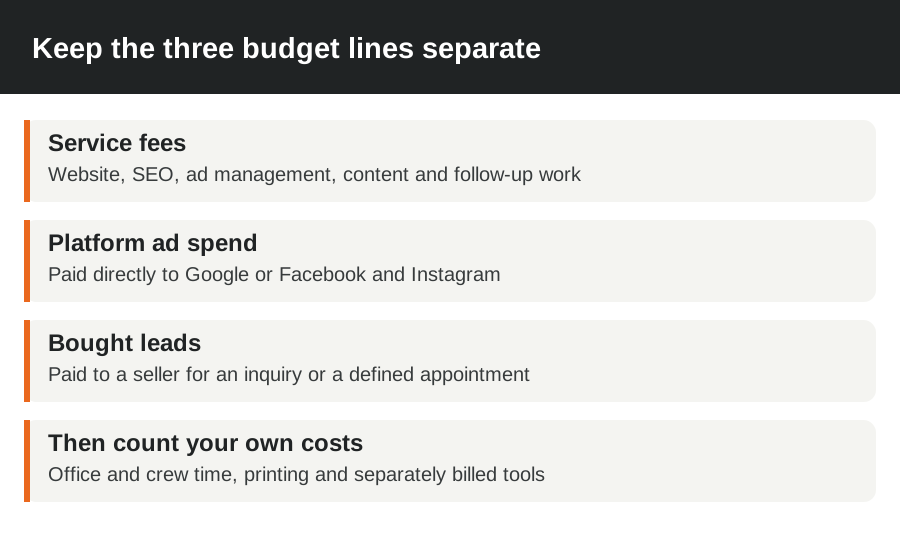
Service fees pay someone to build, manage and improve the work: your website, local search, ads, content or follow-up. Ad spend pays Google or Facebook and Instagram to show ads. Bought leads pay a seller for inquiries or appointments.
Then add the costs that don't arrive on an agency invoice: office time, canvassing wages, printing, call tracking, photography and any software you pay for separately. Your own time still takes you away from inspections and estimating, even when no cash leaves the account.
Don't count the same cost twice. If hosting and follow-up software are included in a package, don't add another subscription allowance for them unless you actually need it. Ask whether a quoted total includes tax and whether anything starts charging after an introductory period.
What each line costs and buys
I'd use the table to compare the work before comparing the totals. The ranges are published price examples and practitioner guides checked in October 2026. Choose the rows you need; you don't have to buy every channel.
| Budget line | How you pay and what to allow | What I'd ask | Useful when |
|---|---|---|---|
| Google profile and local SEO | No profile listing fee; managed SEO guides commonly quote $1,000 to $5,000/month | Which services, pages and local tasks will you improve? | You want an ongoing local search presence |
| Website | Professional agency builds usually cost $2,000 to $10,000 up front plus roughly $50 to $200 a month for hosting and upkeep. DIY builders and templates are the cheaper do-it-yourself route, at about $14 to $29/month or $800 to $1,600 for a one-off template build plus hosting. 9xLocal includes the build with no separate setup or build fee | What's included, who owns it and what happens when I leave? | Visitors need a clearer route to an inspection |
| Google Search | Our starting test is $50 to $100/day in ad spend, plus management | Is spend separate, and which booked outcomes are tracked? | Homeowners are already searching for your service |
| Local Services Ads | Pay per lead; get a current estimate for your area | What counts as a charge and who answers the calls? | You're eligible and can take the work |
| Facebook and Instagram | Our focused starting test is $30 to $50/day, plus management | What's the offer and how do replies reach the office? | You're promoting planned replacement work |
| Shared leads | Published seller comparisons put many roofing inquiries around $45 to $110 each | How many roofers receive it and what's refundable? | You've got spare inspection slots and fast response |
| Exclusive inquiries or appointments | Published comparisons show about $75 to $150 per exclusive inquiry and $150 to $400 per appointment | Is it an inquiry, a set appointment or a kept inspection? | The service, area and stage fit your sales process |
| Signs, hangers and mail | Printing, delivery and staff time; get a current quantity-and-delivery quote | Does the total include stakes, postage and distribution? | You're already working in that neighborhood |
| Referral thank-yous | Your time and any permitted reward | Can I offer this reward to this person? | Customers and partners already know your work |
For the website choices, see roofing website design. A quick AI layout and a larger migration are different jobs. You don't need to pay for a large custom build just to get a useful first site online.
SEO costs
Published roofing SEO pricing guides commonly span $1,000 to $5,000/month, with larger competitive projects above that. Before you accept a retainer, ask what work that buys on the pages and towns you actually serve. A useful service page and a tested call route matter more than a report listing a large number of minor edits.
I'd expect a clear starting review, accurate business details, useful service-page work, genuine job proof and reporting on inquiries and jobs. The website's starting condition changes the workload. A broken migration and missing service pages need more work than a tidy site that needs regular job updates.
Look for the work rather than a fixed page quota. You don't need a separate thin page for every ZIP code. You need accurate coverage, useful answers and pages that a homeowner can understand on a phone. Our roofing SEO services page gives you a buyer checklist.
Here's how I'd judge a $3,500 monthly quote. At $4,200 gross profit per replacement and a 25% inspection-to-sale rate, a booked inspection carries $1,050 of expected gross profit. About 4 extra booked inspections could cover that fee in the model. Covering a fee isn't your whole business goal: you still need room for office costs, risk and profit.
Make the runway visible too. A $2,500 monthly SEO fee is $30,000 across 12 months. If that's the quote you're considering, decide how you'll fund it and what useful work you'll see along the way. Ask what progress you'll see while traffic grows.
Don't buy claims that every organic inquiry is free once a page ranks. You're still paying for upkeep, content or your own time. Compare the cost of useful inquiries and paid jobs over a sensible period.
Google and Facebook: fees vs ad spend
I'd start one focused Google Search test at $1,500 to $3,000 over 30 days, or Facebook and Instagram at $900 to $1,500, plus management. Those are our starting recommendations for a narrow local test. Use local click estimates and the inspection slots you can handle to decide whether the test is affordable.
You'll see three fee models: a flat monthly fee, a percentage of ad spend, or a package that includes ads alongside other work. None tells you enough on its own. A low percentage can still hide a minimum fee; a package can be good value if you'll use the included work.
Published pricing guides show Google Ads management around $500 to $2,000/month or 10% to 20% of spend, and Facebook and Instagram management around $300 to $1,000/month. Compare that with the chosen scope and actual reporting. Don't assume the highest fee buys the most profitable roofs.
Example: $1,500 of Google ad spend plus a $500 management fee is a $2,000 test before any other costs. If it produces 8 booked inspections, the all-in booking cost is $250. Reporting only the $1,500 platform spend would show about $188 and hide part of what you paid.
Read the Google Ads setup and budget guide or the Facebook ads guide for roofers before choosing the first campaign. If you want them managed, compare Google Ads management for roofers and Facebook and Instagram ads for roofers. If your phone isn't answered or forms don't reach the office, fix that route before raising the budget.
Lead costs: shared, exclusive, appointments
Use roughly $45 to $110 for shared inquiries, $75 to $150 for exclusive inquiries and $150 to $400 for appointments as published comparison ranges. Then ask the seller to price your service area and define the thing you'll receive. An appointment on a calendar isn't automatically a kept inspection or a signed roof.
I'd test one source against your current source using the same stages. Record all inquiries, suitable inquiries, booked inspections, signed jobs and completed paid work. A cheaper lead that rarely answers can cost more per roof than an expensive inquiry that's ready for your visit.
Use the roofing lead cost and signed-roof calculator. It already compares those stages, so you don't need another lead calculator here. To generate your own instead of buying, see roofing lead generation. Ask about duplicates, wrong numbers, area exclusions, spending limits and refund deadlines before the first delivery.
How to read a marketing quote
Get these eight answers in writing before you sign:
- What work is included each month, and what needs a separate quote?
- Is platform ad spend separate, and is any markup added?
- How long does the contract run, and how do I cancel?
- Who owns the domain, website files and advertising accounts?
- Are there setup fees, software charges or later price changes?
- Will reports show booked inspections and signed jobs, alongside inquiries?
- Who answers, qualifies and follows up with the leads?
- What will happen in the first month, and what do you need from me?
I'd also ask to see a sample report with private customer information removed. You should be able to follow an inquiry from its source to its outcome. A colorful chart of impressions won't tell you whether your crews got useful work.
"% of revenue" rules
Use 5% to 10% of revenue as a rough cross-check, then build the actual plan from capacity and job economics. Published guides use that range, but it doesn't tell you which channel to buy or whether a quote is reasonable.
You'll also hear a practitioner's sliding rule: around 10% below $1 million revenue, around 5% at $2 million to $3 million, and around 3% beyond $20 million. Treat those as opinions for different business stages. A storm-heavy year, a new town and a well-established referral business can produce very different percentages.
At $1 million revenue, 5% is $50,000 a year, or about $4,167 a month. Look at the work and cash your business can support.
Keep the cash and capacity available
Keep marketing money separate from money needed for materials, wages and jobs you've already promised. A signed replacement may not turn into a collected payment in the same month as the ad bill. Build your test around that timing.
If you're paying for inspections that can't be booked for weeks, reduce the campaign or promote a later opening honestly. If one storm creates a spike in sales, don't turn that temporary revenue into a permanent retainer you can't support in quieter months.
Keep real job photos and useful content in the budget too. The message and proof help the campaign work, even though they aren't an ad-platform charge. Start with the roofs you've actually completed and the questions homeowners ask you. You don't need a separate large branding campaign to do that well.
Test before you scale
Choose one channel, one service area and a 30-day first test, with a wider 1 to 3 month review as inspections turn into sales. I'd review delivery and lead quality every week. You don't need to wait three months to notice that a phone number is wrong.
| What you find | What I'd do |
|---|---|
| No test inquiry reaches the office | Pause paid traffic and repair the handoff |
| Mostly wrong areas or unwanted work | Tighten the service, location and qualifying questions |
| Suitable inquiries don't book | Check reply speed and available inspection slots |
| Inspections happen but estimates don't close | Review scope, price explanation and follow-up |
| Paid jobs fit your margin and crews have space | Increase the working source gradually and keep measuring |
I'd defer weather-app display ads, coupon books and logo-only sponsorships while you're still building a reliable inquiry route. A local sponsorship can have community value, but don't count exposure as booked work. Give each spend a job you can explain.
Want it run for you? 9xLocal's roofing marketing service is an agency replacement with packages from $297/month and no separate setup or build fee. Ad spend is separate and goes directly to Google or Meta without markup. Tell us your area and the roofs you want more of, and we'll show you the first 30 days we'd run. See if we're a fit.
FAQ
How much should a roofing company spend on marketing?
Start with $3,600/month all-in for the example of 3 extra signed roofs, 12 booked inspections and a $300 booking cost. Replace those inputs with your own close rate, margin and capacity. Keep service fees, ad spend and bought leads inside the same total.
How much does roofing SEO cost?
Published pricing guides commonly put managed roofing SEO around $1,000 to $5,000/month. The useful page work, competition and state of your website change the scope. Ask what will be improved and how inquiries and jobs will be reported.
What is a good cost per lead for roofing?
Shared roofing leads usually cost $45 to $110 each, exclusive leads $75 to $150, booked appointments $150 to $400, and Local Services Ads about $86 to $139 per charged lead in published industry price surveys. Then set your own ceiling from the jobs a lead produces. In the worked model, a $300 booked-inspection ceiling and a 50% inquiry-to-booking rate allow $150 per inquiry before extra costs. Compare that with the source's actual service fit and sale rate, rather than choosing the cheapest lead.
Is $3,500/month for SEO too much?
It can be reasonable for a competitive, substantial project if the work and job economics support it. In the replacement example, about 4 extra booked inspections carry enough expected gross profit to cover the fee. You'll still need a funded runway and room for overhead and profit, so ask for the work plan before you commit.
What's the "25% rule" in roofing?
It isn't a marketing-budget rule. People use that phrase for different homeowner repair, replacement or insurance discussions. Ask which rule and location they mean; use your own inspection-to-sale rate and gross profit to build the marketing budget.