I'd allow $50 to $100/day for a focused Search test, plus management. Check the searches you've actually paid for every week, then judge cost per booked inspection and paid roof.
Want help with the setup? See our roofing PPC and Google Ads agency, part of our roofing marketing agency.
How the pieces fit
Build the full route for one service before adding another. Repair, replacement and storm damage can sit in separate ad groups, which are sets of related keywords and ads inside your campaign. Each group needs a page that answers that homeowner's question.
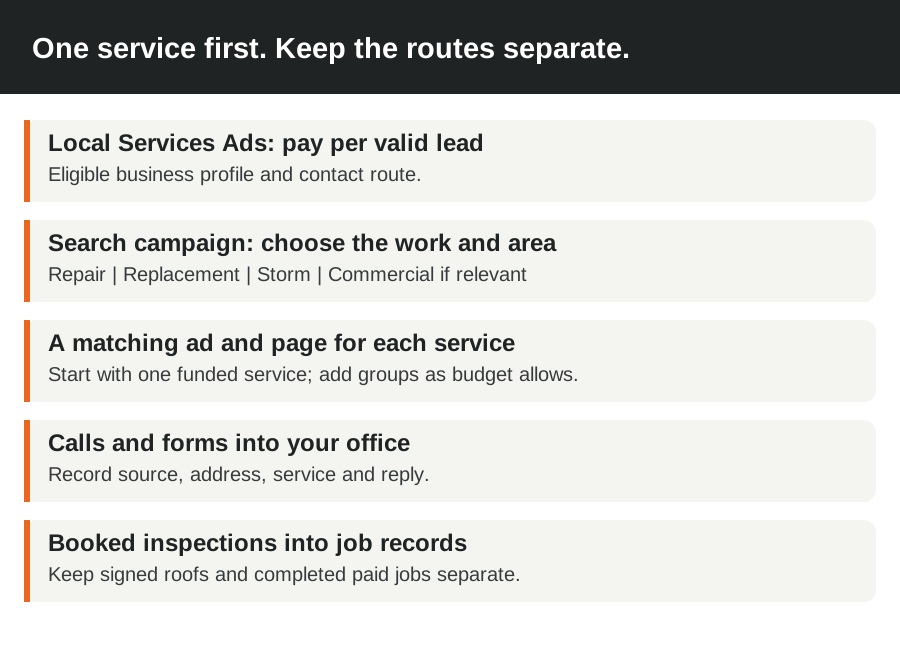
| Route | Where the homeowner goes | What you record |
|---|---|---|
| Search ad for a repair | Repair page, then call or short form | Search campaign, inquiry and booked visit |
| Search ad for a replacement | Replacement page with real roofs and inspection request | Campaign, inspection, estimate and sale |
| Search ad after local storm damage | Damage-inspection page and available appointments | Area, roof problem and booking |
| Eligible Local Services Ad | Your local service profile and contact route | Lead record, booking and job outcome |
Keep Local Services Ads spending separate from Search. If you also take commercial work, give it its own service page and records. Don't mix a warehouse roof bid with a homeowner's leak in one ad group.
Should you start with Local Services Ads?
Yes, I'd price them first for local repair and inspection work if you're eligible. Google's Local Services Ads charge for valid leads and use the Google Verified badge for businesses that complete screening. You'll need to meet the checks for your service and area, including required business, insurance and licensing information.
They're simpler to start than building a full Search campaign, but you have less control over the searches and presentation. Genuine reviews help homeowners choose; ask customers for honest reviews using the same invitation for everyone. Don't offer rewards or select only the happy customers.
Set the services you actually perform and the places you actually cover. Review the lead records, charges and automatic credits. Give feedback on poor inquiries, but don't build your budget around recovering every unwanted charge.
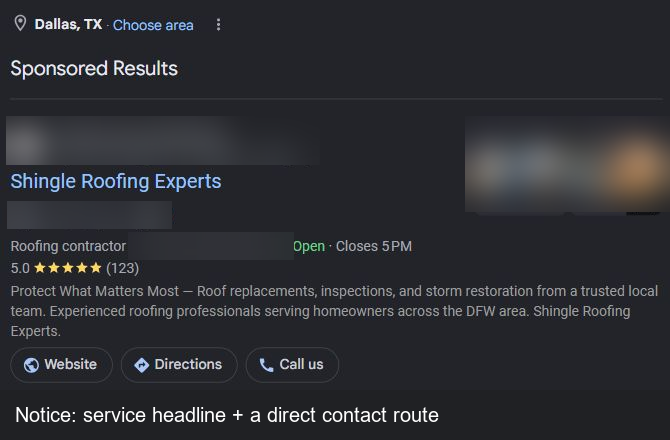
Example ad, source Google Search, captured October 28, 2026. This capture shows a Sponsored result. Use its clear service headline and contact choices as a page-review prompt.
Setting up the search campaign
- Price your own searches. Open Keyword Planner, choose your actual towns and look up roof repair, replacement or the service you're starting with. Use its estimates to decide what you can afford to test. The price of “roofing marketing agency” tells you nothing useful about a homeowner's roof-repair click.
- Choose Search. For the first test, keep Google Search as the route you're measuring. Exclude Display and search-partner traffic through the controls available in your account so the test doesn't spread across extra placements.
- Set real coverage. Select your towns and the presence setting for people in or regularly in those places. Check the addresses on inquiries too; the setting won't catch every out-of-area searcher.
- Pick one funded service. If you want replacements, don't spend the same small budget on gutter cleaning. Add other service groups when you can give them a useful test.
- Match keywords, ads and pages. Start with service-plus-town searches. Keep a repair ad with the repair page, and a replacement ad with the replacement page.
- Choose bidding around your tracking. With a new account, I'd use a clicks strategy with a maximum click bid while checking that real inquiries are recorded properly. Reassess automated conversion bidding after roughly 20 to 30 tracked leads. Switch when those records are trustworthy and useful, rather than because you've reached a particular count.
- Start with exact and a small phrase list. Exact match gives you tighter control; phrase match reaches more related searches. Both can match meaning rather than only the literal words you typed. Read the search terms before adding broader targeting.
- Review automation yourself. Keep auto-applied recommendations off for this controlled test. Inspect automatically created ad text and assets, and disable anything you haven't approved. Don't let a suggested change quietly widen the service or area.
Schedule call-focused ads for hours when someone can answer. If you're accepting forms overnight, make the reply time clear and give the morning follow-up to a named person.
Keywords to bid on and to block
Use the same starter list as the agency page. Add the towns you genuinely serve, then remove any service you don't want.
| Start with | Use it when |
|---|---|
| roof repair [town], roof leak repair | You take repair jobs and can arrange visits |
| roof replacement [town], roofing company [town] | You want replacement inspections |
| roofer near me | Your page explains the services and area clearly |
| storm damage roof repair, hail damage roof repair | You have local inspection capacity after actual damage |
| metal roof installation [town] | Your team installs that system |
Your negative keywords block searches you don't want to pay for:
- Employment: roofing jobs, hiring, salary, apprenticeships.
- Learning: roofing training, courses, DIY, how to install shingles.
- Shopping for materials: shingles supplies, materials for sale, Home Depot, Lowe's.
- Unrelated work: insurance agent and services your crew doesn't provide.
Add specific unwanted phrases as they appear. Don't block “shingles” if you sell shingle roofs, or “free” if you offer a free inspection. Price research can become a real replacement inquiry, so review “cost calculator” and “cheapest” searches before making a blanket exclusion. A buyer watching a roofing video isn't automatically a DIY shopper either.
Negative match rules differ from the keywords you're bidding on. An exact negative blocks that specific search; a phrase negative can block longer searches containing that phrase. Check singular and plural versions as you review the list.
Ads that get calls
Lead with the job and area. Then say what the visit includes and how to request it. Use only the credentials, review counts and availability your business can support.
These are original ad-writing examples. Replace the town and offer with yours:
| Repair ad | Replacement ad | |
|---|---|---|
| Headline | Roof Repair in Your Town | Roof Replacement Options |
| Supporting headline | Find the Cause of the Leak | Book a Roof Inspection |
| Description | Tell us where the roof leaks. Request a visit and a clear explanation of the repair. | See the materials and work included. Request an inspection and a written roof estimate. |
| Destination | Your repair page | Your replacement page |
| Next step | Call or request a repair visit | Request an inspection |
If you provide a free photo report, say that and explain what it covers. If you charge for an inspection, say so before the homeowner books. Don't borrow another roofer's discount or review count.
Add useful assets: call details, links to your main services, approved crew or truck photos, and short factual lines about the work. Only say licensed, insured or same-week inspections when it's true for your business. Keep the call route visible on mobile.
Use the ad-strength score as feedback, then judge the wording against the actual search and inquiry quality. Don't remove an essential service headline just to chase the score. Pinning a headline limits the combinations Google can show, so use it only when that fixed message matters.
Landing pages that match
Put the service and town, a genuine job photo, useful proof and a contact route at the top. A repair searcher shouldn't have to scroll through a gallery of full replacements to discover whether you'll fix flashing.
Ask for a name, phone, address and brief description. Keep the button specific: “Request a roof inspection” tells the homeowner what they're asking for. A short explanation of the visit is more useful than a form with no next step.
Open the page on your phone over mobile data. Tap the call button, submit the form and check the office inbox. Make sure nothing covers the button or forces sideways scrolling. Use the roofing website checklist before buying more traffic.
Tracking calls and booked inspections
Record the steps separately so you can find the problem. A click on a phone number isn't proof that someone spoke to the office, and a thank-you page isn't a booked visit.
- Test call tracking and form delivery before launch. Record a successful inquiry once, even when the homeowner calls and submits a form.
- Give the office a simple record: source, contact, service, address, inquiry date and outcome.
- Update that record when an inspection is booked, an estimate is sent and a roof is signed.
- Add cancellations, completion and payment dates. Keep the original inquiry source with the job.
- Feed useful booking or qualified-inquiry outcomes back to Google when your tracking setup supports it. Don't teach the bidding system to pursue spam or button clicks.
Get consent for calls and texts, and stop marketing follow-up when someone opts out. Keep technical roofing questions with your team.
Budget formula
Use $60/day for 30 days = $1,800 in ad spend as a starting worksheet. Enter your own estimated cost per click. Then change the percentage of clicks that inquire and the percentage of inquiries that book.
Example: the worksheet uses 8% of clicks becoming inquiries and 50% of inquiries booking. Those are editable example inputs. Your call records should replace them as the test runs.
| Calculation | Formula |
|---|---|
| 30-day ad spend | Daily budget x 30 |
| Clicks | Ad spend / your cost per click |
| Inquiries | Clicks x inquiry rate |
| Booked inspections | Inquiries x booking rate |
| Total marketing cost | Ad spend + management and other costs |
| Cost per booked inspection | Total marketing cost / booked inspections |
The tool's 30-day window makes the arithmetic easy. Google's average daily budgets can spend unevenly across days; for most campaigns the monthly spending limit uses 30.4 times the average daily budget. Check the account's limits before setting your cash allowance.
Compare your inspection cost with what a sale leaves. A $14,000 roof at 30% gross margin leaves $4,200 after direct job costs. If one in four booked inspections signs, expected gross profit per inspection is $1,050 before marketing and overhead. With a $300 all-in inspection-cost ceiling, $750 remains before overhead.
Keep signed and completed paid jobs separate. The model helps you choose a test; your collected work tells you what came back.
The 15-minute weekly check
Put this in the calendar. Keep a note of what you changed and why, so next week you're comparing something useful.
| Minutes | Check | Do this |
|---|---|---|
| 1 to 4 | Search terms and service areas | Block clear waste; inspect the whole phrase first |
| 5 to 7 | Answered calls and form delivery | Fix missed inquiries and broken routes |
| 8 to 10 | Booked inspections by service | Compare all-in costs with your ceiling |
| 11 to 13 | Page on a phone | Test the call button, form and next-step message |
| 14 to 15 | Capacity and next change | Choose one useful change and name who'll make it |
Fix broken tracking immediately. Don't pause a useful service just because one week's small sample hasn't sold yet; follow those inquiries through their inspection and estimate dates. Pause obvious waste without waiting for a monthly report.
Seasons and storms
Raise spend when you have room to answer, inspect and deliver. Before a local storm campaign, check the towns affected and the visits you've got available. Keep a separate storm group and stop promoting immediate appointments when they're gone.
Don't promise insurance approval or a free roof, pay a homeowner's deductible or negotiate the claim for them; follow your state's contractor and insurance rules.
When demand slows, start with unanswered estimates and previous customers who want to hear from you. A bigger daily budget won't solve an empty offer or a phone nobody answers. The complete roofing marketing guide covers the other routes to work.
What to fix when the numbers go wrong
| What you're seeing | First fix |
|---|---|
| Lots of clicks for jobs you don't take | Search terms, blocked phrases and service grouping |
| Useful searches but few inquiries | Ad/page match, mobile contact route and proof |
| Suitable inquiries but few bookings | Response time, inspection availability and follow-up |
| Inspections but few signed roofs | Estimate clarity, fit and the next sales conversation |
| Signed roofs but weak cash return | Cancellations, direct job costs, completion and collection |
Change the stage that's failing. Buying more clicks before you've found that stage just makes the same problem more expensive.
Want it run for you?
Our roofing PPC and Google Ads agency connects the ads, pages and follow-up. 9xLocal is your agency replacement for more booked roofing jobs, with packages starting from $297/month. Ad spend is separate, paid directly to Google without markup. Our AI assistant follows up until leads book, and you're month to month with a 30-day money-back guarantee.
Tell us your area and the work you want, and we'll show you the first 30 days we'd run. See if we're a fit.
FAQ
How much do Google Ads cost for roofers?
Start with $1,500 to $3,000 for a 30-day Search test, plus management and website costs. That's $50 to $100/day. Use local click estimates to choose one service and area; expensive replacement searches may need a tighter test or more budget.
Are Local Services Ads worth it for roofers?
Yes, I'd test them for eligible local repair and inspection work. Keep your service area tight, answer promptly and judge the cost of booked inspections and completed roofs. Check charges and credits instead of treating every inquiry as a booking.
What keywords should roofers bid on?
Start with roof repair, roof leak repair or roof replacement plus the towns you serve. Pick the service you want first. Add metal, storm or commercial searches only when you take that work and have a matching page.
Should I use Performance Max?
Start with Search for your first small test. Consider Performance Max later when your tracking distinguishes useful inquiries from spam and you've got budget for a separate test across its wider placements.
Google Ads or Facebook for roofing?
Choose Google first for homeowners searching for repairs now. I'd test Facebook and Instagram for a planned replacement offer with real job photos and fast follow-up. Read Facebook ads for roofers for that setup.