
Our roofing marketing agency page explains the website and inquiry-handling work behind that route.
A measurement report and an instant quote do different jobs. The report describes roof geometry. The quote tool applies your materials, labor and selling assumptions to that geometry. Neither shows hidden decking condition simply because a homeowner entered an address.
Should you add one?
Use this five-question fit test. Mostly yes means you've got a sensible test; a clear no on pricing or follow-up means fix that part first.
| Question | A good reason to test | A reason I'd wait |
|---|---|---|
| Is retail replacement your main target? | Homeowners are planning and comparing prices | Most requests concern claims, repairs or commercial surveys |
| Do people ask price before they'll call? | You can answer that first question usefully | Your first decision needs a condition assessment |
| Can you stand behind a sensible range? | You've checked it against completed jobs | The range is so wide it doesn't help anyone |
| Can the office handle requests quickly? | Someone owns calls and bookings | Requests already disappear into an inbox |
| Are the roofs reasonably repeatable? | Your scope and system are straightforward | Height, access or complexity changes most jobs substantially |
I'd begin with one service area and one replacement type. Keep the normal phone and inspection request available too. You don't need every visitor to use the calculator.
How they work
The homeowner enters an address and selects the right building. Depending on the tool, imagery or a measurement report supplies roof area and geometry. They choose a material or package; your price model produces a range. Contact details and an optional booking step take the request to your office.
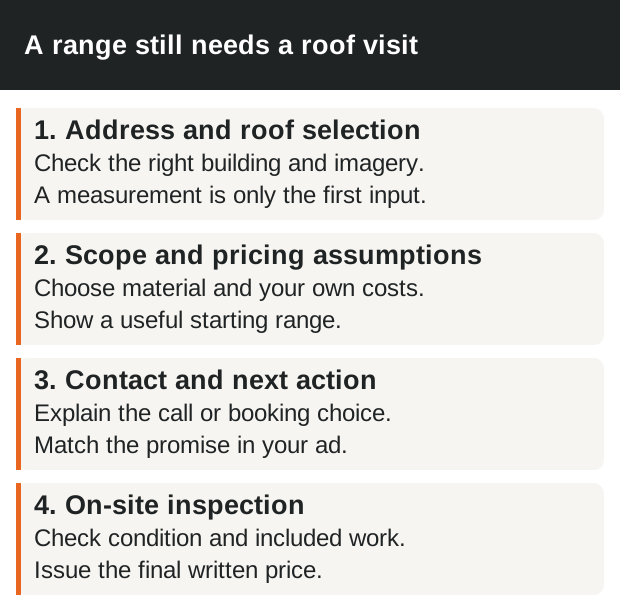
Here's the complete route: address, roof measurement, material choice, range, contact details, your response, inspection and final price. Test the whole thing on a phone. Make sure an address with a detached garage selects the intended roof and that a failed measurement gives a helpful inspection option.
Your office should receive the range, selected system and the assumptions the homeowner saw. Otherwise the caller has to start again, and the number you've just shown can become a source of confusion.
Pros and cons
| What it can help with | What you still have to handle |
|---|---|
| Gives price-conscious homeowners a first answer | Some will leave when they see a realistic price |
| Lets someone explore before speaking to a salesperson | A quote request still needs an actual roofing conversation |
| Offers a clear destination for a replacement ad | A broad or inaccurate range can damage trust |
| Carries the chosen package into the next conversation | Measurement, imagery and form errors need an owner |
| Can help screen for a suitable replacement budget | Software fees and staff time belong in the acquisition cost |
I like the transparency when the range is useful. I wouldn't judge success by the number of quote requests alone. A tool that attracts twice the requests but half the booking rate may leave you with the same inspections and more calls to handle.
Wording price ranges
Use plain wording that describes what the number covers. If your model hasn't earned the word “most,” leave it out and explain the inputs instead.
Example wording: Based on the selected roof area, material and the work listed here, your starting range is [lower price] to [upper price]. We'll inspect the roof and give you the exact price before you decide.
If a roofer has checked comparable past jobs, another option is:
Most comparable roofs in our checked job sample fell within [range] for [defined work]. Layers, decking, pitch, access and material choice can change your price. Book an inspection for a firm proposal.
Name the important inclusions beside the range: tear-off assumptions, underlayment, flashing, disposal, material and any listed allowances. Hidden repairs need a clear process. Don't make a tiny disclaimer carry the whole scope explanation.
A wide range isn't automatically useful. If you can't narrow it enough to help a homeowner decide whether to book, ask for an inspection instead. Show real project explanations on the page so the homeowner understands why one roof costs more than another.
Using it with ads
Send a replacement ad to a dedicated page with the same offer. An ad offering a range should land on a range, with the material and area assumptions easy to find. Use the roofing ad examples and website checklist to review the message and mobile route together.
Keep this source separate in your records. Record the ad, range request, suitable inquiry, booked inspection, attended visit and eventual paid job. If the tool or ad calls a form submission a conversion, remember exactly what that label means when you read the report.
Choose the contact promise deliberately. “No sales calls” means you shouldn't surprise people with a sales call. You could offer the range without contact details, then let them choose a call or inspection. If you're offering a callback, say that beside the form, get the needed permission and honor opt-outs.
For people who request contact, aim to reply within minutes during your advertised hours. Carry their selected range into the conversation: “You've seen the starting range for [system]. Let's arrange the visit so we can check the layers, decking and access.” The estimate follow-up guide covers what happens after that.
Measurement methods compared
Choose the method for the job and the scope you need. None of these methods gives you hidden roof condition just by producing an area figure.
| Method | Accuracy and limitations | Cost per roof | Speed and when I'd use it |
|---|---|---|---|
| Physical measurements | A trained crew can check visible details on site; access and measurement errors still matter | Crew labor, travel and equipment | During a properly planned inspection where safe access is available |
| Aerial or satellite report | Useful geometry; check imagery date, building selection, obscured sections and pitch | Published entry examples are about $13 to $20 for a single-family report, with provider/plan conditions | From under an hour to several hours in published services; useful before a visit or estimate |
| Drone capture | Can show additional views; results depend on capture quality, processing and what is visible | Flight/operator time, equipment and processing or report charges | Useful for suitable complex or inaccessible views with an authorized operator |
| App-based or DIY tracing | Your chosen imagery and tracing affect the result | Free tools exist; paid imagery, subscriptions and staff time may apply | Useful for a first pass or a measured workflow you've checked |
Single-family examples aren't commercial prices. Larger buildings, rush service, premium imagery and broader report packages can cost more. Price the exact report and recurring plan you need before ordering a batch.
Physical and drone work need trained people following applicable access and safety rules. Don't turn a software comparison into a reason to climb a roof for a marketing photograph.
Real roofers using instant quotes
These two public ads show different ways to make the first step feel easier. Use the offer lesson, then write an accurate promise your own business can keep.
Example: a satellite quote before a sales conversation
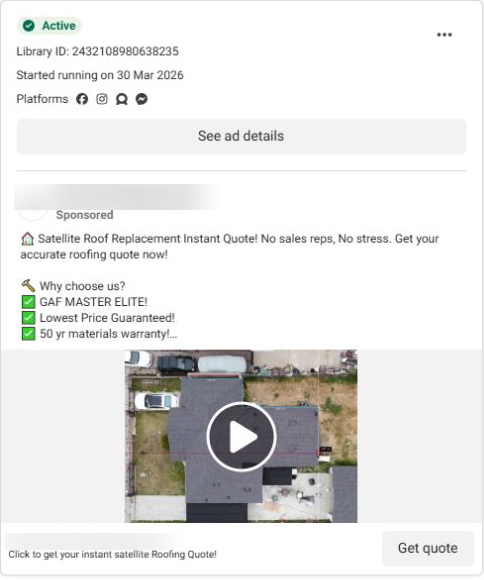
Example ad, source Meta Ads Library, captured 28 October 2026.
What it does well: it puts the homeowner's first price question in the headline and shows a roof view. The offer is easy to understand. I'd test wording that makes the range and next contact choice just as clear, so the website matches the low-pressure promise.
Example: a realistic range without an appointment
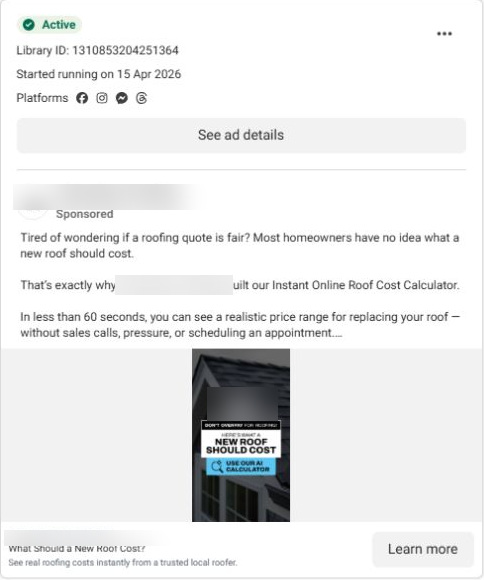
Example ad, source Meta Ads Library, captured 28 October 2026.
What it does well: it speaks to uncertainty about a fair roof price and offers a range before an appointment. I'd test keeping that promise visible beside the result and making the inspection an optional next step. A live ad shows an offer being used; it doesn't tell us what the campaign earned.
DIY option
You can test the wording with a simple calculator using roof area, stories and material, plus your own scoped selling rate. Start with a sample your estimator has checked against actual jobs. A site builder can implement a basic calculation; connecting reliable imagery, your pricing and the office handoff adds more work.
Example: 2,000 square feet at an assumed selling rate of $7 per square foot gives $14,000. A chosen band of 15% either side displays $11,900 to $16,100. The band is an example pricing choice, not a measurement-accuracy rating. Use your actual costs, selling margin and job variation to choose your own range.
Try the range example. It uses an entered roof area and rate. Stories and material flag the scope to review; they don't quietly invent a new rate. It collects no address or contact details and isn't a satellite estimator.
Before putting a customer version on your site, test small, large and complex roofs, an out-of-area address, missing inputs and the path when a measurement isn't available. Make sure the office gets the request and can explain the same range the homeowner saw.
Test the whole route, not just form fills
Example: a plain form gets requests from 1.5% of 1,000 visitors, or 15 requests. If 40% book, you get six booked inspections. A quote tool gets requests from 3% of the same number of visitors, or 30 requests. At a 20% booking rate, it also gets six inspections.
The tool hasn't improved booked inspections in that example. Compare attended visits and completed paid work next, and include the software fee and handling time. You might still prefer it if homeowners arrive better prepared, but measure that benefit rather than assuming it.
Keep traffic source, service area and roof type comparable. Test contact details before versus after the range if both routes fit your offer. Don't change the ad, price model and follow-up process all at once and then credit the calculator for every difference.
What to check before buying measurement software
Ask for a sample report for a roof you know. Check the selected structure, area, pitch, edges and waste assumptions against the work your estimator needs. Find out how a missing or obscured section is handled and how to request a correction.
Then compare the full purchase:
- Geographic and roof-type coverage, image date and report contents.
- Published delivery window, rush charges and applicable plan conditions.
- Per-report charges, subscription minimums and extra-user or imagery fees.
- How the report becomes your estimate, and where you can edit the scope.
- What happens to your data and reports if you stop subscribing.
- Whether the homeowner form works on a phone and reaches the right person.
I'd choose the smallest plan that handles a known sample well, then run a limited test. Keep the phone and inspection-first option available. The complete roofing marketing guide will help you fit the test around the channels you've already got.
Want it run for you? Our roofing website design and roofing marketing service bring the website, ads and AI inquiry follow-up together so suitable requests can become booked inspections. 9xLocal is your agency replacement, with packages from $297/month and no separate setup or build fee. Ad spend is separate and paid directly to Google or Meta without markup. Tell us your area and how you want homeowners to request a visit, and we'll show you the first 30 days we'd run. See if we're a fit.
FAQ
Are instant roof quote tools worth it?
Yes, I'd test one for reasonably repeatable retail replacements when your range is useful and someone handles requests quickly. Keep it only if the full route improves suitable bookings or another outcome you can measure. Fix the normal contact route first if requests are already being missed.
How accurate are satellite roof measurements?
They're useful for roof geometry when the imagery and building selection are right, but they don't assess hidden decking or damage. Check a sample against known roofs, then inspect the job before setting the final scope and price. I'd judge the actual report you receive rather than a general accuracy percentage.
Will showing prices lose me jobs?
Yes, a realistic range can put off people whose budget doesn't fit your work. That's useful when it saves both sides a poor appointment. It can also lose suitable buyers if the scope is unclear or the model overprices their roof, so review the ranges against your real estimates.
What does a roof measurement report cost?
Published single-family entry examples are about $13 to $20 per report, with plan and provider conditions. Multi-family, commercial, rush or premium reports can cost more. Compare the exact deliverable, subscription and turnaround terms rather than treating the entry price as the cost of every report.