
If you'd like help connecting inquiries to appointments, see our roofing lead generation service, part of our roofing marketing agency. This playbook covers the estimate-to-decision routine; the complete roofing marketing guide shows where it fits with the rest of your marketing.
What's sitting in your pipeline
Look at one comparable group of estimates and ask what a small change would mean. Don't count an open proposal as money in the bank. You're comparing possible outcomes from the same set of opportunities.
Example: you send 40 replacement estimates a month. Closing 25% means 10 signed roofs; closing 30% means 12. At $14,000 a roof and a 30% gross margin, those two extra completed jobs would add $8,400 of gross profit before other business costs.
Open the estimate pipeline calculator and put in your own numbers. Compare the same service, source and time period. A larger storm pipeline and a smaller retail pipeline won't tell you much if you mix them together.
The calculator shows a change in expected signed jobs, sales value and potential gross profit. You'll only know the collected outcome once work is completed and paid. Use it to choose where to improve the process, then measure what actually happens.
Before you leave: book the next step
Ask for the next conversation while the roof and estimate are fresh. I'd offer two real times. A homeowner who wants to compare quotes can still choose when you'll help them compare the work.
Original script:
It makes sense to look at the other estimates. Once you've got them, I'd be happy to walk through what's included. Would a short call Thursday afternoon or a visit Saturday morning be easier?
If a visit feels like too much, offer the call. If they don't know when the other quote will arrive, ask when they'd like you to check back. Record that date rather than dropping them into a standard sequence that ignores the conversation.
Before you go, say what you'll send: the proposal, the useful inspection photos and the contact details of the person who can answer. Ask whether they prefer text, email or a call.
If they won't choose a next step, send the promised information and leave a clear route back.
The in-home presentation that makes follow-up easy
Make the estimate understandable before you start chasing a decision. A short conversation about the work gives you something useful to follow up on.
- Include the people making the decision. Ask who needs to review the work and whether they'd like to join the explanation. Don't pressure a household into a same-day decision because one person isn't there.
- Show what you found. Use your real inspection photos and explain the roof detail in ordinary words. Separate an observed issue from something you haven't inspected.
- Offer real choices. If repair, standard replacement and an upgraded system are suitable, show what changes in scope and cost. Don't create a deliberately poor option to steer them toward the middle price.
- Explain the full job. Cover materials, ventilation work where relevant, decking allowances, access, cleanup, warranty and the proposed timing.
- Explain payment choices. Put the full project price beside any lender-supplied monthly-payment option. Ask which route they'd like to explore.
- Set the next action. Give them the proposal and a person to contact, then choose the next conversation together.
Keep the scope and payment details in writing. When someone asks why another estimate is cheaper, you'll have actual work to compare instead of a rehearsed speech about quality.
An instant online range can start the conversation, but it doesn't settle hidden decking conditions or replace the inspection.
The follow-up schedule
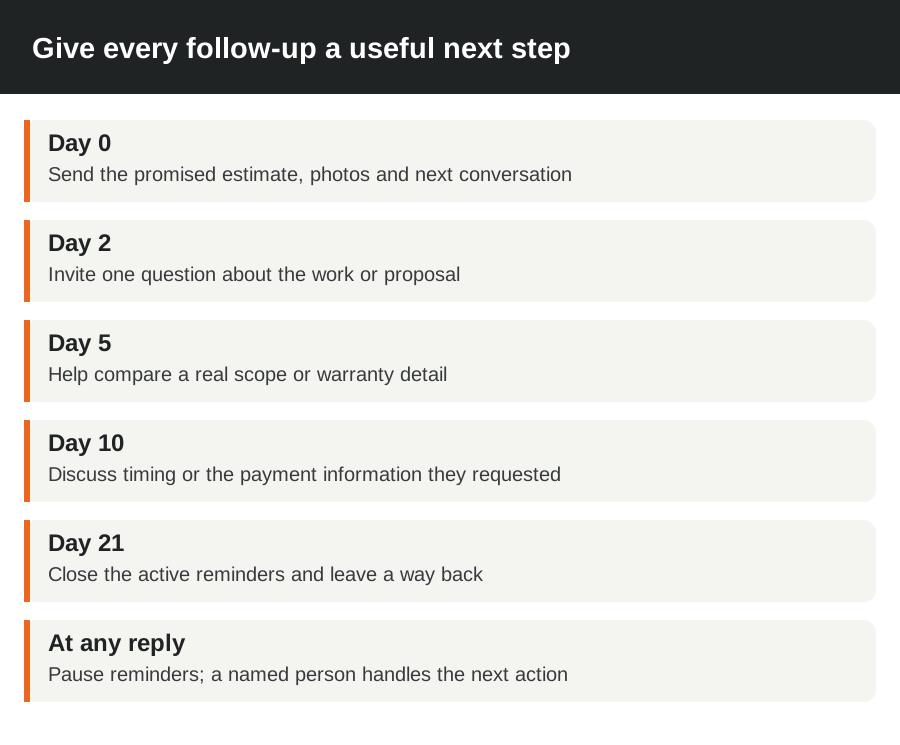
Start with five touches over 21 days. Move a touch to the time the homeowner requested, and pause the sequence whenever they reply.
| When | What I'd send or do | What changes the next step |
|---|---|---|
| Day 0, the same evening | Thank-you, proposal, relevant photos and the next conversation | A missing attachment or wrong contact detail gets fixed now |
| Day 2 | Ask whether one part needs explaining | A reply pauses reminders and creates a task for the right person |
| Day 5 | Explain one useful scope or warranty difference | A competing quote becomes a scope comparison, not an instant discount |
| Day 10 | Ask about timing, repair choices or a payment option they wanted | A real timing issue gets a suitable return date |
| Day 21 | Close the loop and offer an easy way to end reminders | No reply ends the active estimate sequence |
| Later, by permission | A monthly or seasonal update that's relevant to their plan | A clear no or opt-out ends sales outreach |
Use the channel they prefer. A text can ask one question; email is usually easier for a proposal and photos; a call is useful when the answer needs a conversation. Don't send the same message through all three channels at once.
Message formula and templates
Use four parts: who you are, the detail you're discussing, one next action and an easy reply. Thank them naturally. Mention a relevant detail such as the leak location or the date they wanted the work done.
These are original starting templates. Replace the bracketed fields with real information and read the result before sending it.
Day 0: send the promised information
Text:
Hi [name], it's [rep] with [company]. Thanks for showing me the leak near [location] today. I've emailed the roof photos and estimate. We're set to talk [day/time]. If the email hasn't arrived, reply here and I'll resend it.
Email subject: Your roof photos, estimate and next step
Thanks for your time today. I've attached the proposal and the photos we discussed. The estimate covers [main scope]; [specific allowance] is listed separately. Our next conversation is [day/time]. Reply with any questions you'd like me to cover.
Day 2: make a question easy to ask
Text:
Hi [name], it's [rep] from [company]. Is there anything in the [service] estimate you'd like me to explain before our call? You can send a photo of the line you're looking at.
Email subject: Any questions about the [service] scope?
I wanted to make sure the proposal is easy to follow. Is the open question about the work, timing or payment options? Tell me which and I'll get you the useful detail.
Day 5: help compare the work
Text:
Hi [name], one useful thing to compare is how each estimate handles [actual scope item]. Ours includes [real detail]. If the other quote describes it differently, I'm happy to explain our approach.
Email subject: One detail worth comparing in your roof estimates
For your roof, we discussed [finding]. Our proposal handles it by [work]. Here's the photo and the relevant line from the estimate. If another proposal covers different work, we can talk through the difference without changing your decision date.
Day 10: ask what would help now
Text:
Hi [name], is the main question now the timing, the scope or how to pay? If you'd like to look at the repair option or lender payment information we discussed, tell me which and I'll send it.
Email subject: What would help you choose the next step?
You've had some time with the estimate. Would it help to review [suitable repair option], the installation timing or the lender's current payment choices? We can also leave it until [requested month] if that's your plan.
Day 21: close the loop kindly
Text:
Hi [name], I'll close the reminder task for now so we aren't chasing you. If you'd still like help with the roof, reply when you're ready. If you've chosen another route, let me know and I'll stop the sales follow-up.
Email subject: Closing the loop on your roofing estimate
Thanks for considering [company]. I'll end the active estimate reminders now. If you want to revisit the work later, reply here and we'll look at current scope, pricing and availability. If you've decided against the project, a quick reply is enough.
Revive an old estimate with a useful reason
Text:
Hi [name], it's [rep] with [company]. You were considering [work] for [season]. Would an updated estimate with current pricing help, or should I leave it with you?
Email subject: Revisit the [service] estimate for [season]?
We last spoke about [actual issue]. If the project is back on your list, we can review the roof's current condition and update the scope and price. If your plans have changed, let me know and I'll close the task.
Don't invent a supplier price rise, a crew opening or a nearby job to create a reason to contact them. When a real supplier notice affects an unaccepted quote, explain the actual item, date and updated price.
Offering financing
Offer the option during the estimate conversation: "Would you like to see the full-price and monthly-payment choices side by side?" Then let the homeowner choose whether to explore it. A payment plan can help a suitable customer spread a necessary project; it also carries a cost they need to understand.
Use the lender's current approved wording and required disclosures in financing ads and quotes, including any monthly-payment claim. Don't promise acceptance or create a payment number by dividing the job price by a term while ignoring interest and fees.
| Show together | Why the homeowner needs it |
|---|---|
| Full project price and amount financed | They can see how much they're borrowing |
| Annual percentage rate, fees and term | A low monthly payment can still mean a high total cost |
| Total repayment and any promotional conditions | They can compare the whole commitment |
| When payments start and who handles questions | The roofing schedule and loan schedule may differ |
Some deferred-interest plans can charge interest back to the original purchase if the promotional balance isn't cleared on time. Don't describe that as the same thing as an interest-free loan. Give the actual lender terms and space to compare other payment choices.
Let the lender collect the application through its secure route. Your follow-up record usually needs the next action or application status, not a customer's Social Security number or financial documents copied into a sales note. A financing question goes to the person qualified to answer it.
The 5 objections and what to say
Listen for the decision underneath the words. I'd answer that decision first, then suggest one useful next step.
| What they say | A useful response | Next step |
|---|---|---|
| We're getting other quotes | That's sensible. Let's make sure the proposals cover the same work. | Set a short comparison call after the other quotes arrive |
| We need to talk it over | Of course. What information would help the people reviewing it? | Send the relevant scope or photos and choose a return date |
| We're waiting on insurance | What step is the insurer waiting for, and what roof documentation can we provide? | Record the real claim milestone without promising a decision |
| Not this year | Would a suitable repair help, or would you prefer a later review? | Explain only repairs you can stand behind, or set their chosen date |
| It's too expensive | Is the question the total scope, the difference from another quote or how to pay? | Compare actual work, a suitable alternative or lender information |
Don't offer a repair you know won't address the issue. Don't reduce the price before you understand what's being compared. The storm and insurance roofing playbook covers claim-stage conversations separately.
New leads: the first 48 hours
For a new inquiry, aim for a real response within five minutes during covered hours. Identify the company, refer to the work they asked about and offer an inspection slot. If your office is closed, say when a person will reply and keep that promise.
Get permission for the calls and texts you send, follow the applicable contact-hour rules and honor a request to stop.
I'd try the first call, leave one useful message if appropriate, then use their preferred reply route. Make another spaced attempt later that day or the next day. Use the second day to offer a clear next step, rather than copying a rule that every inquiry needs a fixed number of attempts.
When to stop
Stop after a clear no, an opt-out, a different contractor being chosen or the end of the active sequence without a reply. If they ask for a later date, use that date. You don't need to delete their project record to stop the reminders.
A reply that asks a question pauses automation too. Give the task to the person who can answer, then choose the next step from that conversation. If a customer signs, move them to the job process and stop sending sales reminders.
Monthly updates can suit a homeowner who's asked to revisit the project. Quarterly or after-storm contact can suit an existing relationship with permission. Don't move every silent estimate into a permanent campaign by default.
Don't do this
A sales trainer describes a salesperson calling six times in a day and a half to ask whether he'd decided, then losing the job. The useful lesson is simple: repeated requests for a decision add no help. A photo, a scope explanation or a scheduled conversation gives the homeowner a reason to respond.
Don't create a fake deadline. Don't keep calling after the office already got a no. Don't send a payment-plan pitch when the customer's question is about a leak detail. Read the last conversation before you touch the next reminder.
Give every estimate an owner and a reply handoff
Choose one person responsible for the next action, even when software sends the reminder. The office can monitor replies and pass a scope question to the estimator. The salesperson can handle a comparison call. The lender handles loan terms and applications.
Before using automation, test an ordinary reply, a question, a stop request and an accepted estimate. Each should reach the right person and pause or end the sales sequence. Run the same checks after an integration changes. A scheduled message isn't evidence that anyone is reading the replies.
Track it
Keep a short record you can actually maintain. Start with estimate sent, follow-up stage, next task, owner and signed or lost outcome. Record why a job was lost in the homeowner's words when they tell you.
Download the blank follow-up tracker and give every open estimate a next action.
| Field | Example entry |
|---|---|
| Project and source | Replacement, website inquiry |
| Estimate sent | Date and current proposal version |
| Next step | Scope comparison call on the requested date |
| Responsible person | Named office person or estimator |
| Open issue | Timing, scope, payment or claim milestone |
| Outcome | Signed, postponed or lost, with the reason |
Review the list weekly. Separate unanswered messages from answered questions, booked calls and signed jobs. Compare estimates from the same period and give them enough time to reach a decision. Otherwise a busy new month can make the close rate look worse simply because its quotes are still open.
Want the inquiry-to-booking work handled? Our roofing lead generation service connects ads in your accounts with AI text follow-up until leads book, directly in your calendar or through your office. 9xLocal is your agency replacement, with packages from $297/month and ad spend separate. Tell us where inquiries stall and we'll show you the first 30 days we'd run. See if we're a fit.
FAQ
How many times should you follow up on a roofing estimate?
Start with five useful touches over 21 days: the same evening, day 2, day 5, day 10 and day 21. Change the timing to suit the homeowner's request. Stop or pause when they reply, decline, sign or ask you to stop.
Do roofing companies offer financing?
Yes, many offer a lender's payment option alongside the full project price. If your business offers it, explain the actual rate, term, fees and approval process. Keep the homeowner's choice separate from your roofing recommendation.
Can homeowners pay monthly for a new roof?
Yes, if an available lender approves the application and the terms suit the homeowner. Show the monthly payment beside the full cost and total repayment. Don't imply that every homeowner qualifies or that a promotional plan has no conditions.
What do I text after a roofing estimate?
Send a short thank-you that names the work, points to the estimate and gives the next step: "Thanks for your time today. I've sent the replacement proposal and roof photos. We're set to talk Thursday at 4. Reply here if anything needs explaining."