Below are six patterns, eight real ad examples and templates you can adapt to your own roofing business. Pick the pattern that fits your work and area. If you want it handled for you, see our Facebook and Instagram ads service for roofers.
6 ad types roofers keep running
1. Explain the price
Answer why two roof estimates can differ. Use your actual scope, roof size and materials. A low headline number needs enough context to mean something.
2. Offer an instant range
Help someone explore replacement cost before a sales appointment. Make it clear what the tool estimates and what still needs an inspection.
3. Give a useful roof report
Offer photos, findings and clear options after an inspection. That's easier to picture than a vague promise to provide a free estimate.
4. Check after a real storm
Name the actual area and offer an inspection. You don't know a particular roof is damaged just because the neighborhood had bad weather.
5. Show nearby work
Use a real before-and-after from a job you're allowed to share. Explain the problem and work, then offer the same inspection route to nearby owners.
6. Remove sales pressure
Tell homeowners how they'll get information without an unwanted visit or a barrage of calls. Then make your follow-up match that promise.
Watch for ads that make a quote request look like a special program. A headline asking for a fixed number of homeowners doesn't establish that there's funding, a subsidy or a limited allocation. Be clear about who provides the service and what the homeowner is requesting.
Real examples from the Meta Ad Library
These ads were observed on October 28, 2026. An ad running for a long time isn't proof that it's profitable. Use the examples to study the message and next step, then test your own offer.
Price explainer: give the number context
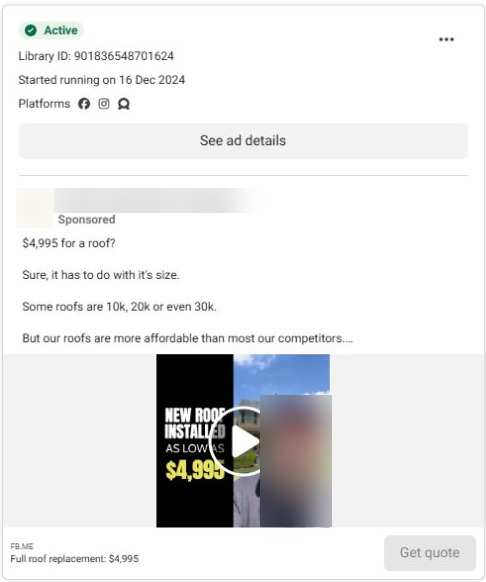
Example ad, source Meta Ad Library, captured October 28, 2026.
Notice: the ad opens at $4,995 and immediately mentions size and higher-priced roofs. The full copy explains its price through the company's overhead.
Suits: a retail roofer with a clearly defined starting package. Borrow the idea of explaining scope; don't borrow the price or claims about being cheaper than other contractors. Your costs and the jobs that qualify need to support your own offer.
Another price explainer: a template isn't your advantage
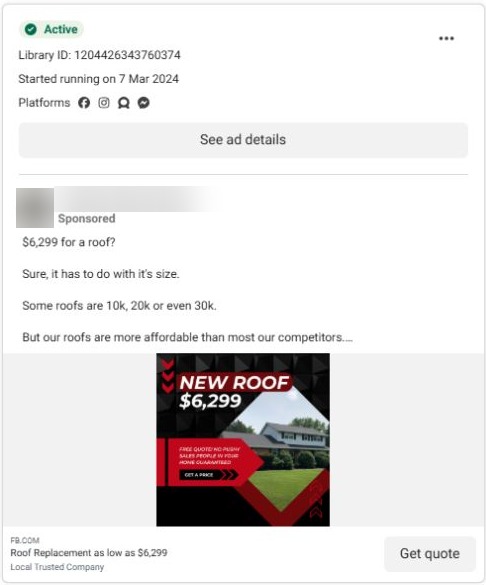
Example ad, source Meta Ad Library, captured October 28, 2026.
Notice: this ad opens at $6,299 but repeats much of the first ad's wording about size, overhead and price. That suggests a shared template, although the copy alone doesn't tell us who wrote it.
Suits: an owner learning how to explain an estimate. Replace the generic script with your actual package, local job evidence and the reason your process helps the homeowner. A different number isn't enough to make an ad your own.
Satellite quote: remove the first appointment
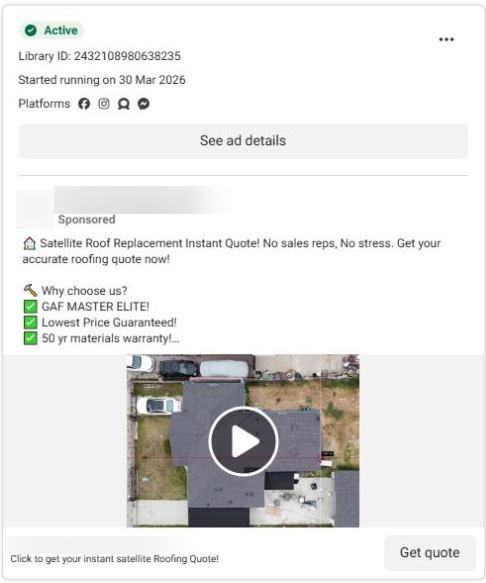
Example ad, source Meta Ad Library, captured October 28, 2026.
Notice: the hook combines an online roof quote with a low-hassle promise. The offer is specific enough for someone to understand why they'd click.
Suits: replacement businesses with a working estimate tool. Test the tool before running the ad, explain what the number covers and make the next inspection step clear. The advertiser's certifications, warranties and price claims belong to its offer; they aren't claims you can adopt.
Price-range calculator: help the researcher
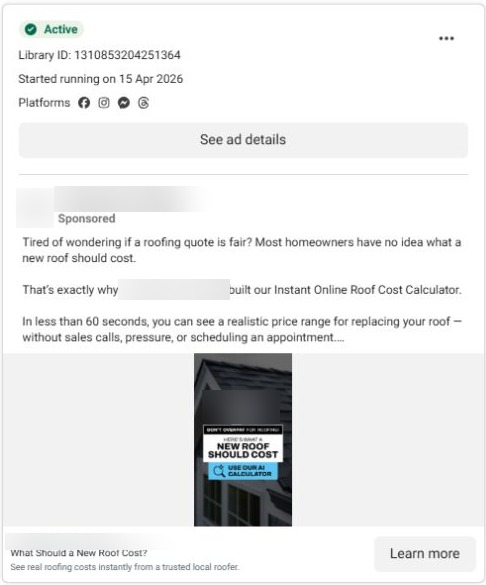
Example ad, source Meta Ad Library, captured October 28, 2026.
Notice: the ad answers the worry that a quote might be unfair and offers a range before an appointment. It makes the research step feel manageable.
Suits: homeowners comparing replacement options. If your tool asks for a phone number, explain what contact they'll receive. Don't promise no sales calls and then send the request into an aggressive calling sequence.
Storm inspection: connect the concern to a real service
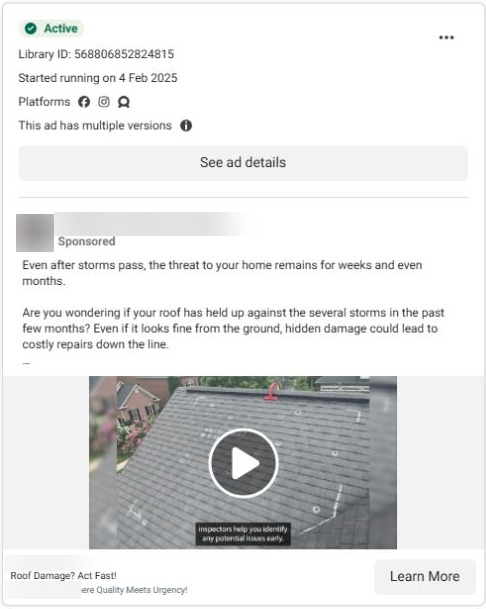
Example ad, source Meta Ad Library, captured October 28, 2026.
Notice: the ad gives a worried homeowner a reason to request an inspection after storms have passed. Its full copy also makes a broad assurance about insurance coverage that I'd leave out.
Suits: a local team with inspection capacity after an actual weather event. Explain what you'll inspect and what report they'll receive. Keep coverage decisions with the insurer and the homeowner's policy.
Metal roofing: answer the sales-process objection
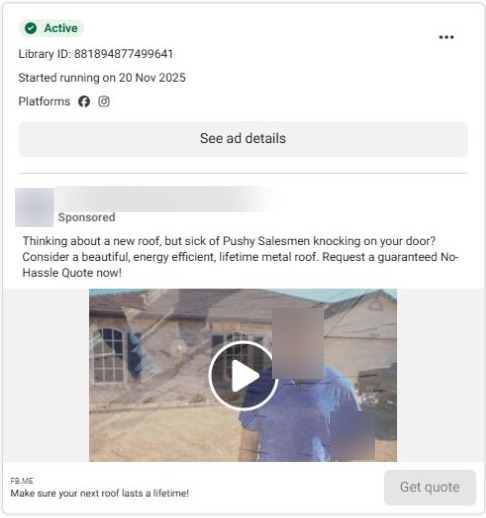
Example ad, source Meta Ad Library, captured October 28, 2026.
Notice: the hook addresses unwanted sales visits before describing the roofing product. It's selling an easier way to explore the option as well as the option itself.
Suits: a metal installer with an educational consultation. Explain the system, appearance and quote process. Don't carry over lifetime or energy-saving claims unless you've got evidence and the exact product terms to support them.
Before-and-after: let a real job explain the work
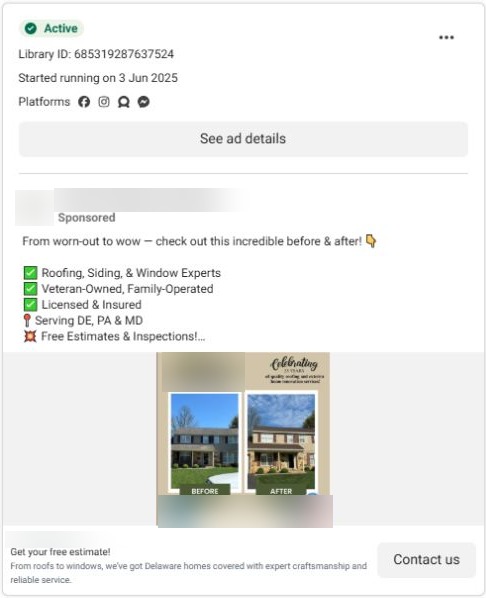
Example ad, source Meta Ad Library, captured October 28, 2026.
Notice: the paired images make the change easy to understand, while the copy names the service area and offers an estimate or inspection.
Suits: a roofer with permission to share recent work. Photograph from a similar angle before and after, and tell people what changed. If the project included siding or windows, say so instead of letting the roof take credit for the whole transformation.
Program-style wording: make the service clear
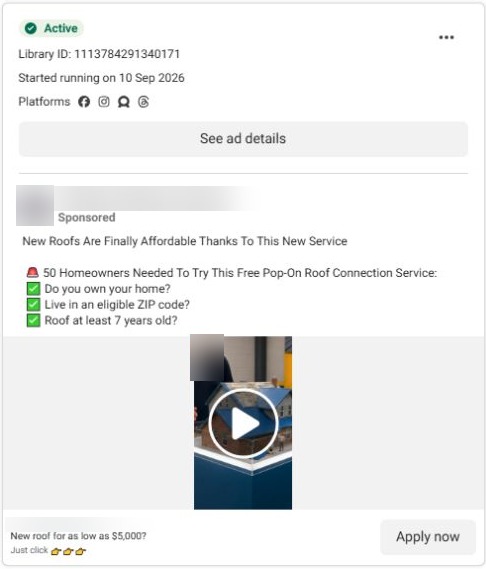
Example ad, source Meta Ad Library, captured October 28, 2026.
Notice: the ad asks for 50 homeowners and describes a free connection service. That isn't the same thing as a free roof or a funded home-improvement program.
Use it as a warning: if you're the contractor, make your identity, offer and next step plain. If you're buying leads, establish who collects the request, who receives it and what the homeowner was told. Program-like wording alone doesn't tell you whether an inquiry will be exclusive or suitable.
What makes a roofing ad work
Before you spend, read the ad as someone who doesn't know your company:
- Does the opening name a problem or decision they recognize?
- Is the message about their roof, cost or inconvenience, rather than a company biography?
- Does it name a real service and area?
- Can they picture what they'll receive, such as inspection photos and explained findings?
- Is there genuine project or review evidence behind the promise?
- Does the button lead to the offer they just read?
- Is any deadline or reason to act real?
You can use AI to help organize a script, but give it your actual facts and read every line. For a short owner video, write a hook, a useful explanation and an offer. A teleprompter can help you say it clearly; it doesn't turn an invented testimonial into proof.
Use your own job footage instead of a generic roof image you've found online. Say who you're helping and what's wrong in words the homeowner uses. You don't need to open with roofing jargon or a dramatic disaster scene.
Write your own: templates
Replace every bracket with a fact you can support. These are original starting points, not promises to publish unchanged.
1. Price explainer
Comparing roof estimates in [town]? For [defined roof size and material], our recent quotes range from [your supported range]. Here's what changes the number: [two main scope factors]. Request an inspection and we'll explain the options for your roof.
2. Instant price range
Planning a replacement in [area]? Start with a roof-price range from our online tool. You'll see [what the tool shows] and what still needs checking on site. Explore your options, then choose whether to request an inspection.
3. Photo roof report
Not sure what condition your roof is in? Book a [free, if true] inspection in [area]. We'll show you photos, explain what we find and tell you which repairs need attention. If the roof looks sound, we'll tell you that too.
4. After-storm check
[Actual storm/date] brought [observed weather] to [area]. If you've noticed [visible symptom], our local crew can inspect your roof and explain the findings with photos. Request an appointment that fits your schedule.
5. Nearby project
This [roof type] in [town] had [actual problem]. We [work completed], and these photos show the change. If your roof has a similar issue, ask us about an inspection. We'll help you understand the options.
6. Less sales pressure
Want to compare [roof system] without a surprise sales visit? Choose a consultation time, see real project examples and get your questions answered. We'll explain the estimate process before you decide on the next step.
Offers worth testing
Pick an offer your crew and office can deliver consistently. A bonus that costs more than the job can support isn't a good offer just because people click it.
| Offer | Make it concrete | Decide before launch |
|---|---|---|
| Roof condition report | Photos, findings and a simple condition grade | What each grade means and how you'll explain it |
| Instant price range | A defined starting estimate | Included work, missing details and inspection route |
| Seasonal deadline | A real promotion with an end date | Capacity and what happens when it ends |
| Gutter cleaning or guards with replacement | A named included service | Size limits, exclusions and actual delivery cost |
| Upgrade for veterans, teachers or first responders | A specific optional upgrade | Eligibility and cost to your business |
| Financing | A clear route to available finance options | Get the ad wording and required disclosures from your lender |
For a roof report card, explain the grade with photos instead of using a low grade to scare someone. If you offer an upgrade, make sure the homeowner knows what they'd receive without it. For a seasonal promotion, stop the ad when the offer ends.
Metal roofing ads
Start with the question the homeowner actually has: what does it cost, what will it look like and how does it compare with the roof they've got? Show the specific metal system you install. Standing seam and stone-coated metal don't look the same, and a general metal-roof photo won't answer every buyer's question.
If you compare lifetime cost, put the assumptions beside the numbers.
Example: compare a $14,000 asphalt installation with a $24,000 metal installation over 40 years, assuming asphalt is replaced once at year 20 for the same $14,000 and metal isn't replaced during that period.
| Assumed work in the comparison | Asphalt | Metal |
|---|---|---|
| Initial installation | $14,000 | $24,000 |
| Replacement at year 20 | $14,000 | $0 |
| Installation and replacement total | $28,000 | $24,000 |
That comparison excludes inflation, financing, repairs, maintenance, removal costs beyond the assumed quotes and any resale effect. Change the replacement timing or include those costs and the comparison changes. Use your actual quotes and product evidence; don't present the table as a roof-life guarantee.
Stone-coated metal may be worth discussing with buyers concerned about hail, but don't promise insurance savings. Let the homeowner get any eligibility or premium change from their insurer for the exact product and property.
Google search ad examples
Search ads should match the job someone is already looking for. Keep repairs and replacements distinct so each visitor gets the relevant page.
Original repair example
Roof Leak Repair in [Town] Book a Roof Inspection Find out what's causing the leak. See photos and explained repair options. Request a visit.
Original replacement example
Roof Replacement in [Town] Compare Your Roofing Options Explore materials and see local work. Book an inspection for a clear replacement estimate.
These are copy concepts. Check the completed headlines against the platform's current limits after inserting your town. Send each to a matching page with a working call or form route. If you'd rather not build these yourself, see Google Ads management for roofers. Use the Google Ads for roofing guide for setup, budget and search-term checks.
Offline: trucks, signs, mailers, tarps
Make the service and phone number readable at a glance on a truck or sign. A postcard gives you more room: lead with the problem, show a relevant job, explain the offer and give one clear response route. Proofread the phone number before printing the batch.
Branded catch-all tarps can make a live job recognizable; a QR code is an extra route for someone who can safely stop and scan it. Don't rely on a passing driver reading a QR code. Keep the number or short web address visible too.
Use yard signs with permission on private property and follow local sign rules; for door hangers or canvassing, check permits and no-knock restrictions.
Ads that get you in trouble
Keep these out of your copy:
- Free-roof or deductible-waiver promises, or offers to negotiate a homeowner's claim: check your state's rules on contractors and insurance claims.
- Made-up deadlines, nonexistent subsidies and claims that a particular house is damaged before you've inspected it.
- Other companies' job photos, fabricated reviews or AI roofs presented as work your crew completed.
- Unsupported prices, warranties or claims that every homeowner will qualify for an offer.
Make the advertised service and the actual experience match. If you're offering information before a visit, don't turn the request into an unwanted doorstep pitch. Get the appropriate consent for follow-up calls and texts and respect opt-outs.
Test one offer and follow it through to a paid job
Start with one service in one area. Use a real job photo and a short owner video to present the same offer, then compare the inquiries they bring. You won't learn much if you change the area, offer, landing page and creative at the same time.
| Record | What it tells you |
|---|---|
| Ad and creative | Which message produced the inquiry |
| Qualified inquiry | Whether the work and address fit your business |
| Booked inspection | Whether the offer and follow-up got someone onto the calendar |
| Signed job | Whether the inspection led to accepted work |
| Completed paid job | Whether the work became collected revenue |
| Advertising, management and offer cost | What you actually spent to acquire the work |
Test the form and office notification before you pay for traffic. Review unsuitable inquiries with the person answering them. If the ad says replacement but most callers want a small repair, change the message or the page before increasing spend.
Don't call an ad a winner because its inquiry cost is low. Compare cost per booked inspection and completed paid job, and allow for the time between those stages. The Facebook ads for roofers guide has the fuller test plan.
Want it run for you? Our roofing Facebook and Instagram ads service writes and runs ads in your own account, with packages from $297/month and ad spend separate. Tell us your area and the work you want, and we'll show you the first offer we'd test.
FAQ
What is the best way to advertise a roofing company?
Start with Google Search for people actively looking for your service, and test Facebook or Instagram when you've got a clear offer and real project evidence to introduce to local homeowners. Pick one paid channel first if the budget is tight. Your area, job type and ability to follow up should decide the next test.
What should a roofing ad say?
Name the homeowner's problem, the service area and one useful next step. Support it with a real photo or review. A specific inspection report or explained price range is easier to understand than a generic claim that you're the best.
Do price ads work for roofers?
Yes, they're worth testing when the price has a clear scope and your margins support the jobs it attracts. Use your own quote data, explain who qualifies and compare booked work with acquisition cost. Don't use another company's starting price to fill a gap in your offer.
Where can I see competitors' roofing ads?
Use the Meta Ad Library. Choose your country and All ads, search for a known local contractor, then use the Instagram publisher filter when you're researching Instagram examples. Open the ad's details and record the Library ID and date. Study the promise and next step; don't copy the wording or assume active means profitable.