
I'd build this into the next 3 jobs before ordering a big campaign. If you'd like help connecting it with local ads and booking follow-up, see our roofing marketing agency. The designs and wording below give your printer a clear starting point.
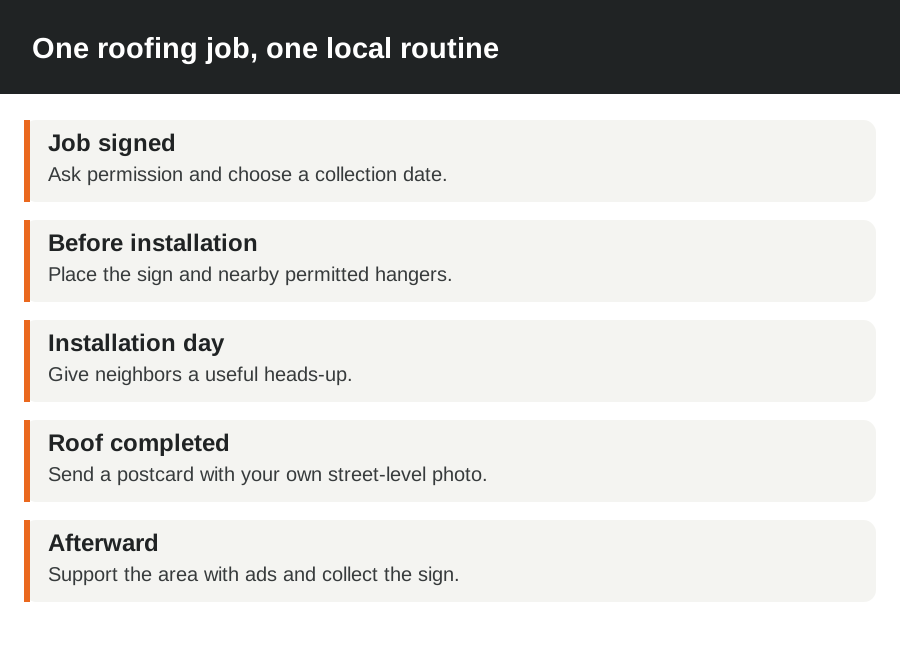
The job-site routine (graphic)
The roof you're installing is the reason to be visible on that street. Use the same company name, colors and inspection offer on each piece, so a neighbor recognizes you when they see you again.
| Stage | What you'll do | Who'll own it |
|---|---|---|
| Job signed | Ask about the yard sign and permission to show the finished work | Salesperson |
| Before installation | Place the permitted sign and drop hangers at nearby homes you're allowed to approach | Named field rep |
| Installation day | Give a useful heads-up about trucks and noise | Site contact |
| Work finished | Send a short postcard using your own street-level job photo | Office |
| Afterward | Support the area with local Facebook and Instagram ads for roofers and collect the sign on the chosen date | Marketing contact and field rep |
Ask for the job duration plus a week afterward if the homeowner's happy with that and local rules allow it. If they want it down sooner, collect it. You shouldn't leave the homeowner wondering whether the sign is now their job to dispose of.
Use door knocking for roofers for the conversation at the door. This page handles what you'll leave behind and how you'll tell whether it's worth repeating.
Yard signs that get read at 55 mph
Choose an 18 x 24 inch sign as your starting size. It's a common format, easy to carry between jobs and large enough for a clear service line and phone number. Don't try to squeeze your whole website onto it.
The service and company should register at a glance. Save the detail for someone who stops or visits your website later.
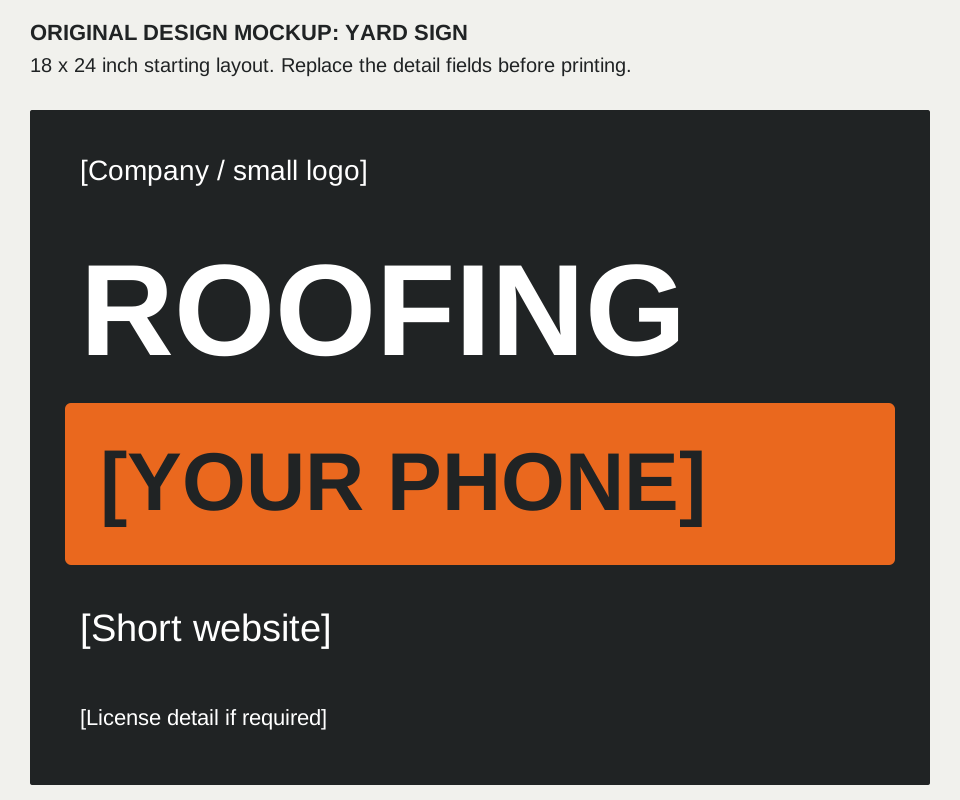
Original design mockup. Download the SVG and copy the wording.
Build the layout in this order:
- Service: “ROOFING” or “NEW ROOF BY” in large, high-contrast letters.
- Contact: a large working phone number, with a short website below it.
- Company: your name and a small logo, without competing with the service line.
- Required detail: your license number or other wording where the job's location requires it.
I'd keep a QR code secondary on a yard sign. It's useful for someone walking past, but your phone number and short web address should work without it. Test the finished-size proof from the distance you expect people to see it, then ask someone who hasn't designed it what they noticed first.
Use customer yards and partners' private property with permission. Some practitioners talk about putting out 100 to 500 signs a month, but your first target should be consistent use at real jobs, not a pile of signs around town. Track each placement and its collection date.
Don't let a crooked, faded sign become the first impression of your company. Check the stake and printing when the rep visits the site. A sign that's still usable can move to the next permitted job instead of being bought again.
Door hangers: front and back
The hanger has more reading time than the sign, so give the neighbor a reason to keep it. Lead with the nearby work, then explain the inspection offer and how to book.
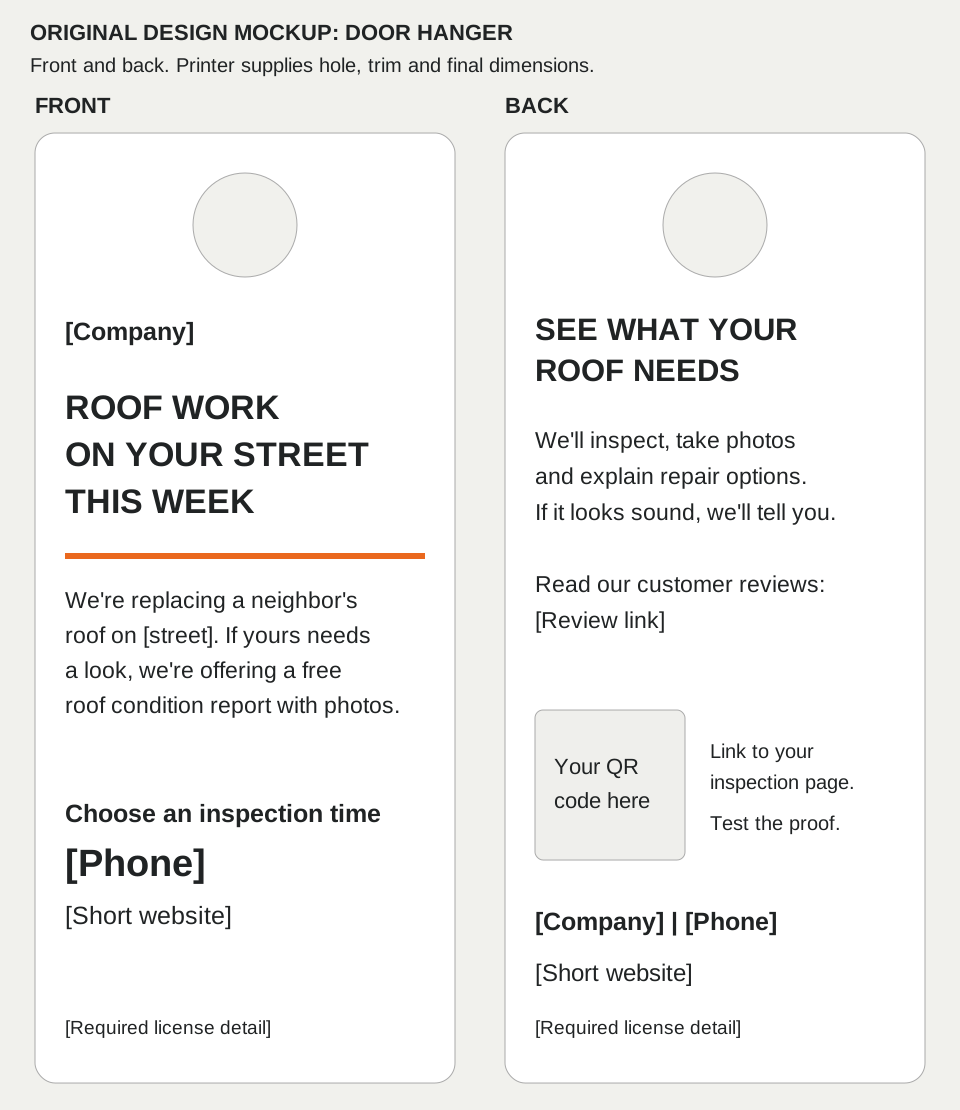
Original design mockup. Download the SVG and copy the wording.
Front:
Roof work on your street this week
>
We're replacing a neighbor's roof on [street]. If you've been meaning to have yours looked at, we're offering a free roof condition report with photos.
>
Call [phone] or visit [short website] to choose a time.
Back:
See what your roof needs
>
We'll inspect, take photos and explain any repair options. If it looks sound, we'll tell you.
>
Read our customer reviews at [review link].
>
[Company] | [phone] | [short website] | [license detail if required]
Use “free” only if that's your actual inspection offer. Link to real reviews rather than printing an invented quote or a star rating that isn't yours. If you include a review excerpt, use the customer's actual words with permission.
The brackets are fields for your own details. Replace them before printing, and change “this week” if the dates won't be true when the piece reaches the door. A general “We're working nearby” version is easier to reuse than a stack naming the wrong street.
Keep the hanger hole and the printer's trim area clear. Test the QR destination on a phone, then print a paper sample and try it on a door handle. You'll catch cut-off text and awkward placement before paying for a carton.
Postcards and letters
I'd start with a small addressed postcard list around a finished job. Show a street-level photo of the actual roof, with the homeowner's permission, because that's the view a neighbor recognizes. Don't use a stock house or an AI image as proof of your work.
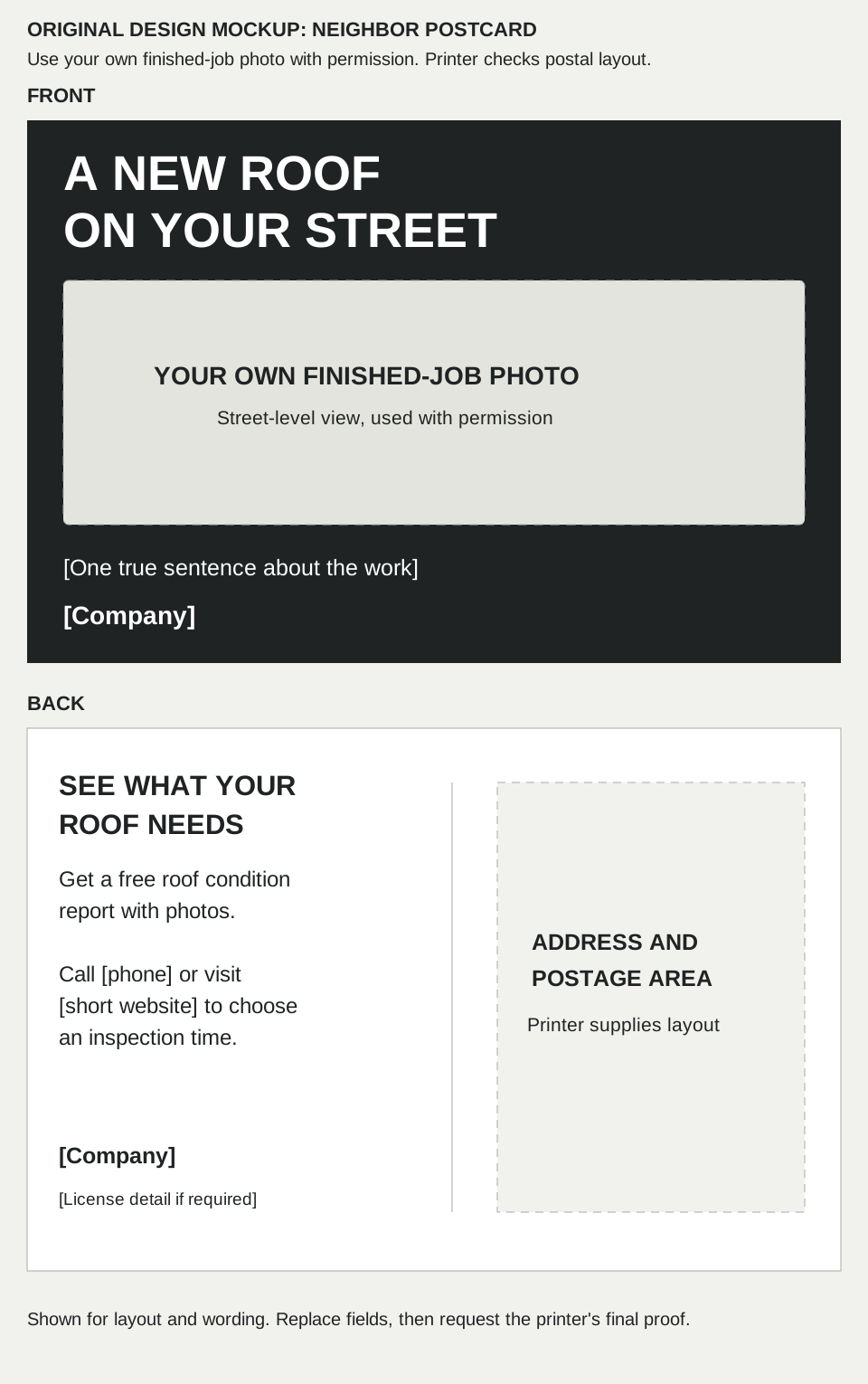
Original design mockup. Download the SVG and copy the wording.
Try this structure:
- Headline: “A new roof on your street.”
- Local proof: your real finished-job photo and a short description of the work.
- Offer: “Get a free roof condition report with photos.”
- Next step: “Call [phone] or visit [short website] to choose a time.”
Use a real reason to act now, such as a visit you're already making nearby or an appointment window you can keep. Older housing can help you choose a list, but it doesn't tell you that a roof hasn't been replaced.
A hand-addressed letter is worth testing when you've got a short, carefully chosen list and a personal reason to write. Keep it to the nearby job, what you can help with and how to reach you. It'll take more time per address than a postcard, so include that time when you compare the two.
For the postcard, leave the address and postage area clear and have the printer check the finished mailpiece against USPS requirements. The example below uses a standard eligible postcard; a bigger format can change the postage. A route-wide mailing is a different order from sending 20 addressed cards to nearby houses.
Before ordering, call the printed number, type the web address and scan the code from the proof. Then ask someone else to do it. The best design in the world won't rescue a wrong phone number.
Business cards, truck wraps, tarps
Use the same simple message on the pieces people see around your crew. A business card needs your name, company, phone and a short web or review link. A truck needs the service and readable contact details. Your branded tarp can carry the company and website without becoming a wall of text.
A QR code on a card or stationary display can open reviews or the inspection page. Keep it away from moving-traffic decisions. For tarps, don't let a marketing layout interfere with the equipment's safe use.
These pieces support recognition; they won't tell you which one caused a sale on their own. Don't order an expensive wrap because someone attributes every neighborhood inquiry to a branded truck. Get the job-site routine working first, then decide what extra visibility is worth.
Track which piece worked
Give each piece a source label in your customer record. A separate tracking number or a tagged QR link can help, but your office still needs to ask, “How did you hear about us?” A homeowner may have seen the sign, kept a hanger and searched your name later.
Keep both the first source they remember and any other touches they mention. Don't claim three separate leads when one homeowner called after seeing three pieces.
Download the blank neighborhood tracker. Record the job, piece, quantity, placement or mailing date, cost, permission and collection date. As inquiries arrive, add booked inspections, attendance, signed jobs and completed paid jobs.
| What you see | What I'd check next |
|---|---|
| No inquiries | Is the contact route working, and did the pieces reach the right homes? |
| Calls from outside your area | Is the service area clear on the piece and destination? |
| Bookings that don't attend | Did the office explain the visit and send the appointment details? |
| Inspections but little suitable work | Is the offer attracting the jobs you want? |
| Jobs that don't pay enough | Compare acquisition cost with the job's actual gross profit. |
For useful design comparisons, keep the offer and area similar and change one thing at a time. Don't attribute a storm-week spike to a new color scheme just because you changed both in the same week.
What it costs per job (table, prices checked at draft)
Budget about $50 in materials used per job for a basic sign, 20 hangers and 20 mailed postcards. Print quantities, sides, delivery and the time to distribute them change what you'll actually spend. Prices below were checked on 28 October 2026 against published printer lists and USPS rates.
Example: buy 5 double-sided signs with stakes for $85, 100 front-only hangers for about $52 and 100 double-sided 4 x 6 postcards for about $31. Use one sign, 20 hangers and 20 postcards at a job. The table allocates the materials you use, with figures rounded to whole dollars.
| Item used at one job | Allocated cost |
|---|---|
| 1 sign and stake from the 5-sign order | $17 |
| 20 front-only hangers from the 100-piece order | $11 |
| 20 printed postcards from the 100-piece order | $6 |
| Postage for 20 eligible domestic postcards | $13 |
| Materials and postage used | About $47 |
The upfront order is about $181 including those 20 stamps, before shipping, tax and distribution time. You've still got signs and printed pieces left for later jobs. The front-and-back hanger design above needs a separate two-sided quote; the table's basic price buys the front only. You can put the main message and contact details together on that side for the first test.
Add design, delivery to you, address preparation, walking time, phone tracking and any lost signs to your campaign total. If you're printing a fresh job photo for each street, don't spread one 100-card design across five jobs as if every roof photo were the same. Use a reusable general version or price each small custom run properly.
Now compare the whole cost with work won. A $14,000 replacement at 30% gross margin has $4,200 of gross profit. If 1 in 4 attended inspections becomes a completed, paid job at that margin, each attended inspection carries about $1,050 of expected gross profit across the group. Use your own close rate and overhead needs when deciding how much you can spend.
Judge it by completed paid work and the full campaign cost, not a sign seller's return claim. See roofing marketing costs for the wider budget calculation.
Rules
Check the town's sign ordinance, HOA conditions and private-property permission before placing signs; public rights-of-way and roadside placements are banned in many towns. Property-owner permission alone doesn't authorize an intersection or road verge. Respect no-soliciting signs and access restrictions for hanger drops, and keep unstamped materials out of and off mailboxes.
Put the placement and collection dates in the job record. You're asking to use someone's property, so a clear pickup plan is part of doing the job properly. If permission ends, remove the sign.
Don't use insurance outcomes or deductible offers as print headlines. Your piece should explain the service you can deliver. When you use referral partners for permitted private placements, make the contact and collection arrangement just as clear as you would with a customer.
For the wider mix, see the complete roofing marketing guide and roofing advertising examples. Keep the local proof and offer consistent across print and digital.
Want help with the local campaign?
Our roofing marketing agency can pair your job areas with Facebook and Instagram campaigns and follow-up until an inquiry books. Packages start from $297/month, with ad spend separate. Your team handles print placement and the site visits; we'll connect the campaign and booking steps.
Tell us your area and the work you want, and we'll show you the first 30 days we'd run.
FAQ
Do roofing yard signs work?
Yes, they're worth testing at your active jobs with the homeowner's permission. Use a readable service line and phone number, then log the inquiries and paid work they help bring in. I'd start with consistent placements on your next 3 jobs before buying signs in volume.
What should a roofing door hanger say?
Say why you're nearby, offer one useful service and give a clear way to book. “Roof work on your street this week” followed by a photo roof report offer is a good starting point when it's true. Add your actual company details and a real review link on the back.
What size yard sign is best?
Choose 18 x 24 inches for a first order. It fits a large service line and phone number without being awkward to move between jobs. Use fewer words before moving to a larger sign, and follow the size allowed at the placement.
Are postcards worth it for roofers?
Yes, I'd test a small addressed run around completed jobs before mailing a whole town. Use your own job photo, a working offer and source tracking. Compare the full printing, postage and handling cost with completed paid work before ordering the next run.
Can I put signs at intersections?
Skip intersections and start with permitted private job yards. The rules section above explains the town, road and property checks you'll need for any other placement. A busy corner isn't worth a removal notice or a complaint.