
For help with the website and marketing behind that work, see our roofing marketing agency.
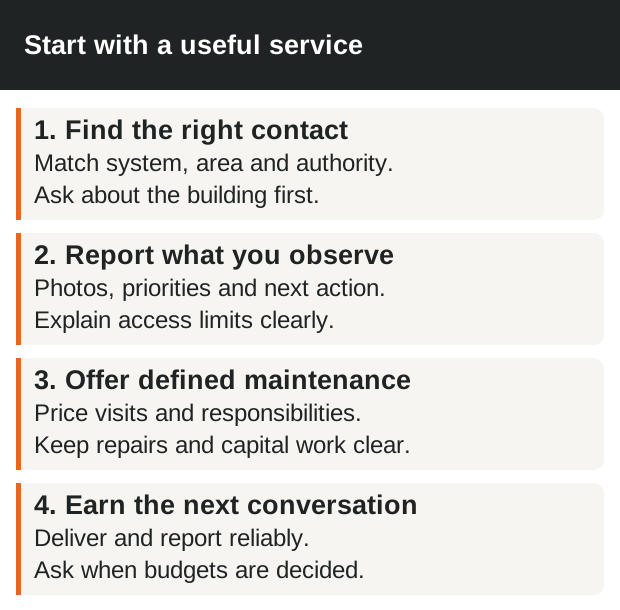
Choose buildings your crews can service well. If you're a shingle installer moving into low-slope work, settle the training, insurance and system capability before you sell a maintenance agreement. Your first commercial account should fit what you can deliver.
Who to target
Commercial buyers want the building protected with as little disruption as possible. A manager may handle a leak repair while the owner or board approves replacement. Find both roles before you spend days preparing a proposal.
| Buyer or partner | What creates the need | Useful first offer |
|---|---|---|
| Property managers | Leaks across several occupied buildings | A clear reporting and service process |
| Facility managers | Keeping a site running and planning repairs | A roof condition survey tied to their maintenance schedule |
| HOA and condo boards | Shared roofs and committee decisions | A report they can take to a board meeting |
| Churches and schools | Budgets, access and occupied spaces | Inspection timing that works around building use |
| Retail and strip-center owners | Tenant complaints and business disruption | Repair priorities and a staging plan |
| Industrial owners | Access restrictions, equipment and production | A site-specific survey and coordination plan |
| HVAC contractors | Equipment and penetrations on roofs | A reliable roofer to call when their work exposes a roof concern |
| Commercial realtors and insurance agents | Building sales, policy questions and condition reports | Factual roof information with a clear role for each professional |
Start with one or two building types. Your examples, service radius and outreach will be more useful when they speak to the same buyer. Referral partners can introduce you, especially HVAC firms already servicing the roofs you work on.
Building your list
Use county assessor records to identify the owning entity, then find the management contact through the building's website, a property-management directory or a business introduction. An LLC name gives you a research starting point. It doesn't tell you who signs the roof contract.
LinkedIn, local business groups and BOMA chapters can help you learn who manages properties in your area. You can also keep drive-by notes of suitable buildings, without guessing at roof damage from the road.
I'd record the building, roof system if known, owner, manager, contact source/date, service area, apparent need and next action. Add the actual buyer, approval process and budget date as you learn them. Mark unknowns as unknown rather than filling the sheet with guesses.
Start with the blank commercial target log. If 50 buildings is more than your team can handle this month, start with ten. A small list you've researched and followed up is more useful than hundreds of names nobody owns.
Outreach that gets meetings
Lead with the building and the service you can provide. A letter or short email can introduce you; a call can find the responsible person; a permitted office visit can leave a useful sample. Respond the same business day when someone asks for help, and give a real visit date.
Here's an original email:
Subject: Roof service contact for [building/area]
Hi [name], we handle [roof systems and work] around [area]. Who manages roof inspections and leak repairs for [building]? We can provide a condition report with photos and repair priorities. If that would help your maintenance planning, could we arrange a short call about access and your current process?
For a call:
Hi, I'm [name] with [company]. Who handles roof maintenance for this building? I'd like to send a sample condition report and learn how you approve a roof survey. What's the right business contact?
For a permitted office visit:
We're a local roofing service company. Could I leave this sample for the person responsible for building maintenance? Our contact details and the systems we handle are on the front.
Use honest business outreach, follow applicable calling and email rules, and honor requests to stop. Don't add a directory contact to repeated automated texts. If the building has a visitor process, follow it; you aren't entitled to walk onto the roof or through a tenant's workspace.
I'd offer a free initial condition report only where you've set the survey scope and can afford the visit. A large or complex survey may need a paid proposal. Tell the manager what you'll inspect, what access you need and what they'll receive before booking it.
The roof condition report
Put the useful findings near the front. A manager shouldn't have to read ten pages of company history to find out which leak needs attention. Explain the observed condition with photos and give each recommendation a location, priority and next step.
| Report part | What I'd include |
|---|---|
| Cover | Building, date, contact, roof system and inspected areas |
| Main findings | Photos with locations and a short explanation of what you observed |
| Repair priorities | What needs action now and what can be planned later |
| Budget view | Present repair options, a 1 to 3 year planning horizon and longer-term items where supported |
| Maintenance | Proposed visits, checks and reporting |
| Access and limits | Areas not inspected and any further testing needed |
| Supporting material | Relevant system information, insurance documents and genuine references |
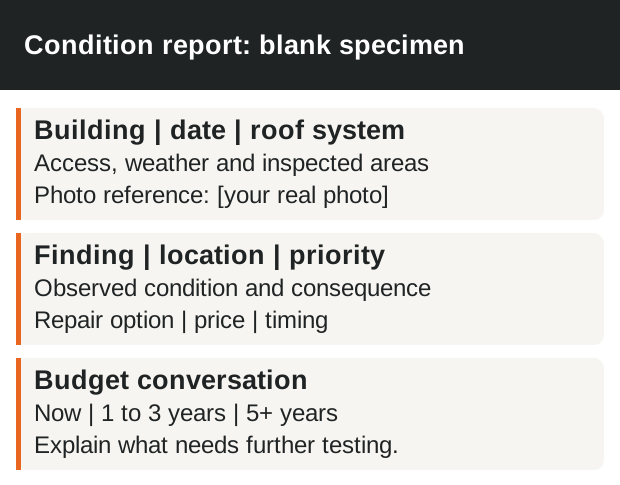
Use a condition rating only if you explain it. A red label should mean something concrete, such as an active leak needing a repair decision. Don't give every roof the same urgent score.
For a five-year-plus planning item, explain the basis and what would change it. If you need a moisture survey or opening before choosing a restoration system, make that the next step. The report should help the owner choose between maintenance, repair, restoration and replacement based on the actual roof.
Maintenance agreements
Start with two scheduled inspections a year as a planning option, then adjust for the roof, building use and manufacturer requirements. Define what the visit includes and which repairs are priced separately. The promise is a service your team can schedule and report on.
Before offering an agreement, set these details:
- Buildings and roof areas covered, with safe access arrangements.
- Visits per year and the season or scheduling window.
- Inspection tasks, photo reporting and delivery contact.
- Any minor repair allowance and the approval limit for extra work.
- Leak-response hours and the difference between acknowledging a call and arriving on site.
- Annual price, payment schedule, renewal and cancellation process.
- Warranty responsibilities, exclusions and emergency work terms.
Have the agreement reviewed for your state and the work you're promising before you use it. This checklist is for designing the service; it doesn't replace your contract.
Example: 20 buildings at $800 per year produce $16,000 in annual agreement fees. At two visits per building, you're committing to 40 scheduled building visits, plus whatever leak-response work the agreement includes. Price the crew time, travel and reporting before deciding whether that fee works for you.
Use the maintenance value calculator to change the building count, annual fee, visits, repair sales and delivery costs. It keeps fees separate from the amount left after direct costs. Put hoped-for replacements in your opportunity log, outside the recurring fee total.
Getting the first call on a replacement is valuable, but you haven't won it merely because you maintain the roof. Keep earning the relationship through useful reports and dependable repairs.
Presenting and closing
I'd aim to present the findings within a week of the inspection while the visit is fresh. Ask when the next budget or board meeting happens and who needs to attend. A clear next conversation beats an estimate sent to an inbox with no decision date.
Ask these questions during the survey conversation:
- Who can approve a repair, and who approves capital work?
- Is there a budget already, or does the owner need a planning figure?
- What building activity must stay open?
- When does the decision need to happen?
- Does the owner want repair, restoration and replacement options compared?
If phasing is suitable, show which work can be separated and why. For example, urgent leak repairs may happen now while an owner plans a later roof section. Don't split a system in a way that creates unsupported warranty or watertightness promises.
For a suitable roof, a restoration option can give a proactive owner another choice. Explain the inspection and preparation it needs, what the system covers and how it compares with replacement. The cheapest first invoice isn't always the lowest total ownership cost.
What wins the job: coordination
Show how you'll work around the building. A facility manager needs to know where deliveries go, what areas will be closed and whom to call when a tenant has a question. Put that plan in the proposal beside the roofing work.
| Coordination item | What the manager needs to see |
|---|---|
| Tenant notices | Who sends them and how much notice is needed |
| Parking and deliveries | Staging location, delivery windows and access routes |
| Safety and roof access | Site requirements and responsibility for the work area |
| Noise, odor and equipment | Activities that may affect occupants or air intakes |
| Schedule | Work sequence, weather planning and a named contact |
| Paperwork | Current insurance and any required prequalification documents |
| Closeout | Photos, completed items, warranty material and the next maintenance date |
If your estimator promises something the service team can't deliver, the relationship will be difficult from the first visit. Let the crew or service lead review the coordination plan before it goes out.
Bid lists and GCs
Join general contractor bid lists for systems your crews install well and projects your company can finance and coordinate. Get the prequalification documents ready: relevant work examples, insurance, required licenses or bonds, safety information and references.
I'd pass on a bid when the system is outside your capability, the site conditions are unclear or the deadline leaves no time for a proper estimate. Ask about specifications, access, exclusions, alternates, payment terms and the award process before allocating estimating time.
Keep maintenance prospecting alongside suitable bid work. One builds direct owner relationships; the other can bring defined construction opportunities. Track which route produces completed paid work at an acceptable margin for your business.
Digital for commercial
Build a capability page that shows your real roof systems, service area, relevant projects, credentials you hold and the contact person for commercial work. Include a sample reporting process and explain how a manager requests a survey. Use the roofing website checklist to test the contact route.
Local search can help owners already looking for commercial roofing in your city. Start with accurate business information and a useful commercial service page; the SEO guide for roofers covers that foundation, and our roofing SEO services can build it for you. For the wider channel sequence, see the complete roofing marketing guide.
Post relevant project explanations on LinkedIn where your target managers are active. Show the building-use challenge, work performed and coordination, using photos you can share. I'd build the target list and capability page before paying for a broad awareness campaign.
Keep a prospect's agreed next date, including next year's budget review when that's their timing. Follow up with something relevant to the roof or the decision. If they decline further contact, close the outreach rather than treating persistence as permission.
Qualify the building before you quote
Check system fit, actual service area, access, warranty status, need and authority. A list entry is a research record; a commercial inquiry starts when somebody expresses a need or asks for contact. A booked survey still needs a proposal and a buying decision.
Example: the building manager wants a leak inspected this week but replacement funding goes to a board in six months. Record a service opportunity now and a separate capital conversation later. Don't show the whole roof replacement as this month's likely sale.
If a manufacturer or supplier introduces a prospect, ask about program eligibility, territory, the opportunity definition, follow-up responsibilities and any fees. Keep your own records of the result. A manufacturer introduction can help, but it doesn't replace qualification.
A first 30-day commercial prospecting plan
In week one, select the building types and 50 suitable properties, or ten if you're handling this yourself. Prepare one sample report and the required vendor documents. In week two, contact a manageable group and find the responsible people. Use week three for surveys and the first report presentations. In week four, review the next actions and follow up on the dates buyers gave you.
Count contacts researched, actual conversations, surveys booked, proposals sent and completed paid work separately. If you get conversations but no survey requests, improve the first offer. If reports stall, find out whether the owner, budget or proposed timing is missing.
Want it run for you? Our roofing marketing service can support your commercial capability page, local search and suitable ads. 9xLocal is your agency replacement, with packages from $297/month and no separate setup or build fee. Ad spend is separate and goes directly to Google or Meta without markup. Tell us your service area and the buildings you can handle, and we'll show you the first 30 days we'd run. See if we're a fit.
FAQ
How do I get commercial roofing leads?
Build a list of 50 suitable buildings and start with the people responsible for maintenance. Offer a useful roof condition report, learn their approval process and propose defined maintenance where it fits. I'd start with ten well-researched buildings if you're doing the outreach yourself.
How do I sell roof maintenance agreements?
Start with a condition report and a clear two-visit annual service option. Explain the inspections, reports, repair allowance and leak-response terms, then price your delivery costs. Use the building's needs and manufacturer requirements to set the final visit schedule.
Is commercial roofing more profitable than residential?
It can be, if you've got the crews and cash flow for it. Commercial jobs are bigger and maintenance contracts bring steady repeat income, but bids take longer, margins can be tighter and you'll often wait longer to get paid. Compare your own job gross margin and cash needs rather than job size alone. Compare collected sales after direct costs, then the marketing and overhead required for each route.
How long does it take to close commercial roofing deals?
Plan in months for budgeted commercial replacements, and sometimes years for a long-term capital opportunity. A live leak repair can move in days when access and approval are ready. Ask for the actual budget or board date at the first useful conversation so your follow-up matches the buyer's timing.