
If you want the plan run for you, our remodeling marketing agency connects the selected marketing, website and follow-up. This guide helps you choose the order before buying more activity.
Choose the project and next start
Choose the work you want more of, rather than advertising every job you've ever taken. A general contractor may handle additions, whole-home renovations, basements and smaller repairs. Those jobs have different buyers, margins and demands on the office.
I'd begin with a service you deliver well, can show clearly and have room to sell. A split-level renovation that combines living areas needs a different message from an urgent repair. Talk about the homeowner's problem and the scope you handle.
Write a short brief for the person doing the marketing:
One-project marketing brief
We want more {project type} in {towns we serve}. Our strongest example is {your own comparable project}. We can take {number} planning conversations each week, with building openings from {honest window}. We handle {design/build responsibilities}. We decline {excluded work}. New inquiries go to {person} for {next step}.Fill the dates from the sales, design and crew calendars. A full crew schedule may leave room for planning future work. A design team already behind on current projects may have no room for more. Use the booked-out advertising decision when those calendars point in different directions.
Check gross profit too. The largest contract isn't automatically the best job to advertise. Compare the direct costs, estimating effort and work you can repeat profitably. One focused service gives you a much clearer first test.
Fix trust and response first
Give a homeowner enough proof to recognize the business and decide whether to call. Start with accurate Google business details, a service page for the advertised job and your own explained projects. Then test the phone and form.
Reviews help people check a company they haven't hired. BrightLocal reports that 97% of consumers read reviews for local businesses in its 2026 survey. That's broad local-consumer research, rather than a remodeling sales rate. Use it as a reason to make customer experience easy to find.
Ask customers neutrally for feedback after real experiences. Keep project photos, business details and the next step current. Google's rules require the profile to represent your real business; serving another town doesn't create another office.
Run one test inquiry through your own site. Ask about a future multi-room renovation, check who receives it and read the response. Can that person explain the next conversation and available dates? A request landing in an abandoned inbox needs fixing before more traffic.
The remodeling website design checklist covers the buyer tasks and office receipt test. For managed work, compare our website design service for remodelers. A clean page and reliable reply are the foundation for the paid channels below.
Pick one paid channel
Use Google Search when homeowners are already looking for a contractor for the job. Use Facebook and Instagram when a visual project and a clear planning offer can help someone recognize what they want to change.
I'd start with one channel rather than splitting a small budget between every platform. Choose the job and homeowner stage first:
| Starting position | First paid test | What must be ready |
|---|---|---|
| People search locally for the service you want. | Focused Search campaign. | Matching service page, local forecast and someone answering. |
| You've got strong project photos and room for planning conversations. | Facebook/Instagram project offer. | Your own proof, one invitation and scope questions. |
| You're short of proof or can't serve new inquiries. | Repair the foundation before ads. | A clear job, credible page and reply owner. |
| You win complex work through introductions. | Strengthen partners first. | A project-fit sheet and a dependable first call. |
For a split-level renovation, a social story could explain how the family gained connected living space while keeping part of the existing layout. The invitation is to discuss a similar change. A Search campaign would instead match someone typing “whole-home renovation contractor [Town]” with the relevant page.
Original social offer for a multi-room renovation
Love the neighborhood, but need the rooms to work together? See how we changed {your own project's layout problem}. We handle {your scope} in {area}. Tell us which spaces you'd like to change, and we'll explain the first planning conversation and our current availability.Use our Facebook ads for remodelers guide for offers and setup, or Google Ads for remodelers for searches, LSA and tracking. If you're buying management, compare remodeling Google Ads services against a specific service and budget.
Set a budget the job can carry
For a first paid test, I'd discuss around $1,500/month in social media spend or $3,000/month for focused Search, plus the selected management and office costs. These are editorial starting recommendations for a funded, narrow test. They're neither platform minimums nor promised remodeling results.
Use the planner to check three things before spending: whether the job gross profit supports winning the job, whether the office can serve the inquiries and whether the cash is available while you wait for projects to progress.
Here's a fresh planning example: a $2,000 monthly test with $600 in service fees and $400 in handling costs uses $3,000 each month. Funding three months means $9,000 before any extra production cash. Two consultation slots a week is a separate limit; spending more won't create estimating time.
Keep money needed for current jobs out of that test fund. A signed contract value isn't cash available for advertising, and a planning payment may already be committed to design work.
The remodeling marketing budget worksheet expands the margin, inquiry and cash calculation. When you're comparing paid sources, our remodeling lead-source guide includes request terms and handling effort. Buy a test you can explain and afford to finish.
Build referrals and neighborhood visibility
Keep the relationships that already produce good work. I'd start with three complementary professionals who meet homeowners at the right stage: perhaps a designer, an architect and a realtor working with older houses. Give each one a short description of your work, coverage and next planning window.
A realtor may meet a buyer before the renovation scope is clear. A designer may need construction input before taking a layout too far. Your first conversation should explain where you can help and where another professional's judgment is needed.
Use the contractor referral program for the customer and professional introduction scripts. The value is an easy, dependable introduction, rather than a complicated reward scheme.
Jobsite visibility can support those relationships. Put a permitted, customer-approved sign where the work backs up the message. The general contractor yard-sign guide covers design, placement and tracking. Ask new callers how they first heard your name; a scan alone won't tell the whole story.
Home shows and direct mail can be worth a small local test when the job and audience fit. Include booth or print cost, staff time and follow-up. Give a visitor one next step, such as a short call about a future renovation. A stack of event contacts without follow-up isn't a pipeline.
If you handle accessibility-related remodeling, describe the work and qualifications you can support. Use a relevant project and the buyer's needs. A broad claim to solve every accessibility problem is less convincing than a clear explanation of your role.
Turn interest into a consultation
Ask about scope, town, timing, budget and the people making the decision. Keep the tone conversational. A homeowner shouldn't need marketing knowledge or finished drawings to ask for help.
For a multi-room job, find out whether they're changing the layout, adding space or updating finishes. Those are different estimating tasks. Explain your first call, what a visit includes and when paid planning becomes a separate service.
Move a planning conversation forward
It sounds as though the main decision is {open question}. Before we arrange a detailed visit, let's talk through {scope or planning step}. Have you got {photos/plans/measurements already discussed}? We can explain what we'll assess, any planning fee and the next available dates on that call.Use the remodeling sales process for first-call questions and proposal meetings. Then choose the matching contractor email follow-up when a homeowner is waiting on drawings, budget or a household decision.
Your record only needs enough detail to move the work forward: source, project, town, stage, next action, person responsible and date. A booked visit, a signed planning agreement and a signed build are different outcomes. Keep the later finish and payment with the same homeowner.
For managed help across those stages, compare remodeling lead generation services. The service decision is broader than buying the cheapest form submission.
Your 90-day marketing calendar
Give the contractor, office and marketer a job at each stage. This is a working sequence you can adapt, rather than a promise of jobs by a particular date.
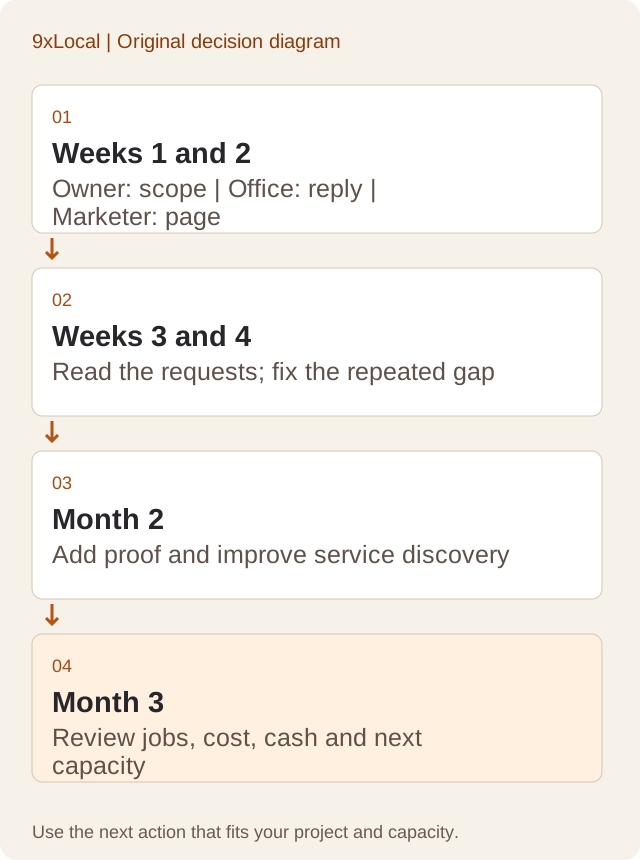
Weeks 1 and 2: make the first offer usable. The owner picks the service and supplies permitted project material. The office tests phone/form receipt and names appointment openings. The marketer repairs the destination and launches the chosen, funded work. Record the starting position so the next review has something to compare.
Weeks 3 and 4: check fit and response. Read the inquiries together. Is the scope right? Are the towns covered? Can people reach a conversation? Change one repeated problem at its source. If the page invites full renovations but most requests are small repairs, inspect both the ad promise and the first questions.
Month 2: strengthen proof and discovery. Add the strongest new project explanation, improve the main service page and use office questions to clarify the process. Our remodeling SEO guide explains that work; SEO services for remodelers covers the managed buying decision.
Expect SEO to take months. Ahrefs gives three to six months as a typical range in its industry poll, with longer waits possible. The first month should still show completed page and profile work you can inspect.
Month 3: decide what earns the next budget. Review the earliest inquiry groups alongside new ones. Which visits became planning, proposals or signed builds? Which are still open? Choose whether to continue, narrow or pause from job fit, cost and capacity. Keep finishing and payment as later outcomes where the work hasn't reached them yet.
One weekly conversation can keep that plan moving. Choose the next change and name who owns it. You don't need a new campaign every time the office has a quiet afternoon.
Use the guides for the next job
Go deeper where the current decision needs it. A directory purchase, for example, is different from running your own site and campaigns. Our Houzz for contractors guide separates its profile, software and advertising before you decide what to buy.
Keep the marketing calendar short enough to use. If your next task is fixing a form, don't postpone it while comparing five more channels. If the form and reply work but nobody sees the service page, choose one discovery task and get it live. The plan should make next week's work easier to pick.
Frequently asked questions
Which marketing channel should come first?
Choose one that matches the homeowner's stage. Search fits active hiring searches; visual social fits planned changes; professional introductions fit work needing early collaboration. Fix the page and first reply before adding spend.
Should I stop relying on referrals?
No. Make them deliberate and add a measurable direct source when you need more demand. Keep the relationships that produce work you want.
How many services should go in the first ad?
One main project type. Give it a matching image, page and next step. You can split or expand later when the inquiries and available budget justify it.
When should I judge the plan?
Review lead fit and response in the first weeks, then follow the same homeowners into later sales and finished jobs. Check completed tasks immediately; give long-cycle project outcomes the time they need.
Your next step
Fill in the one-project brief, test the inquiry path and choose one funded next move. Keep a reply owner, appointment space and review date beside it. That gives you a practical remodeling marketing plan to run next week.
Want it managed? Our remodeling marketing agency is your agency replacement for more booked jobs, with packages starting from $297/month and separate direct ad spend. We'll discuss the work you choose around your projects, area and next opening. See if we're a fit.
Sources
- BrightLocal: Local Consumer Review Survey 2026. Verified October 30, 2026. Broad local-consumer review readership.
- Ahrefs: How Long Does SEO Take? Verified October 30, 2026. General poll-based expectation, not a remodeler-specific deadline.