
Our remodeling marketing agency should work from those dates with you. The useful decision is whether the next inquiry has somewhere worthwhile to go.
Which stage is full?
Check four calendars: first calls, design/planning, estimating and crew starts. Write down the available slots and the person responsible for each. “We're busy” can mean very different things across those stages.
If the office has a backlog of unanswered inquiries, more traffic adds pressure immediately. If design is overloaded, booking extra planning calls can move the same queue one step further without creating capacity. If crews are full but the design team has room, a future-start offer may still fit.
Use the remodeling sales process to separate those stages. An initial call, a paid planning service and a building contract ask different things of your team.
Here's a fresh example. A renovation company has no crew start for eighteen weeks. Its designer can take another project now, while the estimator can handle three new conversations each week. That company faces a different choice from one with the same crew backlog and nobody available to discuss new work.
Mark the real constraint before touching the budget. The campaign should stop or change where the team can't deliver the advertised next step.
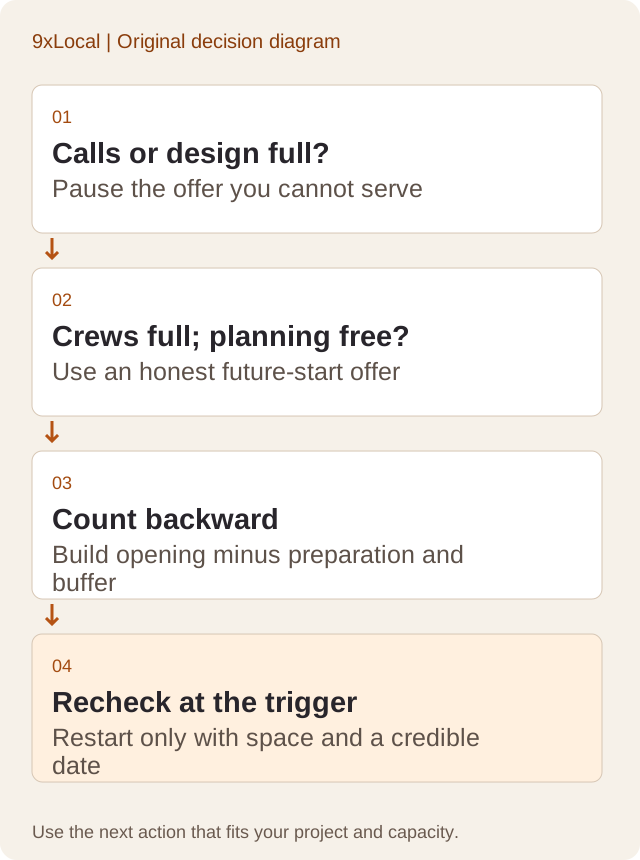
Work back from the next start
Take the weeks until the next build opening and subtract the usual time from first inquiry through sales, design and other preparation. Use your own recent projects and include the stages your company actually handles.
Example: eighteen weeks until the next crew opening minus eleven weeks of usual preparation leaves seven weeks before that preparation would normally need to start. If you also choose a two-week restart buffer, that leaves five weeks before the review trigger in this teaching scenario.
The tool separates that time calculation from the capacity decision. If calls or design have no space, it recommends pausing the unsupported scope even when the date arithmetic leaves room. A calendar calculation won't create a designer.
If the preparation period is longer than the weeks remaining, the advertised build date is already too tight under those assumptions. Move the date, improve a real bottleneck or stop offering that opening to new inquiries. Don't let an old ad promise an available start the team can no longer deliver.
Use a range from your own records when preparation varies. A homeowner with drawings and a defined scope may be further along than someone exploring a phased renovation. Plan the advertising around the stage you're willing to accept, then leave room for ordinary delays.
You don't need to turn this into a precise prediction. You need a date and capacity check strong enough to avoid pausing blindly or restarting in panic after the backlog disappears.
Pause, reduce or change the offer
Choose the action at service level. A company can pause immediate-start bathroom ads while still accepting future whole-home planning work. The office and pages must make that distinction clear.
| Capacity position | Campaign action | What the homeowner should hear |
|---|---|---|
| No response, planning or estimating room. | Pause that demand and repair the backlog. | An honest statement of what you're accepting. |
| Crews full, with planning room for a later build. | Test a smaller future-start offer. | Planning can begin before the stated build window. |
| An opening is approaching inside the preparation period. | Review restarting the relevant service now. | The next step and date the team can support. |
| One service is full, another has space. | Separate the budgets and messages. | The available service, rather than a generic “book now.” |
I'd pause an offer that's wasting homeowner time. I'd keep a future-start campaign only when the next conversation has value and a person owns it. Keeping a token daily budget just to feel active isn't a plan.
A waitlist can work if you manage it. Record the homeowner's project, preferred timing, contact choice and next review date. Explain what joining the list means. A list with nobody assigned to it only postpones the missed-reply problem.
The remodeling marketing plan helps choose the work to continue around a paid pause. Treat this as a capacity decision within that plan, rather than a reason to abandon every marketing task.
Tell homeowners the real timing
Make the ad, page and office response tell the same story. An immediate-start headline with a “maybe next year” first call creates frustration before you discuss the project.
Use current dates your team has supplied. If planning can begin now but construction starts later, explain both. This original offer shows the difference:
Future-start renovation offer
Planning a renovation for {real future season}?
Our next building openings are from {current window}. We can discuss {your accepted planning scope} now, including the decisions needed before an estimate. Tell us about your house in {service area}, and we'll explain whether the timing and work fit.
Keep the next step within your service. A first call can assess fit and explain the process; it shouldn't imply a guaranteed crew reservation, deposit arrangement or fixed construction price unless your business has supplied those terms.
Here is a matching response when an inquiry arrives:
Reply when crews are booked ahead
Thanks for asking about {project}. Our current building openings begin from {window}. We can still discuss {planning step} during {available period}. Does that timing work for you, or is there a deadline we should understand before arranging a call?If the schedule changes, update the active creative, destination and reply instructions together. Give someone responsibility for checking the dates each week while the offer runs. A careful launch won't protect you from an outdated availability line a month later.
Avoid fake scarcity. A truthful later start can help a homeowner plan; an invented “last slot” gives the office a promise it has to explain away.
Keep relationships alive while ads pause
A paid pause leaves plenty of worthwhile work. Keep business information accurate, repair the website, explain new projects and follow up with people who asked to return later.
Choose the next message from the homeowner's decision. Someone waiting for drawings needs a different response from someone who can proceed when your schedule opens. Use the contractor email follow-up guide for that distinction.
Ask when they'd like to hear from you again and record the answer. If they hired another contractor or ask you to stop, close the follow-up. A future-project list should help the office remember a commitment, rather than create an endless chase.
Keep partner relationships accurate too. Tell a designer which scopes and dates you're accepting so their next introduction fits. The contractor referral program gives you a short project-fit sheet you can update when capacity changes.
Use completed work as fresh proof while the team is busy. A short explanation of a phased renovation can answer questions for the next homeowner even when you're paying for fewer visits to the page. Keep permissions and your project role clear.
Set a restart trigger
Write down the conditions for restarting before the pause becomes a habit. I'd use three: the office can answer, design/estimating can take the next step and there's a credible future build opening you want to fill.
Put a person and date beside the review. The owner supplies the capacity; the marketer checks the campaign and page; the office tests the reply and available appointments. Restarting a campaign with last season's dates recreates the original problem.
For the eighteen-week example, the seven-week headroom and chosen two-week buffer create a review in five weeks. That date is a prompt to recheck the facts, not an automatic command to spend. If a current project slips or a designer leaves, the action can change.
If the future opening is already inside the normal preparation period, check the campaign now. You may need to restart the relevant service, adjust the available date or use existing interested homeowners first. The answer should come from the calendars and open projects.
Keep the first restart narrow. Use the service you want and the destination that explains it. For Search-specific help, Google Ads management for remodelers is the separate buying decision. For the execution steps, see Google Ads for remodelers.
Try the rule against two different weeks. In the first, a delayed current project takes the only designer back into revisions. Even though the future crew opening stays unchanged, pause the planning offer until someone can serve it. In the second, design has room and an existing prospect postpones their build. Review the future-start campaign because a real gap may be opening.
Those are separate reasons to act. The first protects a homeowner from a conversation the team can't deliver; the second helps fill work you're now able to accept. Neither decision comes from a fixed rule to keep every campaign on or off. Keep the note with the review so the next person can see why the budget changed.
Budget for a controlled restart
Set the spending limit alongside the appointment limit. A campaign with space for three conversations a week needs a different test from one with a free estimator and an empty pipeline.
Use your last comparable campaign as a starting point, then recheck the costs and message. A pause doesn't establish that all learning disappears or that the old results will return unchanged. Avoid either blanket claim. Verify the current account settings and judge the restarted inquiries as they arrive.
The calculator includes a simple spending view. Example: pausing $1,800/month in media for five weeks avoids about $2,080 of that scheduled media expense using an average month. That's cash not spent, rather than profit earned or the value of any future jobs forgone. Fees and other costs need their own treatment.
The tool's financial view can't decide whether a later job is worth pursuing. Use the remodeling marketing budget worksheet to check margin, full cost of winning the job and cash before funding the restart.
During the first review, read the requests. If homeowners need work earlier than you can offer, make the timing clearer or narrow the campaign. If the future projects fit but nobody books, listen to the reply and appointment choices before buying more reach.
Frequently asked questions
Should I stop every campaign when booked out?
Pause the work you can't serve. Keep future-project demand only where response, planning and estimating capacity remain. Separate services when their available dates differ.
Does pausing destroy all advertising learning?
Not usually. A pause can change delivery and the account may need a careful restart, but the decision still starts with capacity and economics. Inspect the current account rather than accepting a fear-based rule.
Should I advertise a waitlist?
Only if someone owns it. Give the homeowner honest timing, explain the next contact and record permission. A list nobody intends to work isn't a useful offer.
When should I restart?
Before the future gap reaches your usual sales and preparation period, with time for a controlled restart. Check call, design and estimating space first. Use the calculator with your own stage timing and buffer.
What if an existing job gets delayed?
Recheck the opening and update the message. If the new dates no longer support the offer, reduce or pause that scope. Tell homeowners already in conversation what changed through your normal project process.
Your next step
Put four calendars in front of the team, name the constraint and count backward from the next build opening. Choose one action for each advertised service: pause, reduce, change the offer or restart. Give the review a date and owner.
Want help keeping the campaigns and response aligned? Our remodeling marketing agency is your agency replacement for more booked jobs, with packages starting from $297/month and separate ad spend. Bring your real dates and the work you're ready to accept. See if we're a fit.