
Google Ads for remodelers should put your company in front of homeowners searching for the jobs you build. I'd start with one service, a matching project page and around $3,000/month in ad spend for a focused test, plus management and office costs, if your margins and cash allow it. Check Local Services Ads as well as Search. Our remodeling marketing agency can connect your selected ads, website and follow-up when you want the work run for you.
What Google Ads for remodelers cost
Start with the closest published category, then get local estimates for your job and towns. LocaliQ's 2025 US home-services Search study reports these medians across Google and Microsoft campaigns.
| Category | Cost per click | Cost per lead |
|---|---|---|
| Construction & Contractors (General) | $5.31 | $165.67 |
| All home services | $7.85 | $90.92 |
The study covers 3,211 campaigns from April 1, 2024 to March 21, 2025. These are separate category medians, not one campaign's funnel or a remodeling-only forecast. Use the general-contractor row as a comparison, not a quote for addition leads in your town.
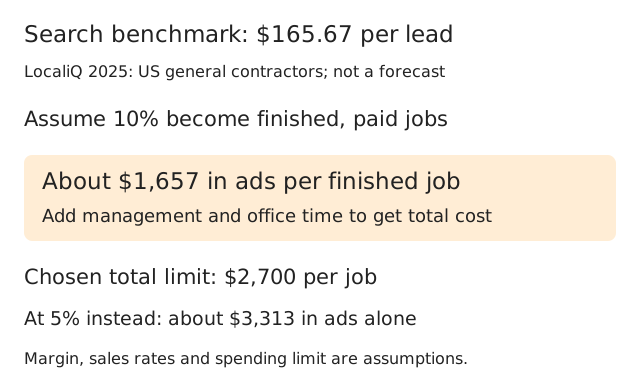
At $165.67 per lead, a $3,000 ad budget would produce about 18 leads. If 10% became finished, paid jobs, ad cost would be about $1,657 per job, before management and office time. The 10% is a teaching assumption. The full job-cost calculation and calculator are below.
I'd keep the first test to one service and a tight area. Choose an amount you can fund while selling and building current work. More budget can buy more chances to learn; it doesn't fix an ad for the wrong job.
Local Services Ads vs Search ads
Check both before deciding where the first budget goes. They charge differently and give you different control over the message.
| Local Services Ads | Search ads | |
|---|---|---|
| What you pay for | Valid leads through the ad. | Clicks on your search ad. |
| What the homeowner sees | Your business profile, services and contact options. | Headlines and text leading to your chosen page. |
| Main setup decision | Eligible category, service area and Google's screening requirements. | Job keywords, ads, budget and a page matching the search. |
| When I'd compare it | Your category is available locally and the service choices match the work you take. | You want to explain a specific addition, basement or whole-home service on its own page. |
Google lists general contractors among eligible US business types, but availability and checks depend on the business and area. Check your category and local options rather than assuming every remodeling service qualifies. A valid LSA lead still needs a sales conversation; paying per lead doesn't guarantee a signed project.
For an addition contractor, I'd compare the available LSA service choices with a focused addition Search campaign. For kitchens or bathrooms, make the advertised work clear enough to separate a full remodel from a small repair. Ask what the selected management scope covers before adding another ad product.
Keywords that bring the right jobs
Start with the job and town. These are starting ideas to check in your local forecast, not measured search volumes.
| Work you want | Starting searches |
|---|---|
| Additions | Home addition contractor [Town]; room addition builder [Town] |
| Kitchens | Kitchen remodeling contractor [Town] |
| Bathrooms | Bathroom remodeler [Town] |
| Basements | Basement finishing contractor [Town] |
| Whole-home | Whole-home remodeling [Town]; design build remodeler [Town] |
Put closely related terms in an ad group, a set of searches sharing an ad and destination page. Send addition searches to an addition page. Use a separate group and page for a kitchen or basement when you have enough budget to test it.
“General contractor” can bring a mix of projects and smaller jobs. Read the search terms, the words people typed before clicking, every week at first. Block clear mismatches such as careers, training, DIY, towns you don't cover and work you don't take. Those exclusions are called negative keywords. Keep planning-cost questions if they come from homeowners you can help.
2 real remodeler Search ads
These sponsored text results appeared for “home addition contractor chicago” on October 30, 2026. They show two ways to write the message, not proof of results.
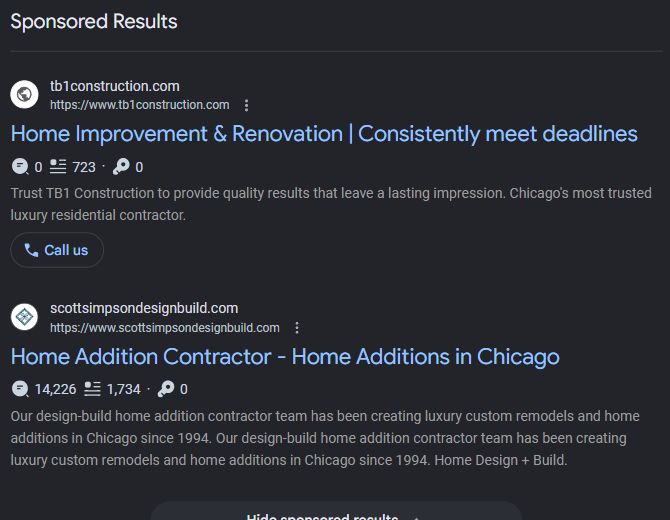
1. A broad renovation message. The first ad leads with “Home Improvement & Renovation” and a deadline promise, then offers a Call us button. The job family is clear, but an addition searcher still needs to work out whether it's for their project. Copy the visible call option; make the headline more specific to the job you want.
2. An addition and location headline. The second ad says “Home Addition Contractor - Home Additions in Chicago.” It follows with design-build wording. Copy that match between the searched job and headline, then use the description to explain your process and next step. I'd remove the repeated description so each line earns its place.
The search used English and US country settings; the browser's location signal was India. The city in the query doesn't make this a controlled Chicago search or a claim about local ad positions. The extra number rows come from browser SEO extensions, not the ads.
Make the ad and page match
Here's an original starting example, separate from the captured ads:
Home Additions in [Town]

See Comparable Work

Plan Your Consultation

Tell us your town and when you'd like to build. See how we approach additions and what happens before we prepare an estimate.
Show a similar job, your area, who handles drawings and what the first call covers. Use your own project and promises you can keep. The remodeling website design page shows how to build that first version and what to include.
Keep the form short: project, town, timing and contact details, with room for plans or a rough budget. Test a call and form before spending. Your selected follow-up can help get the consultation booked; your team assesses the property and prepares the estimate.
Set up one focused campaign
- Choose one job and area. Start where you can estimate and build the work.
- Check local click estimates. Set the budget and cash limit before launching.
- Group the job searches. Give each group a matching ad and page.
- Write the offer plainly. Name the job and town, show similar work and explain the first conversation.
- Test calls and forms. Confirm the office gets the details and knows who responds.
- Review the searches weekly. Fix mismatches and follow good leads through to signed work.
For homeowners who aren't searching yet, Facebook ads for remodelers can show transformations and start planning conversations. Keep SEO for remodelers working on the unpaid search side too.
Work out your cost per job
Keep the benchmark and your own job margin in the same budget conversation. Example: a $60,000 finished project at 30% gross margin leaves $18,000 after direct costs. Allow 15% of that for marketing and sales and you have a $2,700 all-in limit per finished, paid job. Those are teaching assumptions; NAHB's remodeler research separates gross profit from net profit.
Now use the sourced general-contractor CPL:
| Calculation | Result |
|---|---|
| $3,000 ad spend / $165.67 per lead | About 18 leads |
| $165.67 / assumed 10% lead-to-finished-job rate | About $1,657 ad spend per finished job |
| ($3,000 ads + $1,000 assumed fees and handling) / about 1.81 modeled jobs | About $2,209 total per finished job |
| At only a 5% lead-to-finished-job rate, with the same costs | About $4,418 total per finished job |
The 10% case fits the chosen $2,700 limit; the 5% case exceeds it. That's why the sales and build outcome matters as much as the click price. Fractional jobs are planning averages across repeated leads, not half a signed contract or a sale promised this month.
Open the click-to-job calculator and replace the inputs with your own. It starts at the sourced $5.31 CPC and an inquiry rate of about 3.2% to approximate the $165.67 CPL comparison. That inquiry rate is a worksheet input, not LocaliQ's measured conversion rate. The two reported medians don't describe one observed campaign.
Fees and office handling start at $0 in the calculator so you can see media cost first. Enter your selected fee and estimating time before making the spending decision. With zero inquiries or finished jobs, keep the spending and pending work visible until a job-cost comparison is possible.
Track the leads in one place
Compare remodeling lead sources when deciding which channel should get the next budget.
Keep one record per homeowner: source, requested job, conversation, consultation, proposal, signed build and later completion and payment. Google supports measuring deeper lead stages; a platform's converted lead can still be short of finished construction.
Each week, look at the searches bought and ask the office which leads fit. Fix unwanted searches, missed replies or a page that doesn't explain the job. Keep the lead's first-contact month with later outcomes so you compare the same spending and jobs. Increase spend when the job cost fits your margin and you have room to take more work.
Frequently asked questions
What do Google Ads for remodelers cost per lead?
LocaliQ's 2025 general-contractor Search median is $165.67 per lead, with a $5.31 median click cost. These are separate benchmarks from a US Google and Microsoft sample. Use local estimates and your own results for the spending plan.
What budget would you start with?
Around $3,000/month in ads for one focused test, plus management and office handling, if your job margins and cash support it. It's a starting recommendation, not a Google minimum.
Should I use Local Services Ads or Search?
Compare both if your business and area are eligible for LSA. LSA charges for valid leads; Search charges for clicks and lets you build the message and page around a specific remodeling job.
When should I scale?
When the leads match your work, enough jobs have moved through the sale and build to check costs, and the team has room. Keep the test within your cash limit while those jobs progress.
Your next step
Choose one remodeling service, check the local Search forecast and LSA options, and show a project that matches. Test the first reply and booking, then work out the job cost your margin can support.
Want it run for you? 9xLocal is your agency replacement for more booked jobs, with selected ads, website work and follow-up in packages starting from $297/month. Ad spend is separate and paid directly without markup. See if we're a fit.
Last updated: October 30, 2026.
Sources
- LocaliQ: 2025 Home Services Search Advertising Benchmarks. Verified October 30, 2026.