
Our remodeling marketing agency should make those costs clear before you buy. A budget is useful when it tells you what to fund, what to fix and when to stop spending.
Separate the four costs
Give the budget four lines: platform media, the marketing service you choose, optional tools and the office/estimating work needed to turn inquiries into jobs. Keep the costs visible even when one person supplies several services.
The media is what you pay Google or Meta to show ads. The service fee pays for the setup you choose and ongoing work. Tools may add another charge. Calls, visits, travel and proposals take your team's time whether or not they appear on a supplier invoice.
9xLocal packages start from $297/month, with no separate setup or website build fee. Ad spend is separate, paid directly to the platform without markup. The quote defines the work you choose. The starting package price isn't the full budget for getting leads when the plan includes paid media and office handling.
Use a worksheet before comparing proposals:
| Budget line | What to include | Question to answer |
|---|---|---|
| Platform media | The funded Google or Facebook/Instagram campaign. | Can we afford the test while jobs move through sales? |
| Selected service | Management, website or other chosen work. | What tasks and support are included? |
| Optional tools | Software or extras the plan needs. | Is this necessary now, and is it already covered? |
| Office and estimating | Reply, qualification, visits and proposal effort. | Who does it, and how much time does it use? |
For a broad service-price comparison, Clutch lists PPC company rates of $100 to $149/hour in its 2026 guide. That's management work across its platform, rather than a remodeling monthly fee or the cost of a lead. Compare a quote against the tasks you'll receive.
Set a gross-profit ceiling for winning the job
Start with what a job leaves after direct job costs. Revenue pays for materials, trade work and labor before it can pay for marketing. Gross profit then still has to cover overhead and net profit.
NAHB reports average gross margin of 29.9% and net margin of 6.3% for residential remodelers in 2024. Those dated study figures aren't your company's margin or a recommended marketing allocation. They show why treating the full contract value as money available for advertising is a mistake.
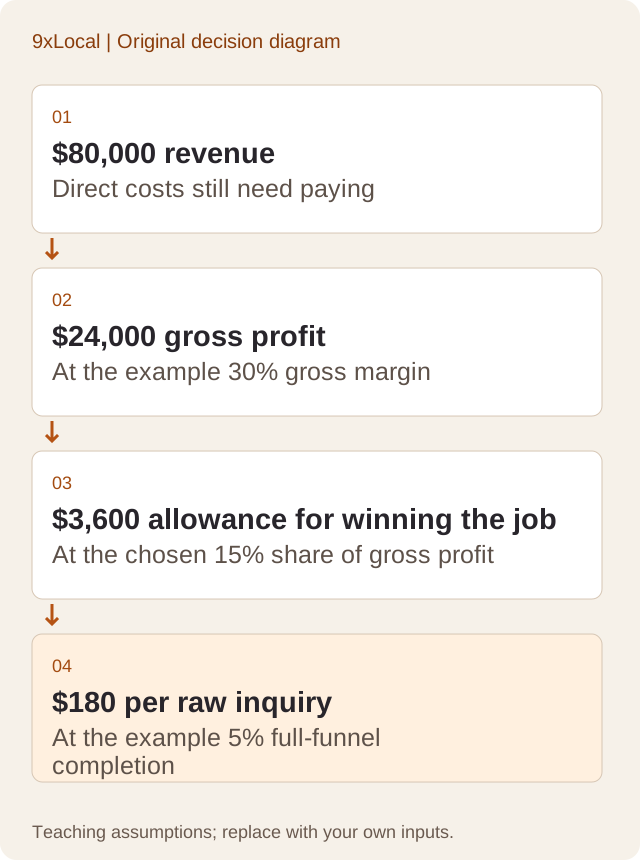
Here's a fresh teaching scenario for this worksheet. An $80,000 finished renovation at 30% gross margin leaves $24,000 after direct job costs. If you choose to allow 15% of that gross profit for winning the job, the limit is $3,600 per finished, paid project.
That chosen limit isn't a target to spend automatically. You still need enough left for overhead, profit and ordinary business uncertainty. Use your own accounting and sales records to set the allowance.
At an assumed 25% rate from attended consultation to finished, paid job, the same allowance is $900 per attended consultation. Four attended visits would produce one modeled completion under that assumption. Individual groups of four visits can produce no sale or more than one; use the model for planning and observed jobs for review.
Model the full inquiry funnel
A raw inquiry has several steps left before it becomes a finished job. Multiply the stage rates instead of applying the consultation close rate to every name that enters the inbox.
Use these teaching assumptions:
- Half the inquiries fit the service, area and basic project requirements.
- Half of those book a consultation.
- Four in five booked consultations happen.
- One in four attended consultations reaches a finished, paid job.
Multiplying 50% by 50% by 80% by 25% gives 5% from raw inquiry to finished, paid project. With the $3,600 job allowance, the all-in raw-inquiry limit is $180.
Put another way, one hundred modeled inquiries would lead to fifty that fit, twenty-five bookings, twenty attended visits and five finished jobs under those assumptions. Keep your own stage definitions consistent so the multiplication means something.
The calculator shows the job allowance, attended-visit allowance and raw-inquiry allowance together. Change any stage and you'll see why a cheap form can still produce expensive work. A zero stage gives no finite path to a finished job under the inputs; the tool asks you to fix that stage rather than inventing a profitable lead price.
For the original group of inquiries, keep the first-contact month beside later sales. A job still in planning belongs in open work. Record signed builds as an earlier sales outcome and completion/payment separately.
The remodeling sales process helps define the stages. The remodeling lead-source comparison helps compare sources with the same costs and starting point.
Allow for the cash delay
Check how much you can fund before expecting spending to win the job to be covered. A profitable-looking completed-job model can still be unaffordable if cash runs out while drawings, sales and building progress.
Example: $1,500 in monthly media, a hypothetical $450 selected service and $350 in handling use $2,300/month. Four months of that plan need $9,200. That's a marketing funding scenario, separate from the cash needed to deliver construction.
Use unrestricted cash available for the test. Keep money committed to current jobs, taxes and your chosen operating reserve protected. A planning deposit may already need to pay for design; a signed contract may have payment stages that leave little cash free for marketing.
The tool compares monthly spending to get leads with the funding period you enter. It also lets you protect a reserve before calculating how many months the remaining cash supports. Enter the period from your own cash plan, rather than a national sales-cycle claim.
If the funded period is shorter than the time you need, reduce the test, choose a lower-cash approach or wait. Don't borrow the current job's materials budget to keep an experiment looking active.
Set a maximum cash loss before launch and name who can stop spending. That limit keeps a promising conversation from turning into an open-ended test no one remembers authorizing.
Choose one focused starting test
Choose the source that fits the buyer and the evidence you have. A company with good project photos and planning capacity can test a visual social offer. A contractor seeing active local hiring searches can test Search. A firm with strong professional relationships may get its best next conversations from referrals first.
Social: one visible project and a clear invitation
I'd start around $1,500/month in media for a focused Facebook/Instagram test when the business can fund it. Show your own work and ask about a specific renovation need. Keep the invitation clear: a project conversation, guide or planning service leads to different follow-up.
Use the Facebook ads for remodelers guide for offers and qualification. The first budget should buy a test your office can answer, rather than cover every service and town at once.
Search: match the hiring query and page
I'd discuss around $3,000/month in media for one focused Search test, then check a local forecast for the actual job and area. Search needs a matching service page and tested calls/forms. The Google Ads for remodelers guide covers that setup; Google Ads management covers the service purchase.
LocaliQ reports about $166 per lead for Construction & Contractors (General) in its 2025 US home-services Search study. Its sample covered 3,211 campaigns from April 2024 to March 2025, and its averages are medians. That's a broad category comparison, rather than an addition-lead quote for your town.
Use that figure as a stress test, keeping media and total costs separate. Example: $3,200 in media at about $166 per inquiry models about nineteen inquiries. Add $650 in assumed management and $650 in office handling, and total spending is $4,500. At the assumed 5% completion rate, modeled cost per finished job is about $4,670, above the chosen $3,600 allowance.
That scenario fails even though the media lead price comes from a recognized benchmark. The management and handling amounts are teaching inputs, and the benchmark isn't one observed campaign funnel. More spend at the same unit cost won't make the job affordable.
Referrals and search foundations: less media, still work
When the cash or proof isn't ready for ads, start with compatible partners, past customers and the main service page. The contractor referral program supplies the introduction scripts; the remodeling SEO guide helps prioritize unpaid discovery.
Organic-only service can use $0 ad spend. The offer also permits media from $10/day, but that funds a smaller test with less evidence. Neither choice makes office effort or ongoing service free. Match the plan to the money and time you can commit.
Check lower, middle and higher costs
Use sensitivity cases to see what would change the decision. Keep the same 5% completion assumption and $3,600 finished-job allowance, then change only the all-in inquiry cost.
| All-in cost per inquiry | Modeled cost per finished job | Decision against the example allowance |
|---|---|---|
| $90 | $1,800 | Below the $3,600 limit; check capacity and cash too. |
| $180 | $3,600 | At the limit; little room for worse results. |
| $300 | $6,000 | Above the limit; repair the economics before expanding. |
These are editable scenarios, not low-, medium- and high-cost cities. Your account's inquiries, stage rates and job margins decide where you sit.
Check the weakest plausible case before launch. If a slower reply rate or lower attendance pushes the cost of winning the job above the allowance, plan how you'll detect and repair it. Use recent comparable jobs where you have them; keep uncertain inputs visible where you don't.
You can also improve the unit economics without buying cheaper clicks. Clearer scope can reduce wrong-fit requests. Better first replies can move more fitting homeowners into conversations. A relevant project page can help people understand the service before calling. Test the gap you can observe, rather than assuming the whole funnel improves together.
Continue, fix or stop
Continue when the inquiries match the work, the team can serve them and mature job costs fit the allowance. Fund the next step within the cash limit. A good week alone isn't a reason to double every budget.
Fix a repeated bottleneck before expanding. Wrong-town requests point to targeting or coverage. Missed conversations point to response. Good visits that stall need a look at scope, pricing and proposal questions. Choose one change and record when it happened.
Stop or narrow a test that's threatening the cash reserve or repeatedly buying work you can't take. If every estimator is overloaded, use the booked-out advertising decision before increasing demand. Available crew time later doesn't solve a full design calendar today.
Review early stages while projects mature, but keep their limits clear. Four new visits with no finished job yet can't establish the final completion rate of a long renovation sale. Equally, pending projects shouldn't excuse unlimited spending beyond the loss limit.
Keep source, date, cost, job type and next action with each homeowner. That gives you enough evidence to decide whether the next dollar belongs in the same source, a repair or the reserve.
Frequently asked questions
How much should I start with?
Around $1,500/month in social media spend or $3,000/month in focused Search media, plus service and office costs, when the job economics and cash support it. Choose a smaller or organic-first plan if they don't.
Should I use a percentage of revenue?
Use gross profit and cost of winning the job first, then use revenue percentage as a sense check. The same revenue can leave very different amounts after direct job costs, overhead and the time needed to win the work.
Is $297 the complete marketing budget?
No. It's the 9xLocal starting package price for chosen work. Paid media, any additional work you choose and your sales effort need their own lines. There is no separate setup or website build fee.
What's the maximum lead cost in this example?
$180 all-in per raw inquiry, using the $3,600 finished-job allowance and assumed 5% inquiry-to-finished-job rate. Media-only lead cost needs to be lower when fees and handling must fit inside that allowance.
What if no jobs have finished yet?
Show the spending, attended visits, signed work and open projects separately. Mark final job cost as pending. Use your cash limit and lead-fit evidence for the current decision while the outcomes develop.
Your next step
Put one service into the calculator with your margin, stage rates, monthly costs and available test cash. Write the loss limit and review date before launch. Start with a funded test that can survive the slower case, then use the results to choose the next budget.
Want help joining the plan together? Our remodeling marketing agency is your agency replacement for more booked jobs, with packages starting from $297/month and separate direct ad spend. Bring the work you want, your available dates and the budget you can fund. See if we're a fit.
Sources
- Clutch: PPC Pricing Guide 2026. Verified October 30, 2026. Broad management hourly range.
- NAHB: Home Remodeling Profit Margin Jumps on Demand and Business Practices. Verified October 30, 2026. Residential-remodeler 2024 gross and net margins.
- LocaliQ: 2025 Home Services Search Advertising Benchmarks. Verified October 30, 2026. General-contractor lead median and sample period.