
Contractor email marketing works best when the message matches the job and the next decision. Start with new inquiries and open proposals before building a monthly newsletter. A homeowner waiting for a kitchen estimate needs a clear answer about their kitchen, not a general article about home improvement.
Start in your existing inbox with a shared list of next actions. You can add software when reminders, lists and opt-outs need more support.
Our remodeling marketing agency can connect your selected marketing, website and lead follow-up. The six messages below give your office a practical starting point for the conversations it already has.
Start with these 6 emails
Use one message at the right stage. Replace every item in braces before sending, add your normal business signature and change the wording to match the conversation. These are original examples for remodeling contractors, not messages from a client account.
1. Reply to a new remodeling inquiry
Subject: Your {kitchen/addition/bathroom} project in {town}

Hi {first name},

Thanks for getting in touch about your {job type}. What's the main thing you'd like to change in the space?

We handle {relevant scope} in {area}. A short call will help us understand the job and explain the next step. Are you free {time one} or {time two}?

If you've got a few photos or drawings, you can reply with them here. Rough ideas are fine for the first conversation.

{name}, {company}
This gives them something easy to answer. If the form already contains photos and scope, acknowledge those details instead of asking for them again. You're showing that someone read the inquiry.
2. Prepare for the consultation
Subject: What we'll cover at your {day} visit

Hi {first name},

We're booked for {day and time} at {address} to discuss {project}.

We'll look at the space, talk through the changes you want and explain how we handle design and pricing. Please bring any drawings or inspiration photos you'd like us to see.

It helps if anyone making decisions about the layout or budget can join us. Is there one question you'd most like answered during the visit?

{name}, {company}
Tell them if the visit is paid and what it includes, using the terms you've already explained. For a whole-home remodel, they may want to discuss living arrangements. For a basement, they may need help deciding whether to include a bathroom. Let that question shape the meeting.
3. Send the proposal with a meeting
Subject: Your {project} proposal and next step

Hi {first name},

Here's the proposal for {project}. It covers {main scope} and shows {important option or allowance} separately.

I'd like to walk you through it so you can ask questions about the price, choices and timing. Would {time one} or {time two} work for a short call?

You mentioned {homeowner priority} at the visit. I've pointed out the part of the proposal that addresses it: {section or page}.

{name}, {company}
The meeting is the request. You're helping them understand a purchase that changes their house. Include the promised file or link and test that it opens before sending.
4. Follow up on one scope choice
Subject: Keep the wall or open the kitchen?

Hi {first name},

You were deciding whether to keep the wall between the kitchen and dining room. We've shown both choices in the proposal.

Keeping it means {scope difference}. Opening it means {scope difference and relevant work}. Would you like to compare those choices together before deciding?

I can call {time}. If another day is better, reply with a time that works for you.

{name}, {company}
Choose a subject that belongs to their job. For an addition, it might be the connection to the existing living room. For a bathroom, it might be keeping the plumbing in place. A specific question gives the homeowner a reason to reply.
5. Return on the date they chose
Subject: Picking up your {basement} plans

Hi {first name},

When we spoke in {month}, you asked me to get back in touch around now about {project}.

Are you still thinking about {main change}, or have your plans moved on? If you're ready, we can review the scope and talk about the next step.

Our current timing is {truthful update}. What would you like to do from here?

{name}, {company}
This message earns its place because the homeowner asked for it. Update the timing and any old price assumptions before sending. A six-month-old proposal may need another look before you offer a start date.
6. Close an unanswered conversation
Subject: Shall I close your {project} file for now?

Hi {first name},

I haven't heard back about {project}, so I'll close the open follow-up for now.

If you're still planning the work, you're welcome to reply when you're ready. If you've chosen another contractor or put it on hold, a quick note will help us keep our records straight.

Thanks for considering us,

{name}, {company}
Keep it calm. There's no need to invent a deadline or imply that the price disappears tonight. You'll leave the door open without filling the office's task list with unanswered threads.
Use a simple follow-up schedule
Start with a prompt reply, one follow-up after three business days and another seven business days later if the conversation is still open. Then use the date the homeowner chooses or close the unanswered task. That's a starting schedule I'd test, not a research-backed best frequency.
| Situation | When I'd send | The next action |
|---|---|---|
| New inquiry | As soon as the office can reply. | Book a short call or answer the question. |
| Visit booked | Before the appointment, with time to prepare. | Make sure the homeowner knows what to expect. |
| Proposal delivered | At the promised delivery time. | Offer the proposal discussion. |
| No reply | After three business days, then seven more. | Address one open question, then choose a date or close. |
| Homeowner asks for later contact | On their chosen date. | Ask whether the plan is still moving. |
| They reply or decide | When that happens. | Stop the old sequence and deal with the answer. |
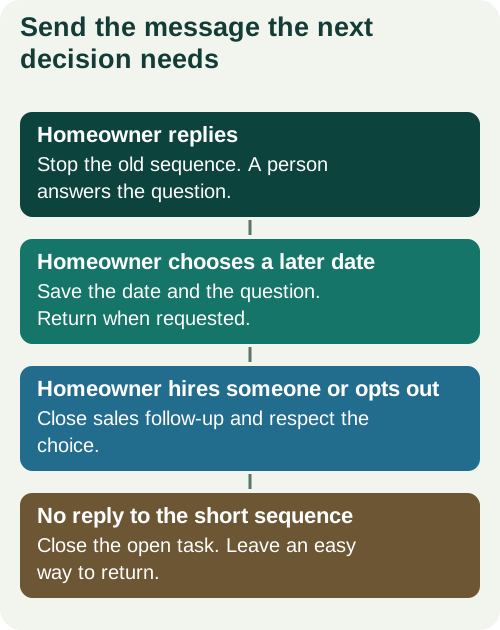
Before switching on automation, give each stage a person responsible. Use the system to remind the office who needs a call. A reply about a structural concern, finance delay or changed scope needs a person who understands the job.
One rule prevents a lot of awkward messages: a reply stops the old sequence. If you've booked the visit by phone, cancel the email asking them to book. If they hired another builder, close the sales follow-up. Your messages should sound like one company talking to one homeowner.
Use the remodeling sales process to decide which stage they're in. Email then supports that process instead of becoming a separate task nobody owns.
Show one project that answers the question
Send one relevant example with a short explanation. You don't need a long newsletter to show that you've handled a similar problem.
Before
“See our latest stunning transformations and discover the possibilities for your dream home.”
After
“You asked how an addition could connect to your kitchen. This project shows how we opened the back wall and joined the new room to the existing space. Here's what changed and what the homeowner kept.”
Use that second version only when it describes your own work. Add the photo or project-page link and invite a question. You can explain a bathroom layout, a basement stair position or a whole-home phasing choice the same way.
A good project page carries the detail: starting problem, scope, photos and the work your team handled. The email's job is to explain why you're sending it. Our remodeling website design page shows how those pages fit together.
Keep a small set of examples the office can find. Label them by job and question: addition connection, kitchen layout, bathroom storage, basement bathroom, whole-home disruption. That saves the owner searching through a phone full of photos whenever a lead asks a common question.
Keep past customers in a separate list
Separate open sales conversations from past customers. A homeowner whose bathroom you finished last month needs a different message from someone still comparing estimates.
For past customers, choose a reason to contact them: checking an unresolved issue, asking for an honest review, requesting a referral or discussing another room they mentioned. Handle service problems first. A sales email after an unanswered repair question sends the wrong message.
A referral request can be short:
“Hi {first name}, we're taking inquiries for {job type} in {area}. If someone you know is planning similar work, they're welcome to contact {name and number}. Thanks again for having us work on your home.”Send it when it matches the relationship and your marketing permissions. Avoid making every old customer part of every campaign. A general contractor who handles kitchens and additions can choose the group most likely to recognize the work being offered.
Set up the inbox and footer once
Use a recognizable sender, a working reply address and a footer your office can maintain. Ask your email provider to check domain authentication. Google's Gmail guidelines require SPF or DKIM for all senders, with stricter requirements for bulk senders. Let the provider handle the settings; the office needs to know that mail arrives and replies reach someone.
For US commercial email, the FTC requires accurate sender details and subject lines, clear advertising identification where required, a valid postal address and an easy way to opt out, with requests honored promptly. The message's main purpose matters when separating service mail from marketing. Start with people who asked to hear from you and keep their choices recorded; bought lists make that job harder.
Before sending a batch, test one message on a phone. Check the name, job details, attachment, links, signature and reply address. Read it aloud. If you'd feel odd saying it to the homeowner, rewrite it.
Judge replies and jobs
Count the answers that move work forward. Opens can help spot delivery issues, but they don't tell you whether someone wants an estimate. Mailchimp explains that privacy and bot activity can inflate open and click figures.
For a teaching example, suppose the office follows up on 40 open proposals. Ten homeowners reply, four book another conversation or visit and two eventually finish and pay for a job. Those are three different outcomes. The two jobs may also have involved phone calls, earlier visits and other marketing, so email alone hasn't earned all the credit.
Ask: Did they reply? What did they need? Was another appointment booked? Did the job get signed? Was it eventually finished and paid? A month of replies is enough to improve your messages even while larger projects are still being planned.
Compare messages at the same stage. A reminder for tomorrow's visit should get a different response from a note about a project planned for next spring. You'll make better changes when you know what each email was meant to do.
A 30-minute weekly routine
Give the office a short weekly appointment for follow-up. I'd use the first ten minutes to check overdue replies and booked visits, the next ten for open proposals and the last ten for dates homeowners asked you to revisit. Adjust that split to your workload.
Each open project needs a name, job, stage, next action, person responsible and date. Keep the customer's question in their words. “Waiting for spouse to review the kitchen layout” tells the next person what to do. “Nurture lead” leaves them guessing.
Bring the owner in for price, scope and scheduling decisions the office can't answer. Over time, save the answers to repeated questions as short examples the office can adapt. That's how follow-up gets easier without sounding automatic.
Frequently asked questions
How often should contractors email a lead?
Start with the next decision and a short schedule. A prompt reply, a three-business-day follow-up and another seven business days later is one plan to test. A homeowner's chosen date takes priority over that default.
Should we automate every email?
Automate reminders and routine preparation messages first. Have a person handle replies about scope, price, problems and timing. You'll get more value from a small sequence that stops correctly than a long sequence the office forgets to update.
What should we send in a monthly newsletter?
Send one relevant project or answer if you've got something worth sharing. Start with active inquiries and proposals before adding a newsletter. They're already asking about work, and clearer replies can help them decide.
What does this cost to start?
Use your existing inbox and a shared follow-up list first. The main cost is staff time. Add email software when list management, reminders or opt-outs need more support, and price that tool against the work it saves.
Your next step
Choose ten open conversations and send the message that answers each person's next question. Put the next date and reply owner beside the job. If you want the website, selected marketing and booking follow-up connected, see 9xLocal's remodeling marketing service. Packages start from $297/month, with no setup or build fee. Ask which services belong in your selected package.