
Our remodeling marketing agency can support the website and follow-up behind those introductions. The relationships still grow from your work, reliability and the next conversation your team delivers.
Choose complementary partners
Choose people whose work meets yours at the right stage. For a remodeler taking larger renovations, that could be a designer, architect, realtor or a trade contractor who regularly sees projects beyond their own scope.
Start with overlap in job type and area. An architect working on major alterations may need a builder who can discuss construction early. A realtor helping buyers assess older homes may need someone who can explain a renovation process without promising a price before assessment.
Your role needs to be clear too. If you build from another professional's drawings, say so. If you provide design-build work, explain how the design responsibility works. A partner should understand where you help and where their own role continues.
| Referral source | Best opening conversation | Make the introduction easy |
|---|---|---|
| Past homeowner | Someone planning work like the project you completed. | A relevant project page they can choose to share. |
| Designer or architect | Your scope, area and point of early collaboration. | A fit sheet and named construction contact. |
| Realtor | Renovations their buyers or sellers often ask about. | A clear first-call process and honest availability. |
| Adjacent trade | Larger work outside their normal service. | The jobs you accept and decline, with a reply owner. |
Don't promise reciprocal work just to secure a name. A useful introduction goes to the professional who fits the homeowner's need. The relationship can be valuable without an equal exchange of contacts every month.
Choose three names and learn how each person works. A short, specific conversation with a compatible partner is a better starting move than a large generic email blast.
Create a one-page project-fit sheet
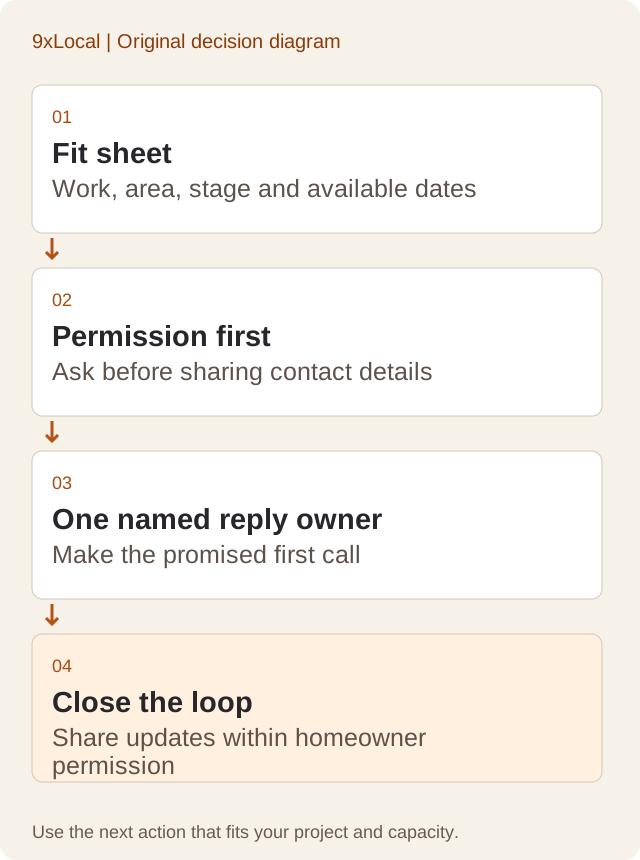
Make it possible for someone to recognize your next job without remembering a long service list. Keep the sheet short enough to forward with an introduction.
Include the work you do, work you decline, towns covered, design stage accepted, next planning window and named contact. Add a comparable project you can show. Use your own minimum project scope only if it's based on how you price and deliver the work.
Here's an original outline to fill with your facts:
Project-fit sheet for a remodeling partner
{Business}: renovation introductions
We handle: {multi-room renovations/additions/your defined work}
We don't handle: {small repairs or other exclusions}
Area: {real towns served}
Design stage: {exploring options / drawings ready / your accepted stages}
Our role: {what we design, build or manage}
Current planning window: {honest availability}
Comparable project: {your own project page}
First contact: {name, role, phone and email}
First step: {what the homeowner receives from the initial conversation}
Use the remodeling website guide to make that project page worth sharing. The image needs the starting problem, scope and your role. A partner shouldn't have to explain a photo on your behalf.
Keep availability current. A sheet saying “we can start soon” becomes a problem when your team is booked through the season. Planning availability can be different from the first crew opening; name both when that changes the introduction.
Ask customers for optional introductions
Ask at a natural point after you've delivered something the homeowner values. That might be the completed project or a resolved milestone. Keep the invitation small and easy to decline.
A customer can share a project page without giving you a friend's private contact details. That's often the easiest first step. Let the prospective homeowner choose to get in touch.
Optional referral invitation to a past customer
Hi {first name}, we're glad {specific improvement from their project} is working well for you. If someone you know is planning a similar {project type}, you're welcome to share this page: {your project link}. It explains the work and how our first conversation works. There's no need to send anyone's details; they can contact {named person} when they're ready.Change the project detail so it sounds like you remember the job. A generic “send us three friends” message puts work onto the customer and can feel like a condition attached to your service.
Keep a review invitation separate. Ask for honest feedback in the customer's words, without a reward or positive-rating condition. A referral and a public review serve different purposes, and combining the requests can confuse the customer about what you're asking for.
Make the introduction with permission
Ask permission before sharing a homeowner's contact details with a professional. Start with the minimum context needed: project, town, current stage and the conversation being requested.
For a new design partner, ask whether your capability sheet would help before sending a pile of portfolio files. This original email gives the professional a clear reason to reply:
Email to a potential design partner
Subject: Construction input for {relevant project type} in {area}

Hi {name}, I noticed your work on {specific, accurate project or specialty}. We build {your scope} in {real area}, and we're open to early conversations when a project needs practical construction input before the scope goes further.
Would a short sheet showing our role, comparable work and current planning availability be helpful? I'd also like to understand when you prefer a builder involved and how you keep design responsibilities clear.
{Your name and business contact details}
Make it personal without inventing familiarity. If you haven't inspected a relevant project, remove that line and explain the overlap plainly. Start with people you have a credible reason to contact. Commercial email needs truthful identity and subject lines, clear promotional identification, a valid postal address and an easy opt-out; honor the recipient's choices.
Once the homeowner wants the connection, make the next step explicit:
Introduction after the homeowner has said yes
Subject: Introduction: {homeowner} and {builder}, {project type}

Hi {homeowner} and {builder}, with {homeowner}'s permission, I'm connecting you about {brief scope} in {town}. The next question is {planning or construction question they want to discuss}.
{Builder}, please contact {homeowner} by {agreed method} about the first conversation and your current timing. I'll leave the project details with you both unless you'd like me involved in a specific design question.
{Referrer's name}
Give the office a named owner and backup for referred inquiries. Save who introduced the homeowner and what was promised next. Use the remodeling sales process for the fit call and planning choices that follow.
Rewards and professional boundaries
Start without a cash incentive. A reliable first response, clear project fit and respect for the partner's role are valuable reasons to introduce you.
If you're considering a reward, check the professional and state restrictions, required disclosures and your own terms for that arrangement before offering it. An architect, realtor and past homeowner can face different constraints. Don't apply one blanket reward plan to all three.
Write the trigger clearly: what action would earn the reward, when it's paid, who qualifies and what happens if the project doesn't proceed. Keep it affordable from the job margin. A thank-you after completed work still needs clear terms if you've promised it in advance.
Keep rewards separate from reviews, ratings and prescribed praise. The homeowner should be free to describe their experience honestly. Good construction and a dependable introduction should stand on their own.
Track referrals through to jobs
Use one small record per introduction. Save the source, homeowner permission, scope, town, next action, person responsible and date. Add the sales stage as the conversation progresses.
Here's a fresh teaching example for a six-month review: ten introductions become six projects that fit, four attended consultations, two signed builds and one finished, paid job. Another signed build remains underway. That's one completion at the review date, with another outcome still to come.
The numbers help you ask better questions. Which partners recognized the scope well? Did anyone wait for a reply? Were the unsuccessful visits for work you should have declined earlier? One completed project isn't an industry referral close rate.
Keep the timing fair. An introduction received near the review date has had less time to progress than one received months earlier. Follow the original inquiry groups rather than comparing a new referral with a mature paid campaign.
Record the reason for a mismatch. “Outside our travel area” gives the partner something to change. “Not our kind of job” leaves them guessing and can discourage a better introduction later.
What your referral effort costs
Include the time that makes the relationship work. Meetings, project-sheet updates, introductory calls and estimating all use resources, even when no money changes hands for a name.
Example: over six months, you spend twelve hours on partner relationships, value that time at $75/hour and spend $150 on a small event. That's $1,050 before any separate project-estimating effort. One finished job gives a $1,050 cost of winning the job at that review; two bring it to $525 each.
Those are teaching inputs, not a recommended reward or owner hourly rate. Add the costs your comparison needs. If a paid-channel calculation includes estimating time, the referral calculation should include it too.
With no finished projects yet, keep the money, time and open work visible. The tool shows job cost as pending rather than dividing by zero. Use the remodeling budget worksheet if you need to set the amount a job can support before expanding the program.
Compare that effort with a source you might otherwise buy. Our remodeling lead-source guide helps separate contacts, appointments and jobs. Referrals should win on the work and full cost, rather than being called free by default.
Keep partners informed
Close the loop within the homeowner's permission. A professional who made a careful introduction should know whether the promised first contact happened. They don't automatically need private budget, drawings or contract details.
An update can be brief: the team has spoken, the project fits and the next planning conversation is arranged. Ask the homeowner before sharing more. If the project doesn't fit, explain the scope or area boundary politely and thank the partner for the introduction.
Use a clear decline when a request is outside the work you take:
Decline an introduction without losing the relationship
Thanks for thinking of us for {project}. We focus on {your scope}, so {requested work} is outside the work we're taking. I've explained that to {homeowner} and haven't booked a visit. Please keep us in mind for {clear future fit}; here's the short project sheet to make that easier.When a homeowner wants to return later, choose a next-contact date together. The contractor email guide helps match that message to the decision still open. Keep the relationship warm through relevance and reliability, rather than repeated “checking in” messages.
Review the partner list periodically. Keep the people whose work fits and whose introductions you can serve well. If repeated requests miss the scope, improve the sheet or pause the referral ask before blaming the source.
Frequently asked questions
Do I have to pay for referrals?
No. Start with clear fit, relevant proof and dependable follow-up. Consider a reward only when it fits the relationship, economics and applicable rules.
Who should I approach first?
Start with happy customers and complementary professionals who know your work or regularly meet the right homeowners. Choose three compatible relationships before building a large list.
Can I reward a positive review instead?
No. Keep review requests neutral and unrewarded. A referral incentive should never depend on a public rating or prescribed review wording.
What should I track?
Track the introduction, permission, scope, response, attended conversation and eventual signed and finished work. Include relationship and estimating effort when comparing costs.
Your next step
Choose three names, fill the fit sheet and give every introduction a reply owner. Use one script that fits the relationship, then review the next conversations before adding a reward scheme.
If the website and response need support, our remodeling marketing agency is your agency replacement for more booked jobs. Packages start from $297/month, with selected marketing, website work and follow-up; ad spend is separate. See if we're a fit.