I'd start with the sector you want more work in, then fix the pages a buyer uses to check your company. A polished homepage helps. A clear healthcare, industrial or commercial interiors page backed by relevant projects does more of the selling. Your business development lead should know what happens when someone asks about a project.
What we do for construction companies
We work on how your company shows up and how a buyer reaches you. Start with the part that's holding up the next conversation. Here's how I'd divide the work.
| Service | What it should do for your company |
|---|---|
| Construction SEO | Help people find your services and sectors in search. Give a referred buyer a better answer when they look up the company. |
| Construction website design | Explain what you build, show your part in past projects and make the next contact clear. Keep owners, trade partners and applicants on the right paths. |
| Google Ads, if chosen | Put a specific commercial service in front of people searching for it. Match the ad with a page about that work. |
| Facebook and Instagram ads, if chosen | Promote an offer to an audience you can serve and follow up with. Use these where the buyer and project type fit the platform. |
| Construction lead generation and inquiry follow-up | Let the AI assistant book a conversation in the calendar or send the details to your office. Your team takes the project discussion from there. |
The monthly scope should name the work, the pages and who's responsible for supplying the material. There isn't a fixed promise of a certain number of projects, posts or pages in every starting package. You can begin with a smaller problem and choose more work when it's needed.
Is this the right fit?
Good fit: a construction company with a clear service area, work it can show and someone who can respond to project inquiries. You might be a design-build firm, a commercial GC or a specialist moving into another sector.
Fix this first: if nobody can say which work you're pursuing, start there. A contractor chasing every project size across every sector gives a marketer very little to aim at. Pick the work your team can price and deliver with confidence.
If most of your work comes directly from homeowners, the remodeling marketing hub is the closer fit. A kitchen inquiry and a developer checking a logistics contractor need different pages and different conversations.
Why construction companies pick 9xLocal
You can buy the website, search, ads and follow-up work you need without a separate setup or website build fee. The service runs month to month, with a 30-day money-back guarantee. Ad spend is separate and paid directly to the platform, without markup.
You own the accounts, domain, content and files we build for you. File handover is part of that ownership. This matters when your company changes staff, adds another office or brings part of the marketing back inside.
The work also gives your project team a way to contribute without writing marketing copy. They can share job photos through the app. A strategist reviews the material for website updates. A PM can explain the work in a few practical notes, and that evidence can become a clearer project page.
I'd judge the fit by the first work we propose for your company. You should be able to point to the buyer problem it fixes. If a prospect can't find a relevant project, another general company introduction is probably the wrong first job.
What construction marketing costs
Broad agency budgets can be much larger than a focused starting package. Clutch puts digital marketing at roughly $5,000 to $50,000 a month across its broad market. That's context for wider agency programs, including much larger scopes.
9xLocal packages start from $297/month, with no setup or build fee. Compare the work in the quote, rather than treating those two prices as the same service. A single company's first website and search work is a different purchase from a full marketing department across several regions.
Keep three costs on the page when you compare quotes: the service fee, any media budget and your team's time. Someone still needs to supply project details and answer inquiries. That's part of running the program, even when a partner does the marketing work.
Example: enter a $900 monthly quote, $1,200 in ad spend and six internal hours at $85 an hour. That's $2,610 a month, or $7,830 over a three-month period. These are comparison inputs, not a 9xLocal package price.
Use the tool before adding another channel. If your office has time for one good campaign and one well-kept sector page, fund those properly. You can spend a quarter keeping five weak efforts alive and still leave buyers with the same unanswered questions.
What the first 90 days look like
The first version of the site or campaign you choose is usually live within 3 working days after access and basic details. That's the first version. A custom migration, portal or wider build needs its own scope and schedule.
| Period | Work I'd put first | What your team should be able to see |
|---|---|---|
| Days 1 to 30 | Name the buyer, gather project evidence and get the first page or campaign working. Test the inquiry path. | A live first version, a clear person receiving inquiries and a short list of missing material. |
| Days 31 to 60 | Improve the weak pages, add approved project details and review the questions coming in. | Better answers on the site and a clearer view of which inquiries fit the work. |
| Days 61 to 90 | Compare the effort with the conversations it supports. Choose the next page or campaign change. | A reason to continue, narrow or expand the work. |
Your award cycle may run well beyond that quarter. Early progress is easier to see in the company presentation, the buyer's next step and the quality of the questions reaching BD. Keep that separate from awards in your backlog report.
Give buyers proof they can use
Show the work in the terms a project buyer uses. A developer wants to know your part, the building type and whether you've handled a similar job. A photograph alone leaves them guessing.
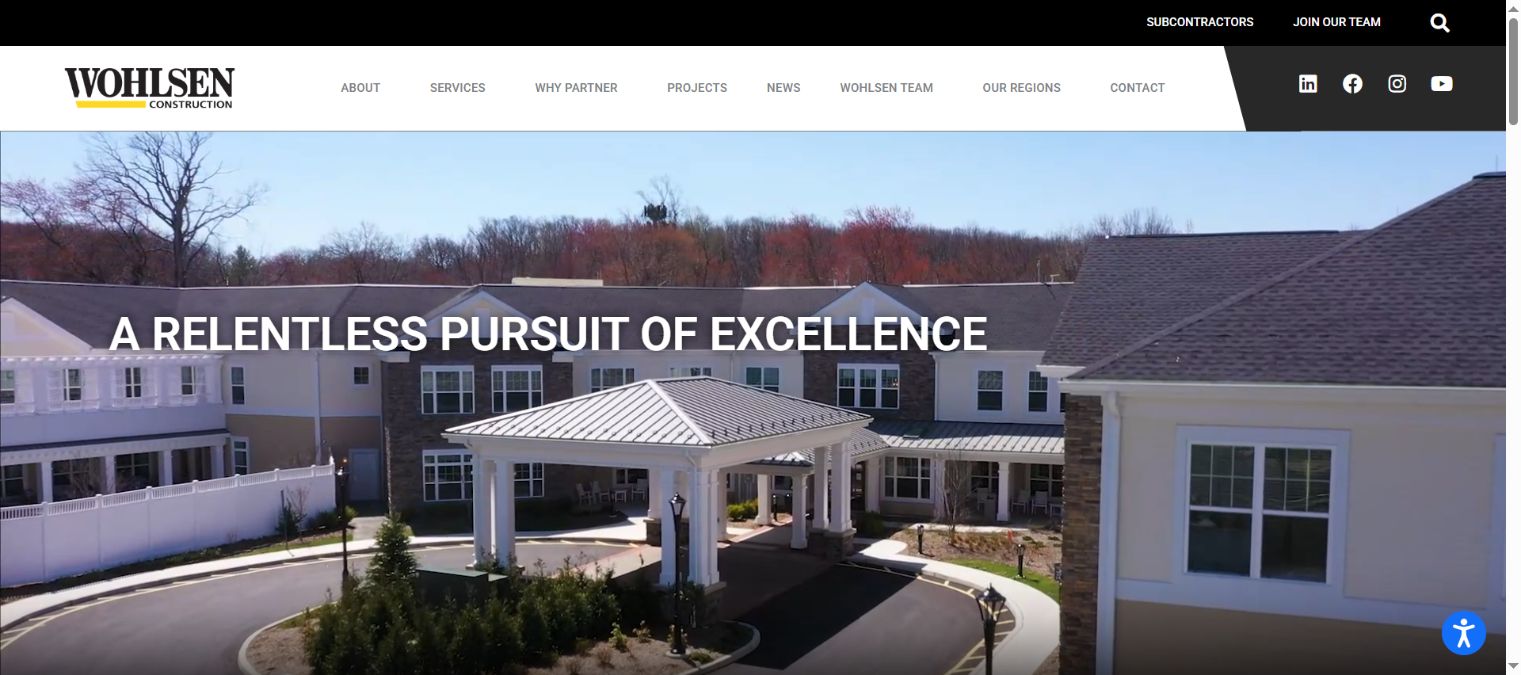
The Wohlsen homepage is a real example of a construction company giving visitors several clear ways to explore its work. Its service and project paths let a buyer move beyond the company introduction.
- What's good: the company presentation leads into work a visitor can investigate.
- What to copy: give services and projects their own clear places in the navigation.
- What I'd change for your site: make your exact role obvious as soon as someone opens a project, especially where design, construction management and GC work differ.
You can apply that lesson with a small portfolio. Start with the projects that best explain your chosen sector. State the client where you can, the location, your role and the work your team performed. Then explain one decision that mattered: maintaining access, staging a turnover or coordinating with a working facility.
Only publish project details, photos and logos you're allowed to share, and give other firms their correct credit.
Get inquiries to the right person
Here's what the service can look like in practice. An owner finds your industrial page and asks about a planned expansion. The AI assistant replies and can book a conversation or send the inquiry details to the office. Your BD lead receives the context and starts the project discussion.
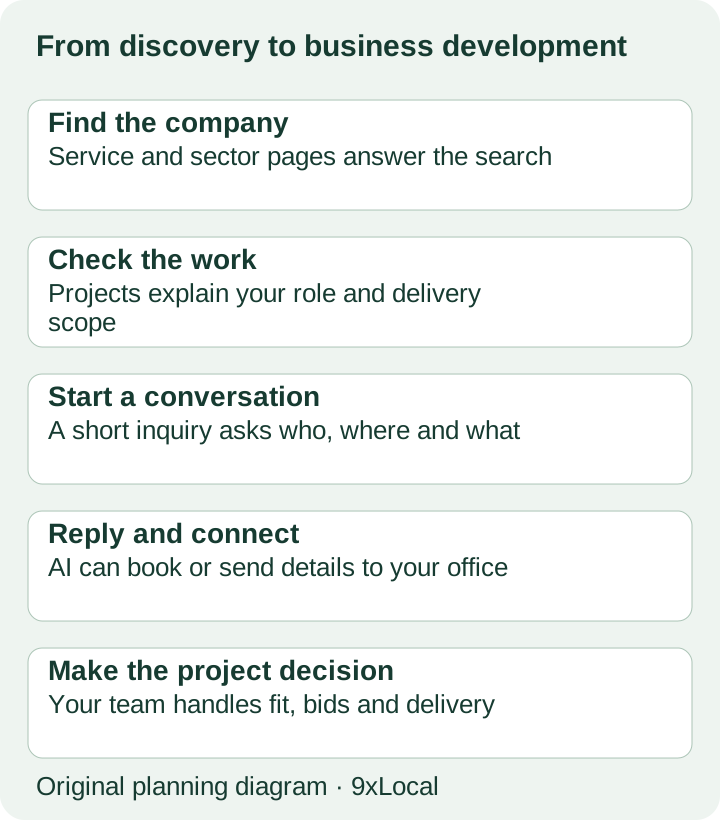
The company handles project fit, prequalification, bids, proposals and procurement. 9xLocal markets the company; we aren't a bid-finding or proposal-writing service.
Meanwhile, a PM sends approved photos from a current job through the app. Add a note about the scope and what changed on site. Strategist-reviewed website updates can turn that material into evidence the next buyer can understand.
Keep the inquiry questions short. Ask who they're with, what they're planning, where it is and the next project milestone. Save detailed estimating questions for the person who can judge them. You're trying to start the right conversation, not make a developer complete a bid package in a contact form.
6 questions before you hire
Get these answered before you sign. Ask for a plain answer you can use to choose the work.
| Question | How 9xLocal answers |
|---|---|
| What work am I buying? | The website, search, ads and follow-up scope you choose. Specific tasks and quantities belong in the quote. |
| What's the starting price? | From $297/month, with no setup or build fee. |
| Who pays for ads? | You pay the platform directly. Media is separate, with no markup. |
| Who owns the work? | You do, including the files we build and hand over. |
| How does an inquiry reach us? | The AI assistant can book in the calendar or send the details to your office. |
| How long am I tied in? | Month to month, with a 30-day money-back guarantee. |
Then ask the provider to walk through one buyer journey on your current site. You'll learn more from that conversation than from a generic promise about leads. They should understand why an owner, subcontractor and applicant need different next steps.
Questions construction buyers ask AI assistants
Put the answers on the pages buyers already use. An AI assistant may help someone make a shortlist, but the site still needs to explain the company plainly.
| Buyer question | Example search | Answer your site should make clear |
|---|---|---|
| Who builds facilities in our sector? | design-build logistics contractor in Ohio | Sector experience, services and real project examples. |
| Does this firm work in our area? | commercial GC serving central Pennsylvania | Service area and the offices that serve it. |
| What was its role on that building? | contractor construction management project role | Your responsibilities, with other team members credited. |
| Can we talk before the design is finished? | construction preconstruction contact | The services you provide and the person to contact. |
| Where do we send the first project outline? | construction company business development contact | A direct project inquiry path. |
Clear text, accurate project pages and a working contact path come before extra markup. They help a person check the answer, too.
Prefer to run it yourself?
Use the 90-day construction marketing plan to choose the buyer and owner of each task. The construction SEO guide explains which pages to improve first. For paid search, use the construction Google Ads guide.
The construction leads guide covers source fit and estimator time. The construction website examples help with your design brief, while the construction social media guide turns project notes into a manageable posting routine.
Frequently asked questions
Can you work with our existing website?
Yes, website work can start with what you have. Show us the site, access and the first problem you want fixed so the scope can address it.
Do we have to buy every service?
No. Start with the work your company needs. The quote should explain what's included and what would be additional.
Will the first version include all our projects?
Start with the projects needed for the first buyer journey. A large archive needs more gathering, checking and page work than a focused first version.
Can you promise work in a new sector?
No. Marketing can present your capability and support conversations. Your experience, relationships and delivery capacity shape the projects you can win.
Your next step
Choose one sector you'd like more of and one page that currently undersells your company. Bring a relevant project, your service area and the person who'll answer inquiries. See the 9xLocal service and start with the marketing work that helps that buyer take the next step.
Sources
- Clutch, Digital Marketing Pricing Guide. Verified 31 October 2026.