I'd use Facebook ads for construction companies when you can show a specific kind of work and give someone a clear next step. A design-builder can invite project conversations. A commercial GC can put recent work back in front of people who've already looked at the company. A hiring campaign can reach applicants. Each needs its own message and a different measure of success.
If you'd rather have the campaign and first response handled, our construction lead generation services explain the managed option. This guide shows what I'd choose, what I'd spend and how I'd set up the test.
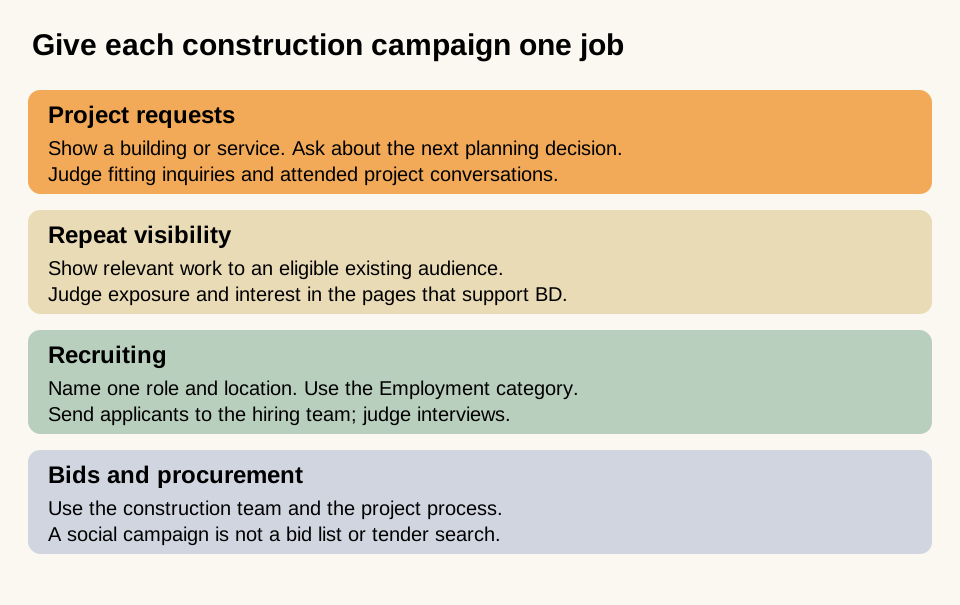
4 jobs Facebook ads can do
Pick one job for the campaign before choosing the photo. Facebook and Instagram, which share Meta's advertising system, reach people while they're doing something else. The ad has to earn their attention and make the next action worth taking.
| Campaign job | Where I'd use it | Ask for this |
|---|---|---|
| Start a project conversation | Design-build, commercial interiors or a residential-leaning builder with work to show. | Project type, location and the next planning decision. |
| Stay visible between conversations | Developers, architects and past contacts who've visited your project pages or engaged with your content. | A look at relevant new work or a service they may need. |
| Find applicants | A defined role with a location, responsibilities and an application process. | An application or hiring conversation, handled by the hiring team. |
| Find bids or handle procurement | Keep this with your construction team and the project's formal process. | Facebook ads don't supply bid lists, tender research or procurement work. |
For a small commercial contractor, I'd first check whether there are enough relevant visitors or engaged people to support repeat visibility. That means showing an ad again to people who've interacted with you. If hardly anyone has seen the company yet, start with good project pages and direct relationships. The construction marketing plan helps you choose that first task.
For a builder working directly with homeowners, a clear project offer can start a direct project conversation. Keep that campaign separate from commercial work. The buyer planning a home and the developer reviewing a contractor have different questions.
What Facebook ads cost
Use roughly $36 to $43 per lead as broad industry context for a project-inquiry campaign, then judge the requests your own office receives. WordStream's 2026 report puts the Industrial & Commercial leads figure at about $36 and Home & Home Improvement at about $43. Career & Employment is about $12. These are separate category medians, not a construction-only range or the price of an awarded job.
The leads data covers 452 US campaigns running from April 2025 through June 2026. The employment figure covers many kinds of employers, so I'd keep it out of a forecast for hiring your next superintendent. The same goes for using a homeowner inquiry figure to price a developer conversation.
I'd set aside $1,200 in media for a 30-day first test if your cash and response capacity support it. That's my planning starting point, not a platform minimum. Use one goal, one service area and one offer. With less to spend, test one narrower question. Splitting a small budget across hiring, projects and company awareness makes it harder to see what helped.
Keep the management fee beside the media budget. Clutch lists broad PPC management rates of $100 to $149 an hour. Ask what the quote includes rather than turning that rate into an assumed monthly package. Your office time is another cost, which the calculator below includes.
3 real construction ads to learn from
These ads were active in the US, all-ads view of the Meta Ad Library on October 31, 2026. They're from regional construction businesses. Each had been running for more than three months when captured. Run time tells us what to study; it doesn't tell us what the advertiser earned.
The captures keep the native ad card, including its primary text, project image or hiring creative, headline area and button. Advertiser details are blurred. Meta shortens some long text and carousel labels in these views; the excerpts below explain the part we're discussing.
1. Name the commercial sectors
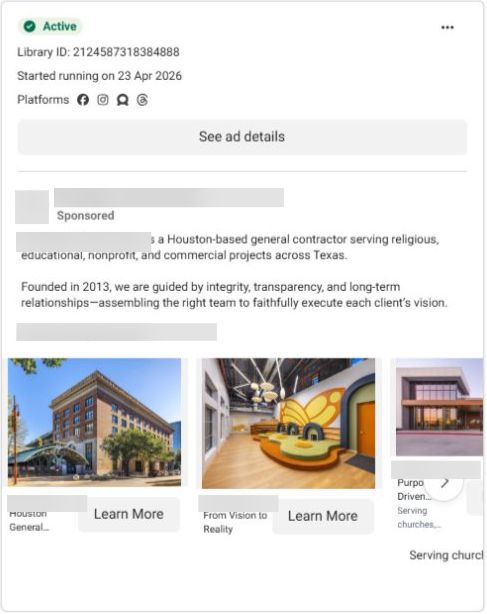
Observed commercial ad excerpt
Main text: “serving religious, educational, nonprofit, and commercial projects across Texas.”
Headline on the first carousel card: “Houston General Contractor”.
Button: Learn More.
Running since: April 23, 2026, about six months at capture. Source: Meta Ad Library. Captured October 31, 2026.
- What's good: the reader can recognize the sectors and region before opening the site. Several project images give the company introduction something concrete behind it.
- What to copy: name the work you want and show buildings that fit it. A regional GC can do this with a few strong projects.
- What I'd change: take the first card to the matching sector page. An owner interested in a church project shouldn't have to search a general portfolio for it.
This is a company introduction, with a low-pressure invitation to learn more. Copy that job if you're trying to stay familiar to a professional audience. An immediate estimate request would ask for a much bigger step.
2. Sell a recognizable building type
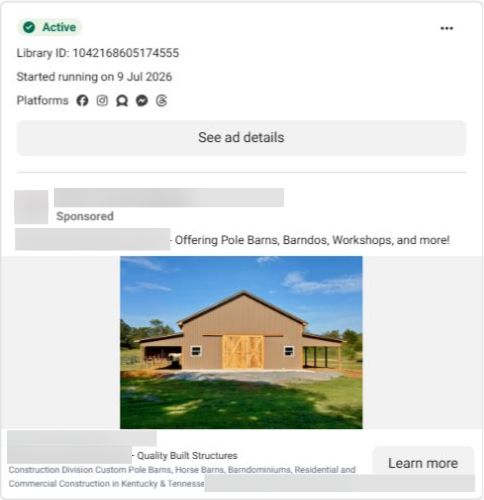
Observed building ad excerpt
Main text: “Offering Pole Barns, Barndos, Workshops, and more!”
Headline phrase: “Quality Built Structures”.
Button: Learn more.
Running since: July 9, 2026, nearly four months at capture. Source: Meta Ad Library. Captured October 31, 2026.
- What's good: the photograph and named building types tell a landowner what this company builds. It's more specific than a general craftsmanship claim.
- What to copy: pair one building type with a photograph of that work. A small builder could start with workshops or an agricultural building it knows well.
- What I'd change: lead with one building and one first conversation. A long list can bring several different jobs into the same inbox.
The ad is relevant to direct buyers of a building, including residential-leaning work. I'd adapt this approach for a contractor with a clear product and area, rather than borrowing it for every commercial sector.
3. Make the hiring job obvious
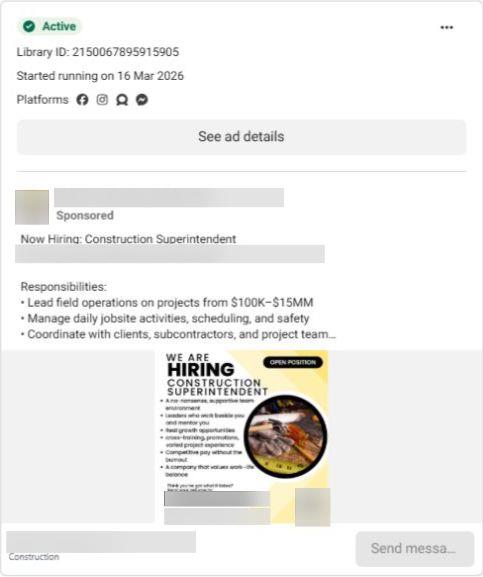
Observed recruiting ad excerpt
Main text: “Now Hiring: Construction Superintendent”.
Creative heading: “WE ARE HIRING CONSTRUCTION SUPERINTENDENT”.
Button shown in the Library: Send message, disabled in the preview.
Running since: March 16, 2026, about seven months at capture. Source: Meta Ad Library. Captured October 31, 2026. The native card's main text is shortened; the full text was checked in ad details.
- What's good: the role is clear in the first line and the image. The text describes field operations, scheduling and coordination, giving applicants more than a company slogan.
- What to copy: show the role, work location and responsibilities, then give the hiring team one place to receive applicants.
- What I'd change: use one clear application destination and make the location easy to spot. The Library preview alone can't show us how the employer handles replies.
A hiring ad should be judged by applicants the company can interview. Keep it in a separate campaign and inbox from owners asking about construction work.
Choose the offer before the audience
Start with something your company already does. A commercial interiors contractor might offer a first discussion about an occupied-space renovation. A design-builder might invite an owner to discuss a site and intended use. A specialist can show one project detail that explains its part in a larger build.
Say what the conversation covers. If drawings or a site review are needed before a price, the offer can be a planning conversation. You can attract an early inquiry without promising free design or a construction estimate before the team knows the scope.
For developers, architects and past contacts, show the work that's relevant to your next conversation. A manufacturing expansion update might explain how the contractor kept access open. Link to the project page with the scope and your role. That's a better reason to look again than a general “we're still here” message.
Use eligible website visitors, people who've engaged with your content, or a customer-list audience only when you have the required rights and permissions. Meta's rules require a lawful basis for that customer data and honoring opt-outs. Seeing an architect on your contact list doesn't mean Meta can identify or reach that particular person. If an audience is too small to deliver, use direct contact and organic updates instead of trying to force it.
Set up a campaign in 7 steps
- Write down the job. Choose project inquiries, repeat visibility or applicants. Name the person who'll receive the response.
- Pick the matching goal. Use Leads when you want a project request. Use Awareness when the job is exposure to your company. Choose the hiring destination around the application process.
- Check the ad category. Meta requires Employment for hiring ads and limits some audience tools. Ads offering housing opportunities or financing need the appropriate category review too.
- Set the area and audience. Use the region you serve. For repeat visibility, check the eligible audience and whether the settings expand beyond it. A job title or interest isn't a verified buying role.
- Make two versions of the same offer. Try a project photograph and a short, captioned walkthrough. Use your own material and describe your company's role accurately.
- Connect the destination. Use a short instant form for a simple request or a matching project page when the service needs explanation. Add the privacy notice and test the notification, reply and booking process on a phone.
- Set the spending limit and launch. Keep a record of the offer, audience and destination. Inspect the first replies before changing the budget.
Preview the text as well as the image. The important job and next step need to survive a shortened headline or sound-off view. Check automated creative changes before allowing them to alter a project image or the meaning of the offer.
The construction social media guide helps your PM gather material without making every update a production job. For people already searching for a contractor, compare the construction Google Ads guide before deciding where your first paid test belongs.
Ask questions your office can use
Ask enough to start the right conversation. I'd use these for an owner-facing commercial campaign:
| Question | What it gives the team |
|---|---|
| What's your role in the project? | Owner, developer, architect or another contact to speak with. |
| What are you planning and where? | Work and location the company can assess. |
| Where are you in planning? | An early idea, site decision, drawings or a coming construction decision. |
| What's the next date that matters? | A reason to call now or follow up at a later milestone. |
| How would you like us to reply? | Contact details and an expected next response. |
Make plans and a rough budget optional when the buyer is early. You'll learn more from a short conversation than from forcing someone to invent a construction budget to submit a form.
Here's an original reply for an expansion inquiry:
Reply to an expansion inquiry
Subject: Your expansion plans in {town}

Hi {name},

Thanks for telling us about the extra space you're planning. Is the next decision the site, the layout or choosing a construction team?

Send any plans you already have, or let us know a good time for a first conversation. {person} can talk through the next step with you.

{name}
{company}
Get the required permission for calls or texts and make stopping follow-up easy. Then keep the reply tied to what the person asked for.
What a project conversation costs
Count the time your team spends as well as the media. Use this for a project-inquiry campaign; a hiring or visibility campaign needs its own result measure.
Example: $1,200 in media, a $500 management fee and five office hours at $65 an hour cost $2,025. You receive 27 forms, nine inquiries for work you take and three attended project meetings. That's $75 total per form, $225 per fitting inquiry and $675 per attended meeting.
Change the inputs to match the same campaign and period. If meetings are still pending, keep the cost to date and the pending count visible. An attended conversation gives your BD lead a next decision; signed work and project profit come later.
Review the test with the person answering
Review the inquiries with the office each week. Ask what work people requested, whether you reached them and what happened next. If most want work outside your scope, change the ad's promise. If fitting inquiries go unanswered, fix response cover first.
For repeat visibility, check who the campaign could reach, how often it showed and whether people looked at the relevant pages. Then ask BD whether those pages helped current conversations. Give the relationship its history instead of assigning an entire award to the last ad someone saw.
After the first month, choose one change. Keep the message if it starts the right conversations. Narrow the work if the requests are mixed. Replace the destination if people need more detail before contacting you. The construction leads guide covers the next project-screening decision.
Common mistakes
- One ad for every visitor. Separate owner inquiries, trade partners and applicants so each knows where to go.
- Buying clicks when you need requests. Choose the result you want and inspect the inquiries behind the count.
- Sending everyone to the homepage. Match the destination to the building or sector in the ad.
- Adding spend without office cover. Name a backup for the person answering, especially when they're on site.
Frequently asked questions
Do Facebook ads work for commercial construction?
Yes, for a defined job such as showing relevant projects to an existing audience or starting a specific service conversation. I'd put clear project evidence and current business relationships first.
Can I reach a particular developer or architect?
Start with your existing professional relationships and eligible engagement audiences. Ad delivery can't promise that a named person will see the message. Direct contact remains the better choice for a particular conversation.
Can I use Facebook to hire construction staff?
Yes. Give the hiring team a campaign with a clear role, work location and application destination. Judge applicants and interviews separately from project inquiries.
Should a small builder start with Facebook or Google?
Choose Search when people already look for the service you sell. Choose Facebook when a visible project and clear offer can start interest, or when you have people to reach again. Fund one focused test first.
Want the campaign run for you?
Bring one project type, the region you serve and the person who'll answer. Our construction lead generation service can connect the marketing work you choose with the first response. 9xLocal is your agency replacement for more booked jobs, with packages from $297/month and no setup or build fee. Ad spend is separate, paid directly to the platform without markup. See if we're a fit.
For the full company-marketing scope, visit the construction marketing agency.
Sources
- WordStream, 2026 Facebook Ads Benchmarks. Verified October 31, 2026.
- Clutch, PPC Pricing Guide. Verified October 31, 2026.