
For commercial business development, I'd start with a professional audience and project evidence, often on LinkedIn. Use other platforms where your buyers or recruiting audience spend time. The plan should fit your company, rather than a promise that daily posting brings project awards.
Our construction marketing agency connects the website, search, ads and follow-up you choose. This guide helps your company run its own professional project-content routine.
Choose the audience before the platform
Name the person the post should help. An owner wants to check relevant capability. A GC may want to understand a trade partner's scope. A future employee may be looking at the people and work environment.
| Audience | What I'd show | Next step that fits |
|---|---|---|
| Owners and developers | Sector work, project decisions and delivery role. | Open a relevant project page or discuss planned work. |
| GCs and project partners | Trade scope, coordination and the team behind it. | Find company information or the right partner contact. |
| Future employees | Real roles, team activity and the work involved. | View careers and open positions. |
You can cover several audiences on the same company account. Keep one clear audience per post. A recruitment update can be valuable without being called a business development result.
Before choosing a format, ask what you have to say. If the PM can explain a useful project decision, a photo and a short caption may be enough. A video earns its place when seeing or hearing the explanation makes the work easier to understand.
3 real posts to learn from
These public commercial-construction posts show scope, milestones and team credit. Take the format, then fill it with your firm's work. Big firms have marketing teams, but these posts don't need one. A PM with a phone and ten minutes can produce the same kind of update.
Skanska: explain what completion involved
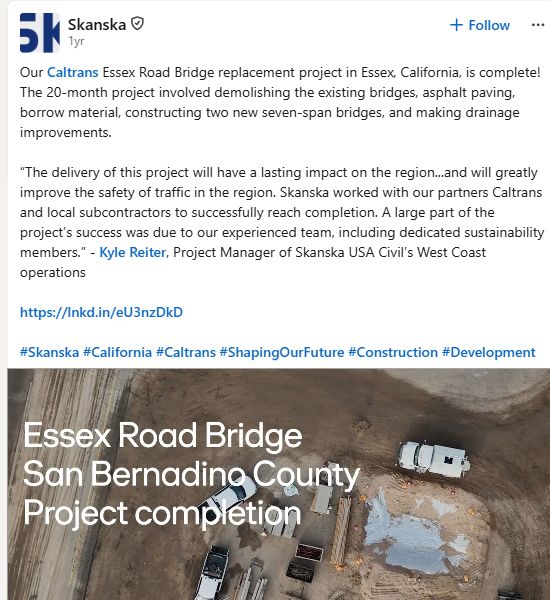
A Skanska post about the Essex Road Bridge completion names the project, explains the work and credits partners. It includes the PM's perspective alongside the project image.
- What's good: completion means something concrete because the post describes the scope.
- What to copy: say what your team did, then explain why that part mattered.
- What I'd change for your BD audience: add a clear path to a fuller project page for someone checking similar experience.
PCL: connect a milestone with the next phase
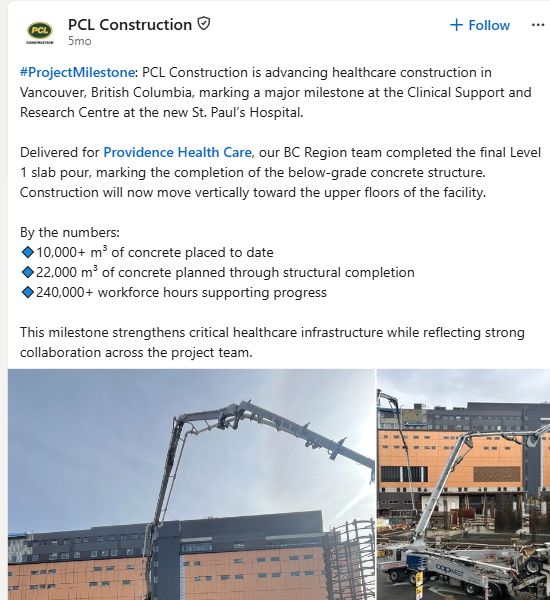
A PCL post about a healthcare project in Vancouver explains a concrete milestone and what comes next. It's a Canadian project used here for the content pattern.
- What's good: the update helps a reader understand progress instead of only announcing that work continues.
- What to copy: connect the finished stage with the next piece of the job.
- What I'd change for a general buyer: keep technical detail close to a plain explanation of why the milestone matters.
S&B USA: give the project team its credit
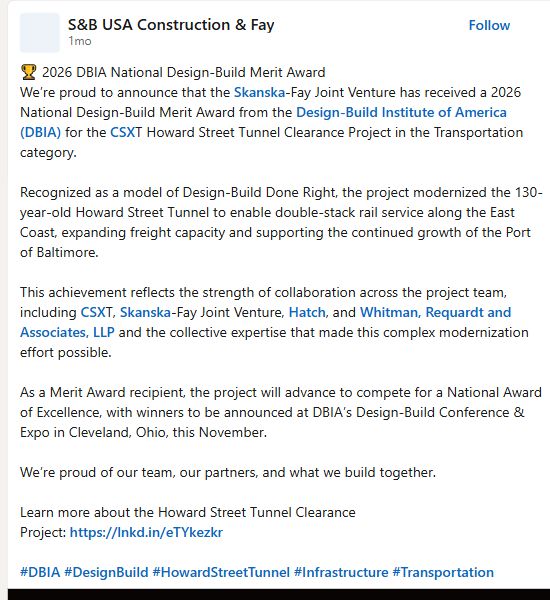
An S&B post about the Howard Street Tunnel award names the joint venture and project partners.
- What's good: the reader can see who was involved instead of attributing a whole project to one firm.
- What to copy: name your company's role and credit the other teams accurately.
- What I'd change for your page: pair the recognition with one short explanation of the work a future buyer can relate to.
The lesson across all three is simple: identify the project, explain a piece of the work and give the reader a reason to care. Keep the company's claims tied to its own role.
Turn one project into a month of posts
Ask the PM for a short note and a few approved photos. You need the project, your role, what changed, what mattered and the next phase. That's enough to start several different stories without repeating the same caption.
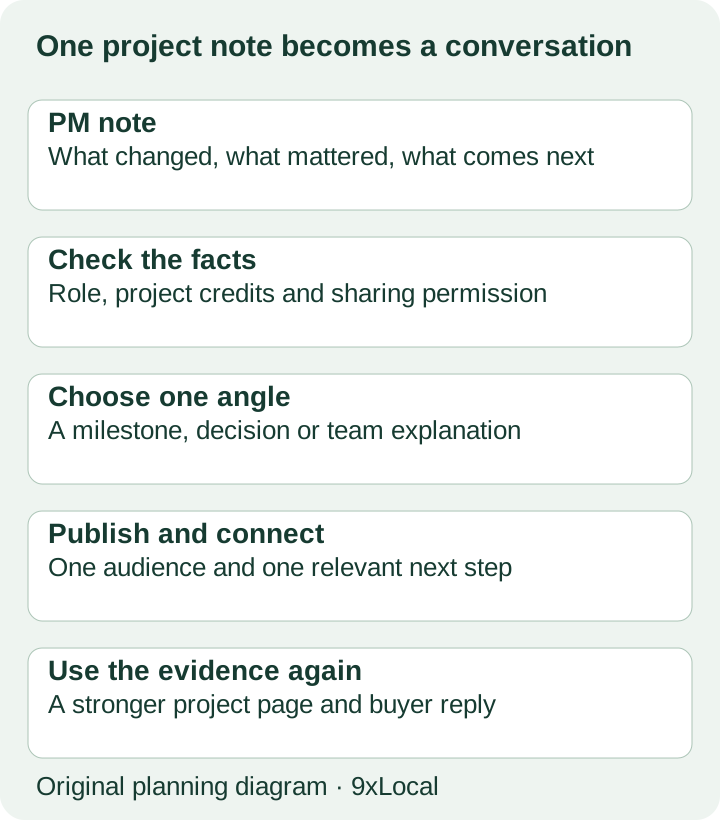
Here's how I'd use a sports-facility project as an editorial example. One post can explain a sequencing decision. Another can show a trade coordination detail. A third can introduce the PM's responsibility. A fourth can link to the completed project page when it's ready.
Each post should stand on its own. Someone seeing only the team post should still understand the work and company role. You can connect the posts through the project name and website page without making the reader follow a series to get the point.
Get sharing permission before publishing photos or project details, keep confidential information out and credit partners correctly. Give the PM a short fact review rather than asking them to approve a vague marketing claim they didn't make.
A posting plan your team can keep
Start with two posts a week for four weeks if your team can support it. That's an editorial starting plan, not a platform rule. You can do less when the material or review time isn't there.
| Task | Example weekly time | Owner |
|---|---|---|
| Gather photos and PM notes | 20 minutes | Project contact. |
| Draft the posts | 25 minutes | Company content owner. |
| Review facts and credits | 15 minutes | PM or responsible lead. |
| Read and answer replies | 15 minutes | Content owner with BD support. |
That's 75 minutes a week. Over four weeks, it's five hours. At an entered internal value of $90 an hour, the effort is $450, or about $56 for each of eight posts. This is staff effort value, not an agency quote or cost per lead.
Use the capacity result to choose the plan. If the team has less time than the work needs, cut the posting scope or add help. I'd protect the fact review and reply time before keeping a higher post count.
Put one person in charge of the calendar. PMs supply material; they shouldn't each have to invent a separate publishing process. When a project changes or a photo can't be shared, the content owner needs another angle ready.
Keep a small reserve of approved material. When a live project update has to wait, you can explain an existing project detail or answer a recurring buyer question. The aim is to keep the routine steady without rushing confidential or incomplete information into a public post. Your content owner should know which material is ready and who can clear the next item.
Write the caption around a decision
Lead with what happened or the point the buyer can learn. “Another great week on site” makes people work to find the story. A sentence about the sequence, constraint or next phase gives the image a job.
These are original caption starting points. Fill them with your company's facts, rather than borrowing the projects above.
Original caption: a sequencing decision
At {project}, our team completed {scope} before {next activity}. That sequence kept {specific project requirement} clear for the next team.

Our role is {precise role}. The photo shows {visible detail}. Read the project overview for the scope and team credits: {project page}.
Original caption: the PM explains a detail
Why did the team choose {verified decision} at {project}?

{PM name and role} explains: {approved plain-language explanation}.

We're responsible for {scope}, working with {project partners}. If you're planning similar work, the project page explains our part.
Original caption: a completed phase
{Phase} is complete at {project}. Our team handled {scope}; next comes {next phase}.

Thanks to {accurately credited teams} for their work on this stage. The next update will show {relevant upcoming detail}.
You can keep the caption short and let the project page carry the wider story. If the draft is full of company praise, ask the PM for the fact behind it. That usually gives you a stronger first line.
Avoid assigning words to a PM they haven't approved. A direct quote needs their words. An explanation written from their notes can simply describe the decision without quotation marks.
Give each post one next step
Match the action to the audience. A buyer checking sector experience can open a project page. A trade partner can find company information. An applicant can open careers. One clear next step is easier to follow than a caption asking for every kind of response.
For a BD post, I'd often lead to a relevant page before asking for a meeting. The page gives the contact something to check and share with colleagues. The construction website examples show how to make that evidence easier to use.
When someone asks about work, keep the first reply short and move project details into the company's normal conversation. Here's an original starting point.
Reply to a relevant project question
Thanks, {name}. Our team can explain our role on this project. Are you looking at similar work in {area}?

If you send the project type and current stage through {company contact path}, the office can connect you with the right person.
The response should help the person take the next step. If they need a supplier contact or a job application path, point them there plainly. Sorting the audience is part of making the account helpful.
When paid promotion earns a test
Try paid promotion when there's a specific audience, message and page worth putting money behind. A project update that supports a clear sector discussion is a stronger starting point than boosting every post automatically. The Facebook ads guide for construction companies covers campaign fit, costs and real examples.
For Facebook or Instagram, ask whether the buyer and service fit the audience you can reach. A commercial construction decision may involve an owner, developer and formal procurement team over a long period. Treat paid social as company promotion or an inquiry test where it fits, rather than a substitute for that process.
If people already search for a specific construction service, the Google Ads guide may be the closer channel choice. If the company needs better pages first, the construction SEO guide covers that foundation.
9xLocal can run the website, search, Facebook and Instagram ad work you choose, with inquiry follow-up. Your company owns the organic professional posting routine described here. LinkedIn management, bid sourcing and proposal work aren't part of the offer described on this page.
Measure conversations and effort
Start with the work the account is meant to support. If the audience is owners and developers, keep a note of relevant conversations, project-page visits and the next step BD took. If the post is recruiting, review it with the recruiting team instead.
Track the effort as well as the reaction. Did gathering the material take the time you expected? Did the review happen? Were replies answered? A manageable routine can continue producing evidence; an exhausting calendar often fades when projects get busy.
Keep likes and follower counts as account activity, rather than calling them awarded work. A relevant comment can start a relationship that takes months to develop. Record what happened next so the company can understand the role the content played.
At the end of four weeks, choose what to keep. You might find that PM explanations start better conversations than general announcements. You might need clearer project links or a simpler review process. Change the next month's plan around that evidence.
Frequently asked questions
Which platform should a commercial contractor start with?
I'd start where your professional buyers and partners already interact, often LinkedIn. Keep recruiting and consumer-facing goals separate when choosing the wider mix.
How often should we post?
Start with a routine the team can keep. Two posts a week is the worked plan here, but accurate material and time to reply matter more than that count.
Can we post from active sites?
Yes, when the material is approved for sharing. Check the project facts, people shown and any confidential details before publishing.
Do we need video for every update?
No. Use video when the explanation benefits from movement or a person's voice. A clear photo and caption can explain a project decision well.
Want help behind the project content?
Use the project material to make the company easier to check. Our construction marketing agency can connect your chosen website, search, ads and follow-up work. Your team can share job photos through the app for strategist-reviewed website updates. Packages start from $297/month, with no setup or build fee. See the service to discuss the company marketing work that comes first.