
Check fit before the site visit
Find out what prompted the call, which part of the yard matters and when the homeowner hopes to start. Ask for the town, a broad description and a photo if it will save a trip. If it's outside the area or below the normal scope, say so quickly and give them a useful next option when you have one.
| First call | Ask | Why it helps |
|---|---|---|
| Job | Are we replacing the patio or starting in a new part of the yard? | Tells the estimator what to expect. |
| Access | Can a crew come straight in or is there a gate or slope? | Tells you who needs to see it. |
| Budget | What have you allowed for the project, and what's essential? | Helps price the starting scope. |
| Decision | Who needs to see the options, and when can you review them? | Keeps the proposal from landing without a next step. |
Decide what you'd charge for design
| Project | What the homeowner gets | When it makes sense |
|---|---|---|
| Patio replacement | Site visit and a straightforward written quote. | The area, finish and access can be sized on a quick walkthrough. |
| Sloped-yard redesign, $900 example design fee | Measured site plan, grading concept, base scope and options. | The homeowner needs to make choices before an installation can be priced. |
If you've got enough detail, talk through a budget range first, like the example in the FAQ below. Before drawing, ask the homeowner to approve the deliverables, fee and any credit toward the build in writing. Engineering, permitting or other specialty plans may need their own scope. If you offered to credit the $900 design fee toward the build, show the credit on the proposal. If you didn't offer a credit, keep the design fee separate and point to the work the homeowner already received. The drawings and discussion are their own work, even if the customer decides to wait.
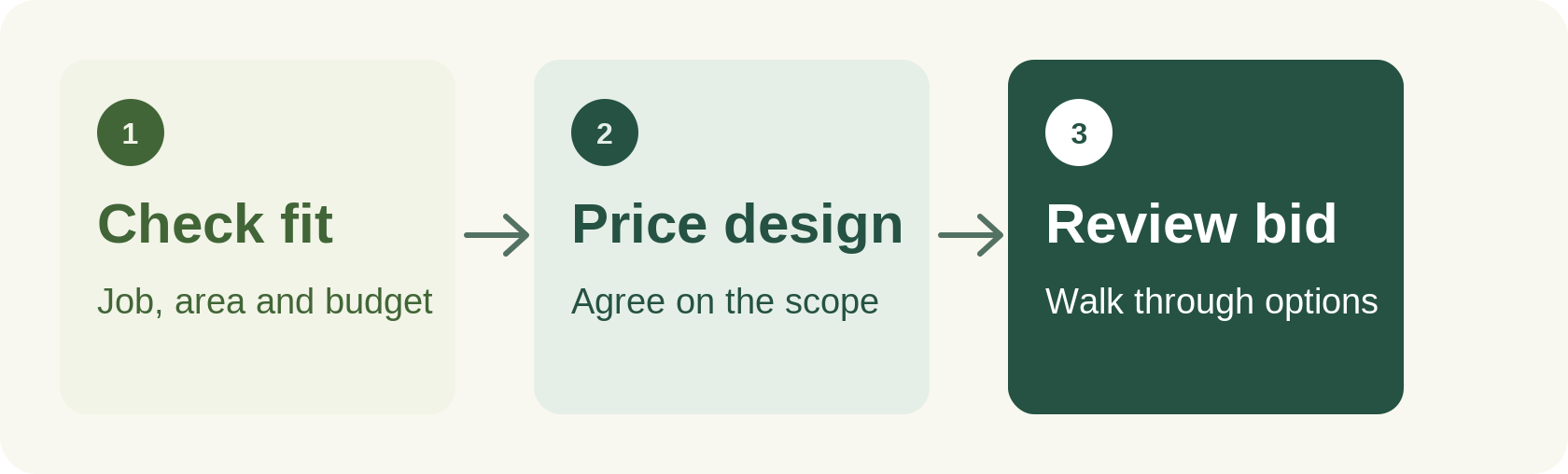
Review the proposal with the homeowner
Show what the price covers, what the customer could add, what still needs to be checked and who will handle it. If the client wants a larger patio, show what it changes about access, drainage or time before you revise the number. Give both sides one next decision and a date to talk.
Proposal review invitation
Subject: Let's review your patio options

Hi [name], I have the base patio scope and the option we discussed for [feature]. Could we spend [time] on [day] going over what's included and the one item we still need to decide? If someone else is helping choose, they're welcome to join.
On that sloped-yard job, the homeowner gets a measured plan, an idea for where the steps and runoff go, and a base patio scope. At the review, ask whether they want the lower seating area now or later. Price the scope they choose and state who will arrange any separate engineering or permit work.
Show the homeowner where a quote can still change
The public design terms for a Pennsylvania landscaping firm's design studio cover design work separately from any construction agreement. A homeowner can pay for a deliverable and still have a decision to make about the build.
Use the sloped-yard example. The homeowner already paid $900 for a measured plan. In the example, the base patio is $24,000, with $1,500 for drainage included. The lower seating area is a $2,000 option. Show the homeowner the base, option and design credit on separate lines.
| Decision | What to write in the example |
|---|---|
| Build the current scope | $24,000 including $1,500 for one catch basin and up to 20 feet of solid drainpipe to the existing outlet. The estimator checks that outlet before the crew orders materials. |
| Add lower seating | $2,000 to pave the lower seating pad shown on the plan. Choose it before the crew starts grading so it can go in the proposal total and schedule. |
| Apply the design credit | If the signed design agreement grants the $900 credit, show $23,100 remaining for the base scope. If it didn't grant one, the base build stays $24,000. |
If the estimator finds the outlet can't be used, send the homeowner the revised drainage line and the price difference. Get their written approval before ordering parts or doing the extra work. The homeowner can still choose the base layout while you check that outlet.
Follow up on the question that's holding it up
If they're deciding on timing, give them the schedule options. If they're comparing price, check they understand the difference between the base and optional work. A good follow-up gives them something to decide, and it also lets you know when to stop holding the slot.
Scope follow-up
Hi [name], are you still deciding between [base option] and [other option]? I can walk you through what each changes about [time, price or use]. Would [day] help?
Release a tentative slot
Hi [name], I'm planning the crew's next few weeks. Are you still looking at [project], or should I free up the tentative time and check in later? Either is fine.
Stay with the sloped yard. On March 5, review the base patio and the optional lower seating area together. Set a call for March 12 after the homeowner has talked it over. If they're still deciding, the office can log: "Base plan is okay. Both owners want to see how many steps the lower area adds. Send the marked plan March 13 and ask for their answer by March 19." If they can't decide by the agreed date, let them know you're releasing the tentative crew slot. Keep the paid design record and offer to revisit the schedule when they're ready.
Use the three worksheets to record the same decisions. Update the editable one as the scope changes and take the two print worksheets to the visit and proposal review. If you need steadier inquiries to use that process, compare channels with the landscaping marketing guide.
Put related work in the proposal or on the project page. Use the landscaping project photo guide to show the details that affect a quote. The landscaping website examples show ways to put that evidence on a page a homeowner can skim on their phone.
FAQ
Should I charge a design fee on every job?
Charge when you're doing design work with a clear output. A simple patio replacement may only need a walkthrough and scope.
When should I send the proposal?
Send it once the scope and options are clear enough to price. Book the review so you can answer the next question while both of you remember the job.
How do I follow up without repeating myself?
Ask which choice needs an answer. Send the example, timing or scope detail that helps with that choice.
Can I give a budget range before asking someone to pay for design?
Yes, if you've got enough about the size, finish and access to explain how you arrived at the range. Say what you still need to inspect, such as drainage or equipment access, and which decisions the paid design will settle. You could say, “We're at about $24,000 for the base patio or $26,000 with the lower seating pad, assuming the existing drain outlet can be used. The paid design will set the patio layout and drainage scope. We'll check the outlet before you approve installation.” If the range is too high, talk about a smaller scope before charging for drawings.
Next step
If you want more design-build inquiries that fit, our expert-led team can handle the website and follow-up work you choose. Your office can take the right requests into the sales process and book the work that's a fit. 9xLocal packages start from $297/month. See what our landscaping marketing services cover. See if we're a fit.