
Start with a job you can price and schedule
Say your crew has room to replace one patio next month. You have photos of a similar install, the equipment is nearby, and you know how long it usually takes to get materials. Pick that as the offer. Give your office a few things to ask before it books the visit.
| Work you want | What the homeowner needs to see | What you ask before driving out |
|---|---|---|
| Full paver patio replacement | A finished patio in a yard like theirs, with a caption about the old base or runoff. | Is it a replacement or a small patch? What town and start window? |
| A wall tied to an outdoor project | The slope before work and the job once the yard was usable. | What does the wall hold back, and is access tight? |
| Drainage that affects a patio | The water problem and one photo of the fix before it was covered. | When does water collect, and where can your crew get in? |
| Small paver repair | A clear repair scope and service area. | Is it work you want, and can a smaller crew handle it profitably? |
Use the homeowner's answers to choose a phone check, an estimate or a polite referral. For the patio pilot, ask for a wide photo if access or slope could change who needs to come out. Set a minimum project scope your crew can explain in one line. When you've got room in the schedule, leave yourself some flexibility for a smaller job that can fit next to another install.
Pick one way to find that buyer
Start with Search if homeowners in your towns are already asking for the service. A search for a paver patio installer is a natural match. People pricing paver pallets or looking up how to lay their own patio have a different job in mind. Look at the search terms that brought people in before increasing spend.
On Facebook or Instagram, give a homeowner planning an outdoor room a reason to stop and picture their yard. A same-angle before-and-after can do more here than an equipment photo. Give the finished job a location and explain one choice the homeowner made. Then offer the next step the estimator can actually deliver.
A third option is asking a paver yard or adjacent trade for referrals. Bring a clear service area and an example they can share. CMHA hardscape directories can help you find trade contacts or verify certifications an installer claims. Talk to somebody locally about what the yard sees and where it needs good installer options.
Paver supplier introduction
Subject: Patio projects near [town]

Hi [name], we install paver patios and handle [specific work] around [towns]. We're looking for [scope] this [time window]. Here's a job that shows what we take on: [project link]. If you get asked for an installer, would it help to have our scope and phone number at the desk? Happy to send people to you for material selections that make sense for their project.
Write down who will return the referral, and give that person an up-to-date link. If a job has permission and natural interest from neighbors, use the patio and drainage flyer files for that small test.
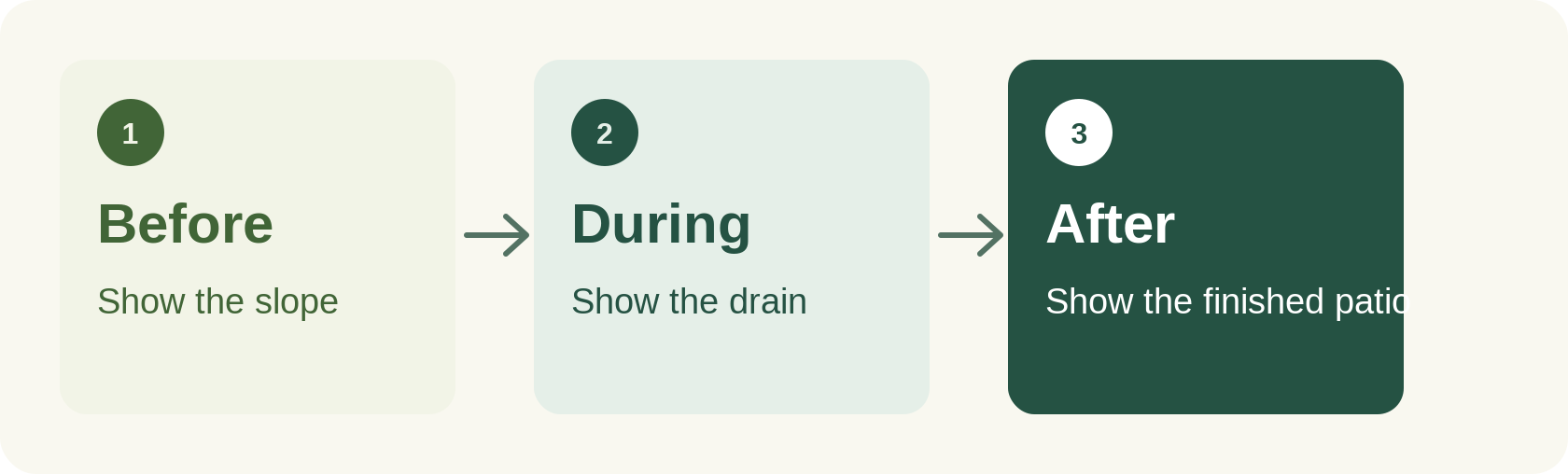
Show what your crew had to solve
A finished patio tells me how it looks. A photo of the gate or where the water used to sit tells me whether you've handled something like my yard. Put that proof on a page with the job name, towns you serve and a clear request for a site visit. Keep the caption about the work.
For example, the owner of a sloped yard might want to know whether the patio needs steps. One well-framed photo showing the change in height is worth more than a dozen shots of the furniture. The project photo guide explains what to save before the base or drain is covered.
| Original job walkthrough | What to share with a homeowner |
|---|---|
| Access | Show the gate and where equipment can reach the patio. |
| Grading and drainage | Point to the low part of the yard and the route the water takes. |
| Finish | Repeat the original view to show how the new space connects to the house. |
Ask for permission before sharing job photos. Frame the useful work and leave house numbers, faces and license plates out.
Set a limit for the estimate slots you can offer
Here's an example for one paver patio. The price is $12,000 and direct labor, materials and installation cost $8,000. That leaves $4,000 before marketing and overhead. If you decide to spend up to 20% of that cushion to win the work, you've got $800 per completed job to work with. That's your decision for this example.
| Item | Example |
|---|---|
| Money left after direct costs | $4,000 |
| Share you'll put toward winning the job | 20% |
| Total allowed for one completed job | $800 |
| Share of visits that turn into completed jobs, assumed for this example | 1 in 5 |
| Most you can spend to get one site visit that happens | $160 |
| Three visit openings | $480 total |
The $480 is the most three visits can justify at $160 each. Set your actual cap at the lower of that allowance and the cash you could lose if no jobs get built. Even at one completed job per five visits, a test this small can end with zero jobs. Use what usually happens on comparable work. If you only know how many jobs signed, keep the completed-job result open. Count the ad bill, fees, office time, estimating and travel on the same basis when you compare results. For a full month, use the landscaping budget guide.
Set an estimate spending limit
Change the example numbers to match your business. Dollar amounts are in USD.
Downloads
Run a small patio test and decide what to change
In this example, a Raleigh crew wants one full paver patio replacement for April. It has three estimate slots in the week of March 9. Use supplier referrals for this test. Drop off a one-page scope and a link to a matching project at a local paver yard. Ask the counter lead to share them with homeowners looking for a replacement installer. The office manager takes the calls and checks the ZIP, project scope and access before offering a slot.
| What the office records | Sample pilot on March 13 |
|---|---|
| Cost to run | $0 in ads, $60 for cards, $0 in management fees, $120 in office time and $180 for the estimator and travel. Total $360 of the $480 cap. |
| Fit and visits | Four requests fit. Three visits took place, so the $360 test averaged $120 per visit. The fourth request can wait for the next opening. |
| Results | One signed, two quotes still open and zero completed jobs. |
| Next review | On April 24, check the open quotes and whether the signed job was built. Add any later costs before comparing with the $800 allowance per completed job. |
Repeat a pilot only if the visits fit the job, your all-in cost per held visit is at or below your ceiling, and you still have room in both the estimator's and crew's calendars. In this example, $360 for three visits is $120 each and fits the $160 ceiling. At one held visit, the same spend would be $360 per visit. Pause and fix the handoff before trying again. Keep the next test under its own cash cap while the quotes are open. If the shop mostly sends small repairs, change the scope on the card before printing again. Use the landscaping leads comparison if you're considering a paid lead provider.
Keep the test about pavers. A structural deck or porch, a poured concrete patio and a poured driveway each call for a different crew and a different estimate.
Follow a supplier referral until you know why the job stopped
Give the supplier's counter one project card for the job you're testing. Put a photo of a full replacement, the work you take, the towns you serve and a way to ask for an estimate on that card. If a homeowner asks about buying spare pavers to fix a small patch, that's a different request. Give the counter one line to use. “They replace the whole patio. If you're fixing a few loose pavers, this isn't the job on that card.”
Read the estimator's notes when the quotes close. Here are two ways a three-visit test can stall. If the office marked all three as replacements but the estimator found that two homeowners only wanted patches, change the question the office asks before booking and retest with the supplier. If all three were genuine replacements and homeowners stalled over tearing out the old patio versus extending it, show those options on the service page or walk through them in the quote. Ask what other estimates included when the homeowner is willing to share.
If the supplier still sends too few jobs that fit after you fix the handoff, price a small Search test for the same service and towns. Multiply the visits you can take by what you can afford per held visit, then use the lower of that amount and the cash you could lose with zero completed jobs. Base the Search visit allowance on its own visit-to-completion rate for similar jobs or a conservative first-test estimate. Keep the supplier quotes in their own test and count work when it's built.
FAQ
Where should a small paver crew start?
Start with one job, one service area and a finished example. Choose a channel you can track through the site visit.
Should I use Search or Facebook ads first?
Start with Search for an active installer query. Use Facebook or Instagram when a finished project can show a homeowner what to plan for.
What if I have three good leads and no jobs yet?
Keep the costs visible and the estimates open. Judge the result once those homeowners have had time to decide.
How do I set a minimum patio job before paying for leads?
Start with the smallest job you'd take. Use a recent job to add up the crew's labor from setup through cleanup, plus materials, equipment, travel and disposal. Add what the job needs to leave for overhead and profit. If the job costs $3,600 and needs to leave $900, your floor before marketing is $4,500.
For paid leads, divide the batch's lead fees and follow-up costs by the number of comparable jobs you actually built. Say you paid $40 each for five leads that produced one completed patio. Add $100 for office calls, estimating and travel. It cost $300 to win the job, so your paid-lead floor is $4,800. For a first test, estimate how many billed leads you'll need per completed job and what it costs to handle them. Use numbers from comparable work when you've got them.
If buyers won't pay that, save smaller jobs for referrals or another channel that leaves enough. Give the office the price and job scope so they can ask, "Full replacements of this size start at $4,800. Does that fit your budget?"
For larger patios that need design decisions before a quote, use the design-build sales guide to scope the first visit.
Next step
Our team can put a matching patio in front of homeowners and help the office follow up with people who want that job. Start with the install you want to book. 9xLocal packages start from $297/month. You pay the ad platform directly for media, with no markup. See what our landscaping marketing services cover. See if we're a fit.