
When does neighborhood marketing make sense for an electrician?
Start with work you want to repeat in an area your crew already covers. A finished home charger or lighting project gives you a concrete service to explain. A panel job gives you an assessment offer. Neither establishes that the next house needs the same work.
Neighborhood relevance comes from being able to serve the area and demonstrate a useful project. Keep the message specific: “Planning home charging? Ask about the electrical installation.” A vague “all electrical work” flyer gives the homeowner less reason to keep it.
Leave the customer's name and address out unless they authorize their use. Get separate permission for a photograph, a sign and any statement identifying them as a customer. A paid job does not automatically buy an endorsement.
Do not divert a technician from an urgent service commitment to distribute advertising. Plan the route and labor separately. When the schedule is already full, a broad distribution campaign can create promises you cannot meet. Keep marketing by electrical job and actual crew capacity connected.
Door hangers, signs, postcards or conversations: which should you use?
Choose one route around access, permissions, cost and the precision you need. Combining everything is not a requirement.
| Method | Good starting use | Main cost or constraint | Check before choosing |
|---|---|---|---|
| Door hangers | A small, lawful walking route near actual work | Printing, distribution time and inaccessible doors | Local distribution rules, property access and no-soliciting restrictions |
| Yard/jobsite sign | Permission-based recognition while work is underway | Production, placement and retrieval | Customer approval, local sign rules and truthful message |
| Addressed postcard | A defined permissible address list | List, print, preparation and postage | Address accuracy, message and full delivered cost |
| USPS EDDM | Coverage of selected carrier routes | Route-sized volume and qualifying mail preparation | Actual route counts, size requirements and current quote |
| Brief conversation | A permitted introduction when appropriate | Labor, solicitation/access restrictions and interruption | Whether approaching is allowed and the person welcomes it |
USPS EDDM Retail currently accepts at least 200 and up to 5,000 pieces per day per ZIP Code, with qualifying preparation and no special mailing permit. It reaches selected carrier routes. It does not create a custom ring of only the ten nearest houses.
Door hangers give you a more selective walking route where access is permitted. EDDM can reach a route without walking to individual doors, with different coverage and economics. Check both against actual access rather than assuming hand delivery is always cheaper.
For signs, use a readable company name, service and contact route. Establish who removes the sign and when. Do not put it on a public verge or another property because the installation nearby belongs to your customer.
Three electrician door-hanger templates you can adapt
These original front/back concepts provide editable copy and a layout starting point. They are not tested winners or production-approved print files. Replace every placeholder, add your actual identity and verify the printer's cut line, hole position, bleed, safe area and proof before ordering.
Download all three editable SVG concepts and the editable copy sheet. The image panels deliberately say “Your permitted job photo”; they do not pretend to show a customer's installation. Use a readable phone and normal URL as alternatives to any QR code.
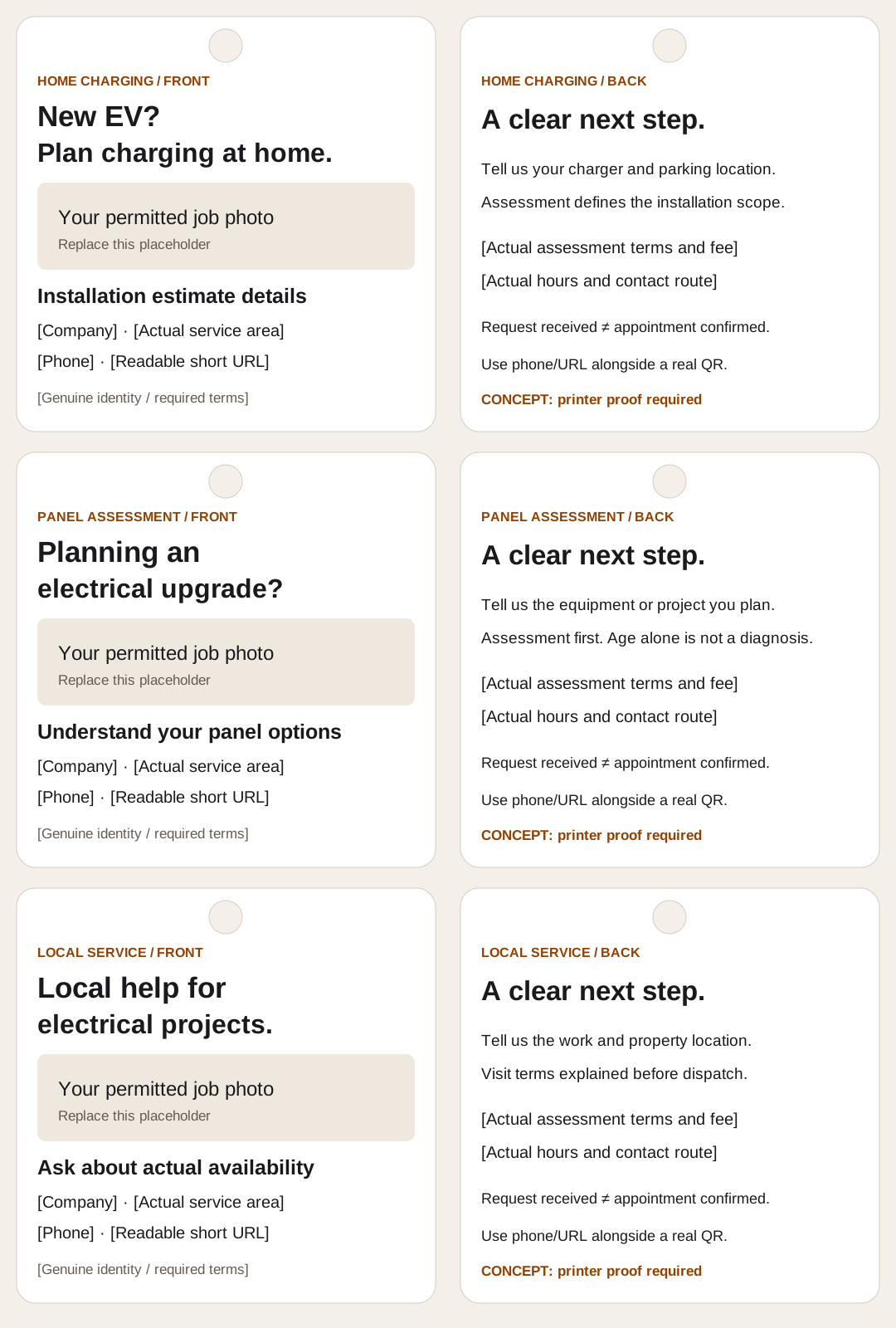
EV charger installation
Front headline: New EV? Plan charging at home.
Front copy: [Company] installs suitable home charging equipment in [area]. Tell us what you drive, which charger you have or are considering, and where you park.
Front visual: Your completed installation with permission, keeping the charger, cable and garage context clear. Remove visible private details.
Main action: Request installation estimate details: [phone] · [short URL].
Back copy: We explain the site assessment, installation scope and proposed price before you decide. Charger hardware [is/is not] included in our offer. Cable route, existing equipment and project requirements affect scope. An inquiry requests a conversation; appointments are confirmed separately.
Add genuine business/license details where applicable and state the assessment terms. Do not print a universal installation price that applies only to an unusual ideal case. The EV installation guide covers the business and scope decisions behind the offer.
Panel assessment
Front headline: Planning an electrical upgrade?
Front copy: Understand your panel options before choosing the work. [Company] assesses existing installations for [actual project types] in [area].
Front visual: Your own old fuse-box or panel photograph, or an old-to-new example, with permission. Label it as an example of your work. Do not disguise the hanger as a utility warning.
Main action: Ask about a panel assessment: [phone] · [short URL].
Back copy: Tell us what you are planning and where the property is. We explain the assessment and any visit charge before booking. Our electrician establishes the required work after checking the actual installation and project. An older panel does not automatically require replacement.
Keep the language calm and specific. The neighbor's recent panel replacement is evidence that you perform the service, not evidence that every nearby house is unsafe. Use the panel sales process to keep the assessment, proposal and follow-up consistent.
Local electrical service
Front headline: Local help for [specific repair or lighting work].
Front copy: [Company] handles [actual services] in [area]. We are working nearby [only while true] and can explain our next available service appointments.
Front visual: A genuine completed job or your actual technician and vehicle. Do not add a customer endorsement or an around-the-clock availability claim without a factual basis.
Main action: Call [phone] or request service details at [short URL].
Back copy: Tell us the requested work and property location. Our office confirms coverage, appointment availability and the visit/diagnostic charge before dispatch. We explain assessed repair work and price before you authorize it. [Actual hours and contact details.]
Avoid a “no callout fee” line unless that is genuinely your offer and the conditions are clear. A small repair campaign still has distribution and drive costs. Keep the service area practical rather than printing a larger area to make the company look bigger.
How do you market around a job without bothering the customer?
Prepare the route before the crew arrives. Neighborhood promotion should fit the job, not turn the customer's property into an unexpected sales event.
- Ask about photographs and signs in advance. Record exactly what the customer permits.
- Pick the service you want to promote and confirm the office knows its terms.
- Check accessible streets, local rules and property restrictions. Exclude no-access and no-soliciting locations as appropriate.
- Estimate distribution time and total cost. Set a spending limit and assign the work without disrupting booked jobs.
- Finish or safely pause the actual electrical work before any separate distribution activity.
- Where allowed, leave door hangers on neighboring houses without entering restricted areas or using mailboxes.
- Record actual deliveries, skipped properties, time, creative version and the inquiry route.
If a permitted conversation is appropriate, keep it short: “Hi, I'm [name] with [company]. We do [actual service] locally. Would you like our service details?” Leave when declined. Do not turn the introduction into an unsolicited inspection, urgent diagnosis or request for an immediate deposit.
Do not identify the customer to establish credibility without consent. “We handle home charging in this area” can explain relevance without disclosing who bought an installation. Remove signs when agreed and collect unwanted materials left under your control.
Tell the office how to recognize campaign inquiries. The person answering should know the service, area, offer version and any charges. If the hanger sends people to a webpage, make it about that project and test the phone/form route. The electrical website guide provides an acceptance checklist.
What rules should you check before distributing anything?
Check municipality rules for flyers, solicitation and signs, together with property access and community restrictions. There is no nationwide permission slip for every door-hanger route. A printer accepting your order does not establish that distribution is allowed.
Keep unstamped advertising off covered mailboxes. USPS DMM 508, including sections 3.1.3 and 3.2.5, addresses unstamped matter attached to or hanging from covered receptacles and advertising on curbside boxes or their supports. Use lawful door distribution or properly prepared mail. Do not hang the piece on a mailbox flag as a shortcut.
Leaving an advertisement is different from making a sale at the door. The FTC Cooling-Off Rule explanation covers certain off-premises consumer sales and exceptions. If you intend to sign work onsite, establish the correct contract, notices and cancellation process for the transaction and state. The electrical contract guide helps prepare that review.
These checks belong before printing and distribution. Keep them in the route record so the next employee does not assume an old route remains suitable after access or local requirements change.
What does a neighborhood campaign really cost?
Count design, printing, distribution labor, travel, tracking and any postage or mailing preparation. If a design is reused, allocate its cost consistently rather than declaring every later campaign free. Use delivered pieces for delivery calculations, not the quantity ordered.
This hypothetical walking-route example is a teaching model:
| Cost | Assumed amount |
|---|---|
| Printing | $200 |
| Distribution: four hours at $30/hour fully loaded | $120 |
| Travel | $30 |
| Design allocation | $50 |
| Total | $400 |
With $250 gross profit per completed job, two completed paid jobs cover acquisition cost. One produces $250 minus $400: a $150 deficit. Two produce $500 minus $400: $100 remaining before other overhead. These are illustrative inputs, not print quotes, wage advice, electrical margins or a response forecast.
Use the calculator to replace these assumptions. It returns the full campaign cost, break-even job count and contribution from the completed jobs you enter. Do not add postage to a hand-delivered route.
YOUR WORKING TOOL
Neighborhood campaign break-even
Runs on this page. Answers are not sent or saved. Numerical starting values are hypothetical; replace them with consistent records.
Complete the inputs and select “Calculate route economics” to see your result.
For mail, obtain an actual current quote. USPS listed EDDM Retail postage at $0.26 per qualifying piece when checked October 25, 2026; printing and preparation add to that. A postal rate is not the complete delivered campaign cost. Confirm current prices, dimensions and route quantity through USPS before ordering.
How should you run and judge a small neighborhood test?
Download the route and outcome log. Record the job type, route, permission checks, date, offer version, actual deliveries, exclusions, time and all spending. Keep calls, form inquiries, suitable estimates and completed paid jobs as different stages.
Use a short URL or QR destination for the campaign and ask callers how they found you. Neither attribution method is perfect: someone can forward a hanger, search your company later or scan several times. A scan is not a customer and does not establish incremental lift.
| Result | Next decision |
|---|---|
| Completed work covers acquisition, fits capacity and brings no unresolved complaints | Consider another comparable route with a stated limit |
| People respond but misunderstand the offer | Rewrite the service, assessment or fee information |
| Suitable inquiries fail to receive estimates | Fix office ownership before distributing more |
| Delivery costs exceed the plan | Change the route or method; cost the revision |
| Poor fit, complaints or loss exceed your ceiling | Stop and resolve the cause before repeating |
Set the pilot size from a manageable route and an affordable loss ceiling. There is no universal minimum thousand-piece order or dependable response percentage that makes an electrical campaign safe. Review comparable routes and time periods while recording differences in job type, offer and access.
One or two wins can make a small pilot economical without proving a durable causal effect. Keep streets with no response in the report. Compare other acquisition sources and local referral partners using the same completed-job and full-cost definitions.
Frequently asked questions
Do door hangers work for electricians?
They provide a local service introduction worth testing where distribution is permitted and the offer fits nearby customers. Judge your own full cost, completed paid jobs and capacity. Do not assume a printer's response claim predicts your result.
What should an electrician put on a door hanger?
One service, a genuine project image, actual company/credential details, real coverage and a clear next step. Include a readable phone and URL, plus assessment or offer terms. Keep text away from the cut line and hanger hole.
Can I put a flyer on or in a mailbox?
Do not use covered mailboxes for unstamped advertising, including attaching or hanging it. Follow USPS rules and use lawful door distribution or proper mail instead.
Should I use door hangers or EDDM postcards?
Compare permitted access, route precision and full cost. Door hangers can suit a small walking route; EDDM covers selected carrier routes with its own quantities and preparation. Obtain an actual route quote before choosing.
How many door hangers should I distribute?
Choose a manageable lawful route and a loss ceiling your business can carry. Count actual deliveries and outcomes. A larger order does not fix an unclear offer, poor access or unanswered inquiries.
For the next suitable job, choose one template, get permissions, confirm the route and set a cost ceiling. Give the office the exact offer before distributing. If the destination or follow-up needs work, ask 9xLocal about website and inquiry support; the neighborhood plan can run independently of a paid-social campaign.